 |
| Image source: Mount Vernon |
Showing posts with label Founders. Show all posts
Showing posts with label Founders. Show all posts
December 6, 2017

June 18, 2016
"A well-regulated militia": the Left's delusion about the Second Amendment

This image, which is making its way around Facebook in the wake of the Orlando nightclub massacre, zeros in on the part of the Constitution's Second Amendment that is the most confusing to modern eyes.
Before we, too, zero in on this phrase, consider for a moment what the Bill of Rights (the first ten amendments) actually was. Why were these amendments added all at once, and so soon after the adoption of the Constitution? Because they were adopted as a condition of the approval of the Constitution by several of the states.
There was widespread suspicion that the proposed Constitution didn't go far enough to explicitly curtail the powers of the central government. The dissenters felt that individual rights would quickly fall prey to expanding government power in the absence of explicit declarations of the inviolable rights of individuals.
The Bill of Rights is the answer to these concerns, and the promise of these was sufficient to get all of the states to sign on to the Constitution.
Here, then, is the complete text of the Second Amendment:
A well regulated Militia, being necessary to the security of a free State, the right of the people to keep and bear Arms, shall not be infringed.Noting the neighboring words "security" and "State", many on the Left would have us believe that the phrase "well regulated Militia" is referring to the military and to state and local law-enforcement agencies -- that this amendment guarantees the government the ability to undertake any and all efforts necessary to protect the country (military) and maintain public order (local law enforcement).
But why, in the midst of a collection of amendments designed to guarantee individual rights, would the Founders drop in a grant of government power that, in essence, had the potential to render the rest of the Bill of Rights moot?
Does anyone honestly think that the dissenters would have gone along with this new government if this were the case? All of human history testifies that when the people of a country have no means to resist the tyranny of their government, their government will sooner or later drift into tyranny.
So what, then, did the phrase "well regulated Militia" mean to 18th-century American eyes?
The militia were the ones who were expected to grab their guns and take action whenever the need arose. Most importantly to the contemporary debate, though, all able-bodied males, regardless of occupation, were considered part of the militia, whether or not they had ever served in the armed forces. This in itself argues for the notion that this amendment was not a restrictive one.
What about "well regulated"? Surely this phrase shows that arms-bearing must be done under the supervision of the government, doesn't it? Actually, no. At the time, the phrase "well regulated" was used interchangeably with "well trained" or "orderly".
Well, then, what about "security of a free State"? In context, "state" is obviously referring to the nation itself, not to the government. There are two ways of seeing the phrase "free state": (1) a nation as a whole free from the control of other nations (this is the modern understanding of the term), and (2) a nation comprised of individuals who are free from the oppression of their government.
If we accept the notion of the entire Bill of Rights being a Bill of Individual Rights, that second interpretation of "free state" gains a considerable amount of weight.
So. Taking the Second Amendment as a whole, I see this paraphrased declaration: A nation of citizens in the possession of and well-trained in the use of firearms is an effective bulwark both against conquest by other nations and against oppression by that nation's government. Therefore, the central government shall take no steps to interfere with the right of the citizens to keep and bear such firearms.
A well-armed, well-trained citizenry is necessary to secure the freedom of said citizenry.
April 8, 2016
The Left, the Founders, and the Constitution
Well, of course the left understands the U.S. Constitution better than its authors did.

November 6, 2013
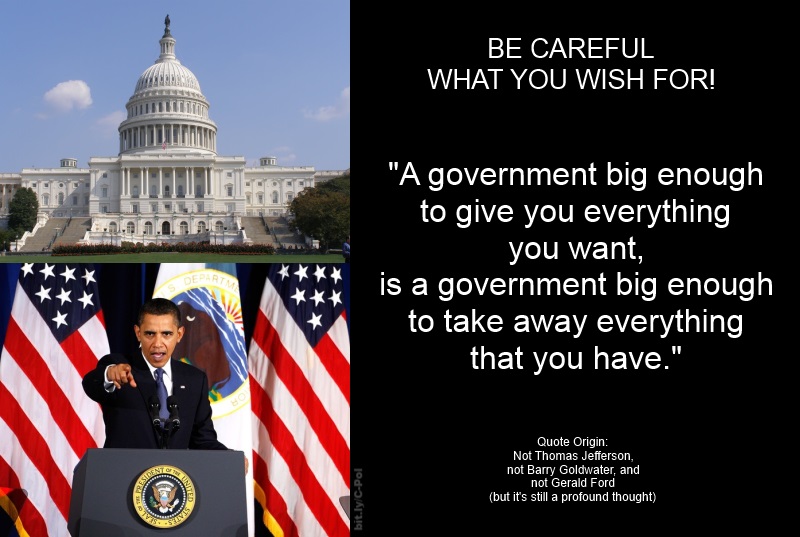
Be careful what you wish for (Or: This won't end well)
 |
| (Click image to view larger version) |
As far as documentary evidence goes, the earliest written examples of the quote date back to the early 1950s; the original sage seems to have vanished into the mists of history.
Regardless of the quote's parentage, the point remains valid and deeply profound. In my opinion, we are likely to see its validation in many unpleasant ways in the coming years and decades.
April 15, 2012
Quick Quote: Noah Webster on getting the government we deserve
"When you become entitled to exercise the right of voting for public officers, let it be impressed on your mind that God commands you to choose for rulers, "just men who will rule in the fear of God." The preservation of government depends on the faithful discharge of this Duty; if the citizens neglect their Duty and place unprincipled men in office, the government will soon be corrupted; laws will be made, not for the public good so much as for selfish or local purposes; corrupt or incompetent men will be appointed to execute the Laws; the public revenues will be squandered on unworthy men; and the rights of the citizen will be violated or disregarded. If government fails to secure public prosperity and happiness, it must be because the citizens neglect the Divine Commands, and elect bad men to make and administer the Laws."
— Noah Webster, History of the United States (1832)
Comment: I see this as the continuation of a theme found in George Washington's farewell address. The reason we have a government that has strayed so far from the Constitution is that the voters have not demanded constitutional fidelity.
People tend to vote their values whether they realize it or not. The kind of leaders we tolerate says as much about our values as it does those of the leaders themselves.
I will expand on this further in a future post.
— Noah Webster, History of the United States (1832)
Comment: I see this as the continuation of a theme found in George Washington's farewell address. The reason we have a government that has strayed so far from the Constitution is that the voters have not demanded constitutional fidelity.
People tend to vote their values whether they realize it or not. The kind of leaders we tolerate says as much about our values as it does those of the leaders themselves.
I will expand on this further in a future post.
August 12, 2011
Quick Quote: Thomas Jefferson on the immorality of passing the public debt from one generation to the next
"I say, the earth belongs to each of these generations during its course, fully and in its own right. The second generation receives it clear of the debts and incumbrances of the first, the third of the second, and so on. For if the first could charge it with a debt, then the earth would belong to the dead and not to the living generation. Then, no generation can contract debts greater than may be paid during the course of its own existence."
— Thomas Jefferson, Letter to James Madison (September 6, 1789)
Via The Federalist Papers (on Facebook)
July 20, 2011
Quick Quote - Alexander Hamilton on the balance between state and federal power
Hamilton certainly did not envision a future where the states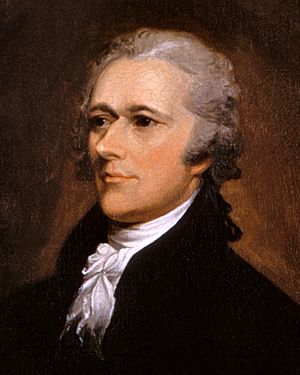 willingly surrendered any leverage they had over the federal government.
"This balance between the National and State governments ought to be dwelt on with peculiar attention, as it is of the utmost importance. It forms a double security to the people. If one encroaches on their rights they will find a powerful protection in the other. Indeed, they will both be prevented from overpassing their constitutional limits by a certain rivalship, which will ever subsist between them."
–Alexander Hamilton, speech to the New York Ratifying Convention, 1788
The causes are various, but one of the most egregious was the states’ ratification of the 17th Amendment, making the Senate a matter of popular vote rather than state appointment.
Whatever the reasons, the states now are for the most part submissive to the will of the federal government, and We The People are overwhelmingly the losers.
(Via Patriot Post)
John Adams: Nip it in the bud!
John Adams, like Barney Fife, saw but one rational response to approaching dangers: nip it in the bud. Writing to the residents of Massachusetts in 1775, he (Adams, not Fife) had this to say about Britain’s “long train of abuses and usurpations”:
Obsta principiis, nip the shoots of arbitrary power in the bud, is the only maxim which can ever preserve the liberties of any people. When the people give way, their deceivers, betrayers, and destroyers press upon them so fast, that there is no resisting afterwards.
Obsta principiis – Resist the beginnings.
Unfortunately, arbitrary power has grown far beyond the shoots. For too long, the American people have given way, to the point where virtually all resistance ceased for many decades.
Groups like the TEA party movement represent an attempt to take a metaphorical machete to the tangled jungle of unconstitutional government. It may be too late, but let history record that someone recognized the peril and at least tried to reverse it.
December 9, 2010
Quick Quote: James Madison on the federal leviathan
“It will be of little avail to the people, that the laws are made by men of their own choice, if the laws be so voluminous that they cannot be read, or so incoherent that they cannot be understood; if they be repealed or revised before they are promulgated, or undergo such incessant changes that no man, who knows what the law is to-day, can guess what it will be to-morrow. Law is defined to be a rule of action; but how can that be a rule, which is little known, and less fixed?”
— James Madison, The Federalist #62
— James Madison, The Federalist #62
November 2, 2009
Quick Quote: Thomas Jefferson on nanny government
 And now, a word from the founder of the Democratic Party:
 Were we directed from Washington when to sow, and when to reap, we should soon want bread.Reference: Jefferson: Writings, Peterson ed., Library of America (74)
– Autobiography, 1821
July 9, 2009
Quick Quote: Thomas Jefferson on what makes good government
And now, a word from the founder of the Democratic Party:
[A] wise and frugal government...shall restrain men from injuring one another, shall leave them otherwise free to regulate their own pursuits of industry and improvement, and shall not take from the mouth of labor the bread it has earned. This is the sum of good government.
– First inaugural address, 1801
Reference: Jefferson: Writings, Peterson ed., Library of America (494)
June 17, 2009
Quick Quote: Thomas Jefferson on wealth redistribution
And now, a word from the founder of the Democratic Party:
-- Thomas Jefferson, letter to Joseph Milligan, 1816
Reference: Vindicating the Founders, West (136); original Writings of Thomas Jefferson, Bergh, ed., vol. 14 (466)
(Found at Patriot Post)
August 6, 2004
My favorite Supreme Court justice
Magic mirror on the wall,
who's the most Constitution-friendly justice of all?
If you listen enough to the rhetoric of the left, you know the party line that Antonin Scalia is Public Enemy #1, and that Clarence Thomas routinely takes his marching orders from him. I hadn't really pondered the question of which justice has the greatest fealty to the 'strict construction' philosophy of constitutional interpretation (to paraphrase Horton the elephant, the Constitution says what it means and means what it says -- no ifs, ands, buts, penumbras or emanations about it). If someone had buttonholed me on the street and demanded an answer, I might have said Scalia, since he's the one who gets all of the press (Thomas doesn't actually exist, since everyone in the media knows that there's no such thing as a black conservative).
As it turns out, though, a law.com article reveals that Thomas boldly and routinely goes where Scalia is often reluctant to go. In his biography of Thomas, Ken Foskett quotes Scalia as saying that Thomas "doesn't believe in stare decisis, period." Foskett considers this to be a "bombshell", although Steve at Southern Appeal says the fact is well-known in the legal community.
Stare decisis, Latin for "to stand by decided matters", refers to the doctrine that gives weight to judicial precedents. If there is a string of Supreme Court decisions on a matter, Scalia is much more likely to uphold the issue on the basis of the precedents, even if he is uneasy with the soundness of the constitutional reasoning behind the precedents.
Thomas, on the other hand, believes that if a previous decision is constitutionally suspect, it has no weight whatsoever. Continuing Scalia's quote:
"If a constitutional line of authority is wrong, he would say let's get it right," says Scalia. "I wouldn't do that."
As much as I admire Scalia, Thomas is in the right here. If you're driving from Washington to New York and you see an exit sign for Atlanta, the solution is not to keep driving and hope everything turns out right.
I understand even more now why the left hates Thomas so much. Not only is he conservative, he's also one of the best friends the Constitution has had in recent generations.
(Credit: The Corner)
Subscribe to:
Posts (Atom)