C-Poll

The latest C-Poll is closed. You can read all about it here!

Showing posts with label Congress. Show all posts

November 21, 2017

The purpose of the 'Commerce Clause' in the US Constitution

In modern times, the US government has arrogated to itself the right to regulate all aspects of commerce that occur within our borders, from the largest mega-corporations all the way down to the most humble sole-proprietor businesses.  When the government bothers to justify its assumed powers at all, there is usually some reference to the "commerce clause" in the US Constitution.

The underlined text in the following image shows, in its entirety, the power the Constitution grants the US government regarding commerce:


"The Congress shall have Power...To regulate Commerce
  • with foreign Nations,
  • and among the several States,
  • and with the Indian Tribes"
The prepositions are important to the proper understanding of the central government's enumerated power.

Congress regulates commerce with other nations and with the Indian tribes, because the US government is granted the right to regulate commercial interactions that cross the national borders of our country. Since the US government is the sole agent in our country's official interactions with other countries, it makes sense that the government should have a say in any commerce that might affect our country's relations with other countries.

When it comes to commerce that remains within the borders of our country, however, the language of the text is different: Congress has power to regulate commerce among (or between) the states. Businesses within those states are engaging in commerce with one another. The states are legally considered to be peers with one another, so what happens when there are disputes between states relating to these commercial interactions?

Congress is assigned the role of binding arbitrator, ensuring that no state will take unfair advantage of another as goods and services cross its borders. Congress does not have the power to dictate the size and shape of the grommets that are manufactured in Colorado, or to force Grommets, Inc. to grant its employees paid leave for yoga retreats. Rather, Congress has the power to prevent Texas (where rival company Also Grommets, Inc. is located) from erecting protectionist regulatory barriers that make it difficult for Grommets, Inc. to get its goods to market.

That is the original purpose of the US government's interstate commerce regulatory power.  Anything else the government does in the arena of internal commerce is almost certainly a usurpation.


"[W]e have abundant reason to be convinced, that the spirit for Trade which pervades these States is not to be restrained; it behooves us then to establish just principles; and this, any more than other matters of national concern, cannot be done by thirteen heads differently constructed and organized. The necessity, therefore, of a controuling power is obvious; and why it should be withheld is beyond my comprehension."

– George Washington, letter to James Warren, Mount Vernon, October 7, 1785; Fitzpatrick 28:290


(Image and quote via the George Washington Facebook page)

November 6, 2013

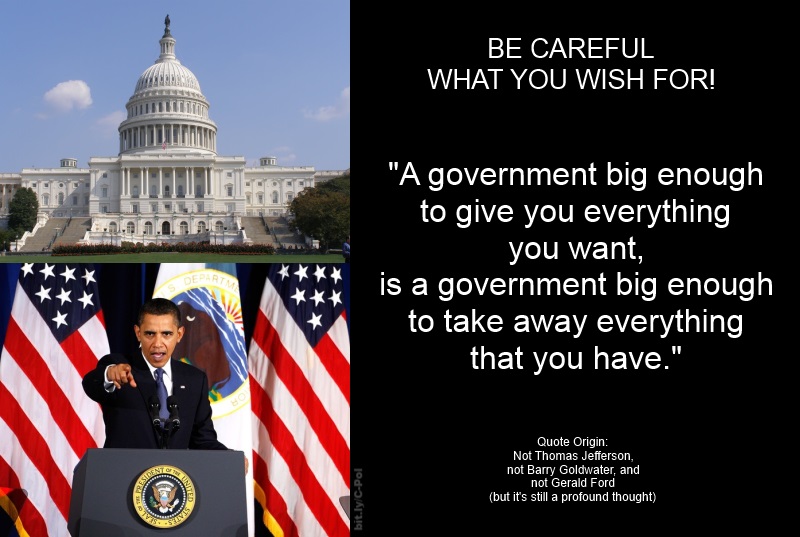
Be careful what you wish for (Or: This won't end well)


(Click image to view larger version)
This excellent point is usually attributed to Thomas Jefferson, but the curators of all things Jefferson at Monticello insist that there is no evidence he is the source.  They also note that other claimed sources, such as Barry Goldwater and Gerald Ford, are also spurious, although they are known to have employed the quote in their speeches.

As far as documentary evidence goes, the earliest written examples of the quote date back to the early 1950s; the original sage seems to have vanished into the mists of history.

Regardless of the quote's parentage, the point remains valid and deeply profound.  In my opinion, we are likely to see its validation in many unpleasant ways in the coming years and decades.

May 18, 2011

Is there a difference between earmarks at the federal level and at the state level?

In a May 15 article, The Daily Caller (TDC) seems to be trying to whip up some controversy regarding possible GOP presidential candidate Michele Bachmann’s apparent inconsistency on the earmarks issue.

Given that Bachmann is a TEA party favorite, this is a serious charge.  TDC notes that she has secured nearly $4 million in earmarks for her district since she was first elected to Congress in 2007.  She also argued to exclude transportation projects from a GOP-championed earmarks moratorium.

These facts are enough to raise eyebrows among TEA partiers and constitutionalists.  I’d like to know how she defends these actions.  Do they undermine the credibility of her TEA Party Caucus on Capitol Hill?

While the answers to these questions are important, TDC raises another issue that got under my skin:

Bachmann’s penchant for earmarks dates back to her days in the Minnesota state Senate. Despite her reputation as a fiscal conservative, from 2001-2006, then-state Senator Bachmann proposed more than $60 million in earmarks, including a $710,000 “Bond For Centerville Local Improvements Around Highway 14? and a $40,000,000 “Bond for Lino Lakes And Columbus Township Highway Interchanges.”

Doug Sachtleben, Bachmann’s communications director, sought to explain the earmarks, arguing that voters resent “taking money from taxpayers in one state to pay for a host of wasteful projects in other states.” He added that voters “also expect that things like road projects should be done at the state level, where voters can have a say through the selling of bonds.” These are not absurd arguments — bridges have to get built somehow — but Tea Party activists may find the argument that earmarks are fine at the state level as appealing as Mitt Romney’s argument that individual health care mandates are fine so long as they are enacted at the state level.

When it comes to government, I believe in the principle of subsidiarity – namely, that any activity that ought to be taken on by government should be taken on by the lowest level of government that can get the job done. 

Road and bridge construction is most certainly not in the constitutional domain of the federal government.  So, what about the other levels? 

Some necessary infrastructure is within the financial means of municipal and county governments.  But the reality is that major projects – highway interchanges, bridges, etc. – can quickly wipe out the treasuries of smaller cities and towns (and the counties containing them).  The money has to come from a higher level.

But think about this: What is a county?  It is an administrative subdivision of… the state government!  Counties are entities created by the state enabling it to govern regions more efficiently.  Likewise, cities are state-created entities.  So, it could be argued that spending at the city, county or state level could all be considered state spending.

This fact – and the principle of subsidiarity – are what make the final sentence in the above excerpt so nonsensical.  Are there TEA partiers who think that the state should not fund highway projects (whether at the request of a local representative or not)?  If there are any, I’d like to hear the logic behind such a position.  I suspect, though, that the author’s “Tea Party activists” are made of straw.

One final thought on the excerpt’s final sentence: There is no equivalence between state funding of transportation infrastructure (a legitimate government concern) and state funding of health care (not a legitimate government concern).

April 12, 2011

There’s simply no way to spin the budget deal as a victory for fiscal sanity

Politics is the art of the possible. -- Otto von Bismarck

Politics is not the art of the possible. It consists in choosing between the disastrous and the unpalatable. -- John Kenneth Galbraith

If $38 billion out of a $1.5 trillion budget shortfall is all that was possible, we’re done for.

March 23, 2011

Senator Biden thinks President Obama should be impeached for going to war against Libya

Senator Joe Biden, campaigning for president in 2007, does not mince his words* regarding a president’s constitutional war powers.  He is absolutely unwavering in his insistence that if a president goes to war with a country in the absence of an imminent threat to the US – even worse, without congressional approval – this is an impeachable offense:

* (Although, it could be said that he never minces his words regarding anything.  It’s quite entertaining sometimes.)

March 22, 2011

Senator Obama opposes President Obama’s use of force in Libya

In a December 2007 interview with the Boston Globe, candidate Obama had this to say about presidents who send our military to war without first consulting Congress:

The President does not have power under the Constitution to unilaterally authorize a military attack in a situation that does not involve stopping an actual or imminent threat to the nation.

As Commander-in-Chief, the President does have a duty to protect and defend the United States. In instances of self-defense, the President would be within his constitutional authority to act before advising Congress or seeking its consent. History has shown us time and again, however, that military action is most successful when it is authorized and supported by the Legislative branch. It is always preferable to have the informed consent of Congress prior to any military action.

March 16, 2011

Another grim milestone for federal spending

Total federal spending has consistently outpaced tax receipts for so long that to even raise the point tends to elicit yawns. 

However, as the Weekly Standard reports today, this year brings us to a milestone without precedent:
We have now gotten to the point — as I noted yesterday — where if national defense, interstate highways, national parks, homeland security, and all other discretionary programs somehow became absolutely free, we’d still have a budget deficit. The White House Office of Management and Budget projects that in the current fiscal year (2011), mandatory spending alone will exceed all federal receipts. So even if we didn’t spend a single cent on discretionary programs, we still wouldn’t be able to balance our budget this year — let alone pay off any of the $14 trillion in debt that we have already accumulated.

Just an Olympiad ago, in 2007, the picture was quite different. In fact, in that year, federal revenues not only exceeded mandatory spending, but they exceeded it by more than $1 trillion ($1.117 trillion, to be more exact). The next year, 2008, during which the gap fell to a still-huge $914 billion, the Bush administration released a report issuing a rather dire warning (p. 25).  The report said that, “if left unchanged, mandatory spending alone is projected to exceed total projected Government receipts in approximately 50 years.”  That dire prediction has now come true — about 50 years earlier than projected.
This bears repeating: Even if we brought discretionary spending to $0.00 this year, there still would not be enough tax receipts to fund the mandatory (in other words, entitlement, or wealth-transfer) spending programs.

This problem goes much, much deeper than the extension of the Bush-era tax cuts.  As Kevin D. Williamson observed in NRO on March 14, there aren’t enough millionaires out there to balance the budget.  Even if  all of the income of “the rich” was simply confiscated, the debt would continue to grow.

The Bush administration might be forgiven for being so far off on its projection… truly, this country has never before seen anything like the profligacy of this administration and its allies in Congress.

January 4, 2011

House Speaker's aides to be formally sworn in -- Meaningless symbolism or a serious commitment to the Constitution?

Politico reports January 3 that incoming House Speaker John Boehner has made an unusual request of Supreme Court Chief Justice Roberts:
In another statement of the new House Republican majority’s commitment to the Constitution, aides to incoming Speaker John Boehner plan to take their oath of office Tuesday morning — a day before the same oath is administered to the 435 House members of the new Congress.

At Boehner’s request, Chief Justice John Roberts will preside over the staff ceremony, which may be a first in congressional history. Aides in Boehner’s Washington and district offices are expected to take the oath in the Capitol in a private, low-key event with no press coverage, a Boehner aide said.
[...] In a sense, the ceremony will be symbolic. House aides already commit to supporting the Constitution when they sign their employment forms. But the formal event will be another measure that Boehner takes seriously his new responsibility.
Dare we hope? Forgive our cynicism (borne of a long history of disappointments), but we'll withhold our applause until we see such gestures followed up with genuine substance.  Onward!

December 14, 2010

How else will our distinguished senators know what’s in the $1.2 trillion omnibus spending bill?

History gives abundant evidence that they can’t be troubled to read it on their own.  Politico, December 14:

As Democrats try to push through a nearly 2,000-page omnibus spending bill, Republican senators are threatening to bog down the floor by forcing Senate clerks to read the full text aloud, a process that could take more than one full day to complete.

“Democrats haven’t given Republicans or the American people time to read the bill, but I’ll join with other Republican colleagues to force them to read it on the Senate floor,” said Sen. Jim DeMint (R-S.C.).

Such a tactic is rarely employed, but any senator can force a full reading of legislation, which is usually skipped by unanimous consent.

Three cheers for Sen. DeMint and other GOP obstructionists.  Stop the runaway train!

December 9, 2010

Quick Quote: James Madison on the federal leviathan

“It will be of little avail to the people, that the laws are made by men of their own choice, if the laws be so voluminous that they cannot be read, or so incoherent that they cannot be understood; if they be repealed or revised before they are promulgated, or undergo such incessant changes that no man, who knows what the law is to-day, can guess what it will be to-morrow. Law is defined to be a rule of action; but how can that be a rule, which is little known, and less fixed?”

— James Madison, The Federalist #62

November 13, 2010

How this election was like the Battle of Midway

In a November 13 American Thinker essay, Greg Richards provides what I think is an excellent metaphor for what was accomplished in this election (emphasis added):

After Jimmy Doolittle bombed Tokyo in April 1942, the Japanese decided to eliminate the U.S. Navy in a final battle. They sent a very strong force to occupy Midway Island, about 1,500 miles from Hawaii, figuring that this would be a challenge the Navy could not refuse and which would result in a decisive battle of annihilation of what was left of the American fleet. 

The Japanese did not realize that we had broken their naval code, and instead of being surprised at Midway, we bushwhacked them, sinking their entire striking force of four heavy carriers. The Battle of Midway, June 4, 1942, is regarded as one of the most decisive naval engagements in history. It was characterized by Admiral Ernest King, the Chief of Naval Operations, as having "restored the balance of power in the Pacific."

We have to remember, of course, that in June 1942, most of the war in the Pacific was in front of us. The battles of New Guinea, Guadalcanal, Iwo Jima, Okinawa, and countless others had yet to be fought. So the Battle of Midway was a turning point only because it was followed by the will of the country to "win through to absolute victory," in the words of FDR.

If conservatives and constitutionalists are satisfied with the election outcome to the point that they demobilize, then we’ve already lost.

We haven’t won the victory – not even close.  We don’t have the political power to get the government back under constitutional control – not even close.  If we lack the commitment to “win through to absolute victory”, what was the point of this election?

A window of opportunity like this may not open again in our lifetimes.

November 5, 2010

What the GOP’s #1 priority in Congress should be for the next two years: STOP THE RUNAWAY TRAIN!

 “You shall not pass!”

Rasmussen released a poll the day after the election indicating that 59% expected the incoming GOP House majority to disappoint them over the next two years.

In my opinion, it all comes down to what we expect the Republicans to be able to do.  The fact is, the GOP has a governing majority in the House, but they don’t control the Senate or the White House.  So, what are their options if they wish to honor the sentiments of those who swept them into office?

I suggest a two part strategy.

First, OBSTRUCT!  In the House, the GOP can prevent any more of the left’s agenda from even coming up for a vote.  In the Senate, the Dems no longer have a filibuster-proof majority – take advantage of this.

Second, GET ON RECORD!  The House should hold roll-call votes on the repeal of the odious things (like ObamaCare) that have already passed.  Then, hold roll-call votes on new legislation that reflects conservative values (WITHIN actual constitutional boundaries, thank you very much).  So what if the Senate doesn’t join in?  When 2012 comes along, you DO want to still be able to draw a distinction between yourselves and the Dems, don’t you?

So, GOP – do you have the guts to do this?  Or will you go back to your old ways of trying your best to be liked by the Dems in Congress and in the media? 

Free hint: The latter option is how you lost in 2006 and 2008.  Your base is in NO mood to see you go back to that.  Just sayin’.

Chutzpah

WaPo, November 5 reports that Nancy Pelosi considers herself to be the one who can best lead the minority she helped to create:

Rejecting demands from some that she relinquish power, House Speaker Nancy Pelosi announced Friday that she will run for minority leader, setting up what could be an ideological battle inside the Democratic caucus.

"I am running for Dem leader," Pelosi (Calif.) said on her Twitter account. She said her decision was in part "driven by the urgency of creating jobs" and protecting this year's health-care and Wall Street overhauls.


Nov 13 UPDATE: Then again, she apparently knows her fellow Democrats quite well.

October 28, 2010

Rasmussen's useless throw-the-bums-out poll

I usually find Rasmussen's political polls to be useful, but the one released today really provides no helpful information regarding the mood of the electorate.  One of the poll questions asked:
Suppose you could vote this fall on whether to get rid of the entire Congress and start over again. Would you vote to keep the entire Congress or get rid of the entire Congress?
No middle ground -- throw them all out or keep all of them?  If these were our only choices, I suppose I'd have to say throw them all out and start over.  Unsurprisingly, 65% of the pitchfork-wielding voters went this way as well, because few in their right mind think that keeping the entire Congress is a good idea.

Here in the real world, it's clear that there are some good guys in Congress who should be returned to office.

What was Rasmussen's point in asking this question?

Far more useful were these questions from the same poll:
Do you have a favorable or unfavorable opinion of the Democratic Party?
Do you have a favorable or unfavorable opinion of the Republican Party?
Do you consider yourself part of the Tea Party Movement? [those who answered "no" or "Not sure" were asked] Do you have any close friends or family members who are part of the Tea Party movement?

It's definitely newsworthy to note that (despite what the Democrat and media elite have said repeatedly) only 56% of people who identify with the TEA Party movement (and only 61% of self-identified Republicans) have a favorable view of the Republican Party.

This fact should have been the headline, because the GOP leadership really, really needs to understand this.

October 15, 2010

Memo to GOP: The national debt wouldn't be where it is now without your active participation

I sure do hope the GOP bigwigs understand the sentiment that appears to be set to thrust their party back into power.  If they think this is just a matter of letting a different party preside over the sinking of our country, their base will withdraw its support with extreme prejudice.
CNSNews, October 14:
The national debt increased for the 53rd straight fiscal year, jumping $1.65 trillion in fiscal 2010, according to data posted online by the Bureau of the Public Debt and confirmed by a spokesperson for the agency.

Fiscal Year 1958, the first year of the run, saw a debt increase of $5.8 billion, a paltry sum these days.  Since then, the cumulative debt increase has been $13.3 trillion.
Although the GOP has been complicit in this drunken-sailor spending binge, the events of the past two years have shown that the Democrats are ideologically devoted to spending without restraint. 
The GOP needs to understand that many of the people who will be voting for them this time will be doing so as the most efficient means of stopping the runaway Democrat train, and not necessarily because they trust the Republicans.
GOP, you'll have two years to earn the trust of these folks.  That's not long, so you'd better not dawdle.

July 23, 2010

MSM starting to report on the “unintended consequences” of Obamacare

“Unintended consequences” – a phrase almost certain to become clichĆ©d in the coming months and years as people and businesses start digging into (and reacting to) the deepest, darkest parts of the new health care law.

AP reports July 23 that the law is already starting to have a negative impact on one class of people:

Some major health insurance companies have stopped issuing certain types of policies for children, an unintended consequence of President Barack Obama's health care overhaul law, state officials said Friday.

Florida Insurance Commissioner Kevin McCarty said in his state UnitedHealthcare and Blue Cross Blue Shield have stopped issuing new policies that cover children individually. Oklahoma Insurance Commissioner Kim Holland said a couple of local insurers in her state have done likewise.

[…] Starting later this year, the health care overhaul law requires insurers to accept children regardless of medical problems — a major early benefit of the complex legislation. Insurers are worried that parents will wait until kids get sick to sign them up, saddling the companies with unpredictable costs.

[…] "Our plans are very concerned about this," said Alissa Fox, a top Washington lobbyist for the Blue Cross Blue Shield Association. "If the law says that insurers have to take you any time, any place, some people will see that as an opportunity to wait until their children get sick to buy coverage."

There is nothing in the law that would stop a hospital from buying a policy for a uninsured child who came into the emergency room, she added.

The law is almost certainly riddled with landmines like this.  The average congressperson can neither confirm nor deny this, primarily because the average congressperson hasn’t actually read the law he or she voted to enact.

If the GOP wants to win in November, it needs to be more than simply not-Obama

Does the national GOP hoping to passively surf the growing wave of anti-Obama sentiment all the way to control of Congress?

In NRO on July 21, Victor Davis Hanson argues that the GOP – as a party and as individual candidates – needs to be specific about how it would govern differently than Obama and the current Congress are governing:

Republican politicos will quite accurately lecture that presenting such detailed alternative plans would be foolhardy: The key now is simply to be against what an unpopular Obama is for. I accept that offering detailed solutions might well turn the public as much against the proposed medicine as against the original malignant disease.

Yet at some point, blanket Obama-bashing without a comprehensive alternative will turn stale. Critics of Obama — if they are to be taken seriously — will have to be about more than not being Obama. Instead, conservatives must identify exactly how to undo the Obama agenda — and do so in a way that does not earn them the disdain that the Republican Congress earned between 2001 and 2006, and the Republican administration between 2005 and 2009.

We need some notion of a contracted agenda, so that conservative voters can hold conservative politicians to account in this age of anti-incumbency. Voters wanted closed borders, balanced budgets, ethical members of Congress, and less government between 2001 and 2006. They believed that all of that had been promised — and then were sorely disappointed.

In short, conservative voters want to see something specific — as much to keep their own honest as to defeat the other.

The Tea Party movement’s very existence shows that the conservative base is restless.  Conservatives are in no mood to be used by the GOP elites to effect a return to We May Be Bad But We’re Not As Bad As The Democrats.  The elites will ignore this at their peril.

March 24, 2010

Is the GOP already losing its will to fight ObamaCare?

Jeffrey Anderson at National Review Online (emphasis added):
Less than three days after the passage of Obamacare, many Republicans are already losing their stomach for the fight. As Ezra Klein gleefully — but aptly — observes over at the Washington Post, “In about 12 hours, the GOP's position has gone from ‘repeal this socialist monstrosity that will destroy our final freedoms’ to ‘there are some things we don't like about this legislation and would like to repeal, and there are some things we support and would like to keep.’ . . . At this rate, they'll be running on expanding the bill come November.

Sen. Jon Kyl said, “I would guess probably more realistically would be a potential repeal of pieces of the bill.” It lights the fire in the belly, doesn’t it? Sens. Mike Enzi and John Cornyn followed suit.

On MSNBC, Rudy Giuliani, said, “You just laid out how the Republicans should run the campaign, when we get a month, two months out of this — not repeal health care.” With all due respect to Mayor Giuliani, this is the sort of thinking that led to his Florida Strategy.

Sometimes, one has to wonder at Republicans’ tin ear. If they were writing Patrick Henry’s famous 1775 address, would they have advised, “Well, full liberty might be a bit much to ask for. And I’m not sure if we really want death. How about, 'Give me a little more liberty, or make me ill'?”

“Repeal, and then real reform” — that’s the right message, and the one that reflects the American people’s views. “Partial repeal” actually legitimizes Obamacare and helps to sell it by suggesting that the GOP doesn’t really think it’s all that bad.
You can read the WaPo article here.

Be sure to vote in our C-Poll some time in the next 7 days!

C-Poll: Have the Republicans grown a spine, and for the right reason?

A new poll has been posted at the top of the page:

The united House Republican stand against the just-passed health care 'reform' bill can best be attributed to…

If you wish to comment, feel free to do so here.


UPDATE:  Is the GOP already losing its will to fight ObamaCare?

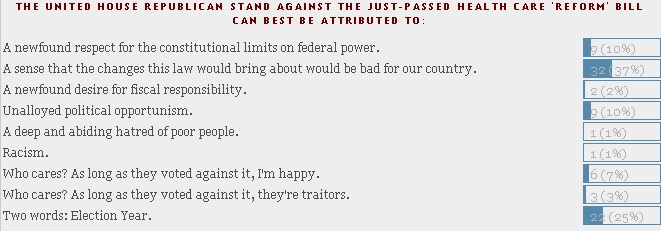
UPDATE, April 2: Here are the poll results (click for larger image):

Unsurprisingly, constitutional concerns (i.e. “A newfound respect for the constitutional limits on federal power”) did not score well, although an amazing 10% thought that the bulk of the GOP congressfolks were thus motivated.  Sorry, dear reader, but that’s crazy talk.

The winner at 37% was the second choice: “A sense that the changes this law would bring about would be bad for our country.”  Well, okay, this happened to coincide with the constitutionally correct vote, but it won’t always.

Political calculation came in second, as embodied in the fourth and ninth choices (combining for 35%): “Unalloyed political opportunism” and “Two words: Election Year”.

For the record, I inclined toward one of the political calculation choices, given that many of the same folks expressing outrage at Obamacare voted for the Medicare prescription drug entitlement a few years ago.