 |
| Via Being Libertarian (Facebook) |
Showing posts with label Critical Thinking. Show all posts
Showing posts with label Critical Thinking. Show all posts
December 16, 2017

February 24, 2016
On the all-too-common phenomenon of assuming one's ideological foes to be ignorant, immoral, or insane
Aaron Ross Powell has written a mostly-excellent essay on the extreme tribalism (although he doesn't call it that) which underlies the emotions aroused by virtually every contentious issue of the day. As I opined in a previous post, the positions we take so earnestly are the rational end of a long chain of propositions that go all the way back to the one or more foundational propositions that form the foundation of our worldview (and are usually accepted without question).
Because our conclusions about the issue of the moment are so mindbogglingly obvious to us, we don't see how anybody could come to any other conclusion. If they do, it's a sure sign that they're ignorant, that they know better but are just too morally corrupt to embrace the right view, or that they are genuinely mentally ill. I don't think I am amiss in assuming that most of us have felt this way about our ideological foes at one time or another, or have been the target of such speculation.
Here's how Powell illustrates the conflict:
If, on the other hand, you wonder if it's even possible to coexist with people who hold points of view that bug you so much, hoping that it is possible, stick around. Understanding this ingrained human tendency to organize into tribes is, I believe, the only alternative to putting the maximum distance possible between all human beings. I also believe that understanding our tribal thinking is the first step to finding a way to knowing how to bring others around to our point of view.
This is going to be a running theme on this blog as I continue to ponder the riddles of human interaction. I hope you'll find it worth the read.
Because our conclusions about the issue of the moment are so mindbogglingly obvious to us, we don't see how anybody could come to any other conclusion. If they do, it's a sure sign that they're ignorant, that they know better but are just too morally corrupt to embrace the right view, or that they are genuinely mentally ill. I don't think I am amiss in assuming that most of us have felt this way about our ideological foes at one time or another, or have been the target of such speculation.
Here's how Powell illustrates the conflict:
Say we believe that Policy A, which we support, will lead to good Result X. We encounter someone who instead advocates for Policy B. Because of our certainty about the evidence and how to interpret it, too many of us too often see that person’s support for Policy B coming not from a good faith and reasoned belief that Policy B is a better way to get to Result X. Because if what we believe is both correct and obvious, then the advocate of Policy B must know that it will undermine the achievement of X. And if X is a good result, then this person doesn’t just disagree with us, but actively wants something bad to happen.If you see nothing wrong with this phenomenon, and your chief goal in any ideological conflict is to vanquish your foes, there's not much left to talk about. Just carry on doing what you've always done. The current chaos that is the 2016 presidential campaign is the world you live in and apparently enjoy.
Unfortunately, this all-too-common way of thinking about political debate leads to serious problems, because it means that our empirical beliefs are essentially closed to critique unless that critique comes from someone who already shares our policy preferences. If our interlocutor doesn’t share our policy preferences, then before the conversation can get off the ground, we’ve already decided he is either stupid (he’s too dumb to see his error) or immoral (he maliciously prefers evil outcomes). But, of course, if our empirical priors or interpretive framework are wrong, then someone with better priors will likely come to a different policy conclusion.
Thus individual policy preferences exist as a signal of their holder’s intelligence or moral worth—and a challenge to one’s policy preferences gets interpreted as an attack on the holder’s smarts or basic goodness. Because we believe that certain policy preferences signal moral worth, we adopt our policy preferences based on how we would like to be perceived. And we hold to those policies regardless of their actual, real-world outcomes, or pay so little attention to their outcomes that we never feel the need to revise our political preferences.
If, on the other hand, you wonder if it's even possible to coexist with people who hold points of view that bug you so much, hoping that it is possible, stick around. Understanding this ingrained human tendency to organize into tribes is, I believe, the only alternative to putting the maximum distance possible between all human beings. I also believe that understanding our tribal thinking is the first step to finding a way to knowing how to bring others around to our point of view.
This is going to be a running theme on this blog as I continue to ponder the riddles of human interaction. I hope you'll find it worth the read.
February 10, 2016
Why most online arguments about politics and religion end in a stalemate
 |
| Image source |
Scenario: Two people are engaged in mortal ideological combat on Facebook. Each person argues their point passionately, genuinely baffled that what is manifestly obvious to them does not register at all with the other. Since The Truth™ is so obvious, each combatant starts wondering why their opponent refuses to concede the point, eventually attributing such incorrigibility to bad character or, even worse, to mental illness.
What is actually going on here? Why do most skirmishes like these end with nobody persuaded and with bad feelings all around?
I believe this happens because the actual conflict usually does not lie in the topic itself, but in the long chain of presuppositions that lead rationally and inexorably to each person's view on the topic. Within the closed system of a person's worldview, the point they're arguing makes complete sense to them, flowing logically from the worldview's foundational principles (i.e. the collection of assumptions forming the filter through which reality is interpreted), many or most of which are accepted as givens.
You won't get them to budge on the topic being debated unless either (a) you can convince them that the point they're arguing is inconsistent with the foundational principles of their worldview, or (b) you can somehow erode their confidence in the foundational principles themselves.
Strategy (a) is possible, but only those who embrace the same worldview are likely to see any success. If someone of an opposing worldview tries this strategy, the natural reaction is to question the aggressor's motives (thus allowing the target to ignore the argument being made).
Even if strategy (b) has any chance of eventual success, the foundational principles aren't even part of the current debate, so forget about that.
 |
| Image source |
Facebook is where I'm most likely to encounter people of significantly differing worldviews. I've developed an instinct for recognizing when, for my potential opponent, an opinion represents a leafy cluster or something closer to the trunk. If the former, I'm more likely to refrain from joining the fray, because the most likely outcome is bad feelings and nothing else. If the latter, I might cautiously engage, in the hope that something worthwhile might transpire.
With the leafy-cluster topics, I will occasionally come across a viewpoint that baffles me so much that I step back and ask myself, How could someone possibly hold such an opinion? Then, over time, through observation and sometimes through tactfully-worded questioning, I will attempt to discern that opinion's chain of presuppositions. As I analyze the presuppositions, I usually am forced to reanalyze and reaffirm the presuppositions of my own worldview.
While very rare, the process does occasionally lead me to soften or change my opinions (or at least stop thinking of my opponent as insane). But -- and this is the point -- I came to this conclusion on my own, not as the result of being outmaneuvered in an online argument.
May 19, 2015
Intellectual diversity is a threat to progressive hegemony, and it shall not be tolerated
Carl Trueman writes in First Things about the fact that modern universities seem designed to prevent vigorous-yet-civil debate about contentious issues. As the progressive tribe solidifies its hold on western culture, the name of the game is conformity to the progressive ideal. Not only will dissent not be tolerated; it will be punished in any way possible.
Universities [...] are not supposed to be confessional institutions inculcating a particular creed, nor should they be built on politicized extensions of child-rearing philosophies founded on self-esteem. They should be places where debate is part of the way of life, and where one has to live shoulder to shoulder with those with whom one differs. Yet they have become the very places where this inability to disagree is now apparently cultivated as a positive virtue. The truly educated person is now no longer the person who understands an opposing viewpoint even as he rejects it. For even to understand an alternative viewpoint is to collude in the oppression which such an opinion embodies.Trueman's hope (expressed in the second paragraph of the excerpt) is no more than a pipe dream, at least for now.
I suspect that the future health of democracy depends upon university administrators worrying less about the dangers posed by whatever is the micro-aggression du jour and more about providing safe places for those who actually want to hold opinions and have debates. Safe places, that is, that are marked by the very risks and danger involved in intellectual engagement.
May 3, 2011
Fake MLK quote is born in the wake of Osama bin Laden's demise
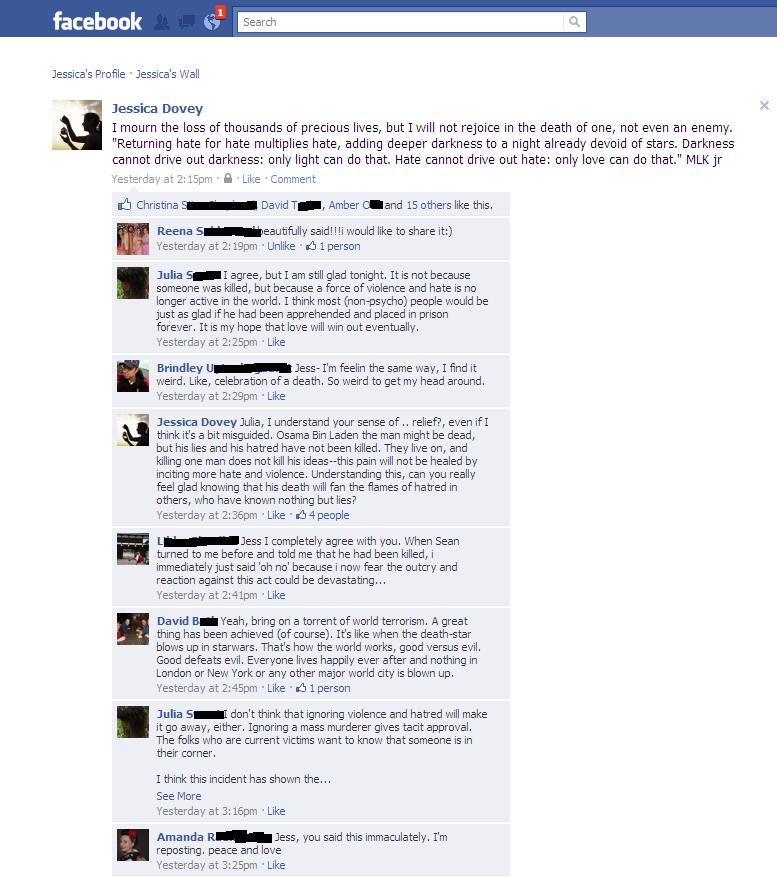
In the day and a half since terror boss Osama bin Laden was dispatched with extreme prejudice by American assets, I have seen the following quote appear countless times in my Facebook newsfeed:
As it turns out, it's not all MLK. Everything but the first sentence comes from King's 1963 book, Strength to Love.
The first sentence actually started out as a comment presented with the remaining quote in someone's Facebook status update. For some reason, people who copied and pasted this person's status moved the opening quotation mark to include the comment. Here's the original (click image to view larger version):
The extra sentence is a great sentiment, and one with which I am sure MLK would agree. ("Fake but accurate", as newsman Dan Rather said in another context.)
Due to the tireless efforts of well-meaning people, future generations will swear up and down that MLK actually said it.
(Via: St Eutychus)
I mourn the loss of thousands of precious lives, but I will not rejoice in the death of one, not even an enemy. Returning hate for hate multiplies hate, adding deeper darkness to a night already devoid of stars. Darkness cannot drive out darkness: only light can do that. Hate cannot drive out hate: only love can do that.The quote is attributed to Dr. Martin Luther King, Jr.
As it turns out, it's not all MLK. Everything but the first sentence comes from King's 1963 book, Strength to Love.
The first sentence actually started out as a comment presented with the remaining quote in someone's Facebook status update. For some reason, people who copied and pasted this person's status moved the opening quotation mark to include the comment. Here's the original (click image to view larger version):
The extra sentence is a great sentiment, and one with which I am sure MLK would agree. ("Fake but accurate", as newsman Dan Rather said in another context.)
Due to the tireless efforts of well-meaning people, future generations will swear up and down that MLK actually said it.
(Via: St Eutychus)
Further evidence that Obama is becoming a dictator!
I missed it on CNN, but this ad I saw on a website makes it clear: President Obama is personally setting mortgage rates now!

It's on the internet, so it must be true.
Seriously, though: This advertiser seems to think that the cult of Obama is a powerful draw.
Seriously, though: This advertiser seems to think that the cult of Obama is a powerful draw.
March 3, 2011
Are President Obama's opponents motivated primarily by racism?
Let's follow the logic here.
Democrats routinely accuse Obama's detractors of opposing him because he's black.
So... Does this mean that I secretly agree with his ideology and agenda, but I'll oppose him to the point of harming myself... simply because he's black? Seriously?
It's easy to jump to the conclusion that the Dems who make this charge are pathetically ignorant, but I really think that's not the case. They're smart enough to know that if a conservative gets tricked into trying to defend himself against this absurd charge, he's already lost in the court of public opinion.
 Conservatives need to stop trying to prove a negative. When this slander is hurled our way, we need to laugh at our accuser, wondering aloud if he realizes how ridiculous he sounds.
Thomas More wrote that "the devil, the proud spirit, cannot endure to be mocked". I doubt that the Dems will endure it well either.
Democrats routinely accuse Obama's detractors of opposing him because he's black.
So... Does this mean that I secretly agree with his ideology and agenda, but I'll oppose him to the point of harming myself... simply because he's black? Seriously?
It's easy to jump to the conclusion that the Dems who make this charge are pathetically ignorant, but I really think that's not the case. They're smart enough to know that if a conservative gets tricked into trying to defend himself against this absurd charge, he's already lost in the court of public opinion.
Conservatives need to stop trying to prove a negative. When this slander is hurled our way, we need to laugh at our accuser, wondering aloud if he realizes how ridiculous he sounds. Thomas More wrote that "the devil, the proud spirit, cannot endure to be mocked". I doubt that the Dems will endure it well either.
July 28, 2010
Who in the world is David H. Comins?
 Does David H. Comins actually exist?
The “Thought For The Day” Listserv had this quote today:
People will accept your ideas much more readily if you tell them Benjamin Franklin said it first.I loved the quote, and wanted to pass it along to my friends, but I was curious about the author, because I had never heard of him.
-- David H. Comins
I’m usually pretty good at digging information out of Google, but so far I’ve come up empty. Searching on his name, I found countless sites that reproduce this quote, but have no information about who Comins is.
So… Is Comins a one-hit wonder, famous precisely for saying the above quote, but otherwise obscure? That’s not very easy to pull off, it seems to me.
I did find a Facebook page for a David Comins, but I’d have to get on his Friends list to see any detailed information on him. There’s a David Comins on LinkedIn, but how would an Information Manager at TimeWarner become famous for a quote on Benjamin Franklin?
C’mon, somebody do my homework for me and point me to a site that tells me who Comins is.
There is a lesson in all of this. How often to we uncritically pass on things we find on the Internet or receive in our email? Do any of the people who posted the Comins quote on their websites know anything about Comins, assuming he exists? I’m willing to bet they don’t.
You’re welcome to prove me wrong.
11 July 2011 UPDATE: The hunt for David H. Comins still rages on, given the number of visits to this post through search engines. I decided to have another look to see if anything else had turned up on him. I think we've got him! It seems that the possibility that I dismissed above as the least likely has ended up being the reality about our mystery man.
All of those sites referring to him as an author may want to reconsider that description, given that pretty much the only thing he ever got published was... that quote. It was a reader submission for a magazine article. In real life, it looks like he was a real estate broker in Manchester, Connecticut for quite a while, but he's well past retirement now. I wouldn't be surprised if he’s spending his golden years marveling about how famous—yet obscure—he is.
18 December 2015 UPDATE: The links in the previous update no longer work, so I thought I'd update my search. A recent book called The Official Rules has this entry for "Comins's Law":

Conclusion, reiterated: David H. Comins is famous for this quotation, and nothing else. If it weren't for his submission to Harper's, he wouldn't exist at all, as far as the internet is concerned.
Subscribe to:
Posts (Atom)