C-Poll

The latest C-Poll is closed. You can read all about it here!

Showing posts with label Diplomacy. Show all posts

September 22, 2009

World’s media continue to lie about the reality of what happened in Honduras

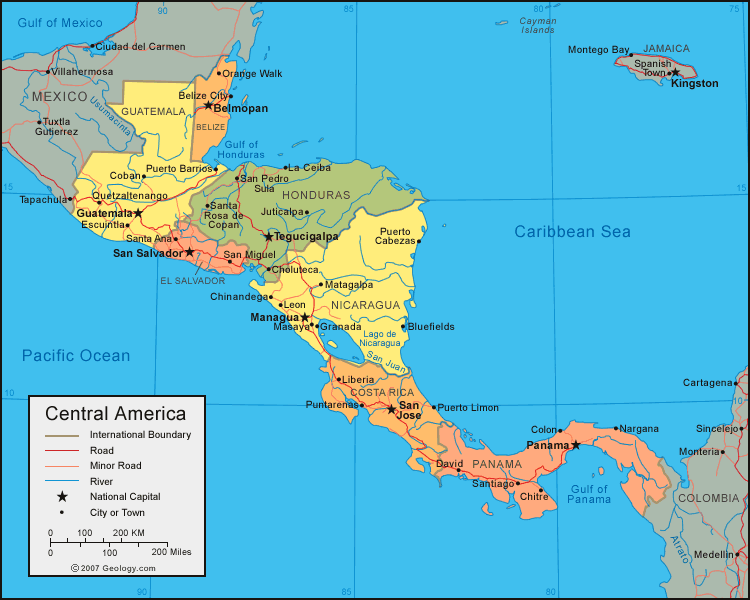
A constitutional crisis is underway in Honduras, but not for the reasons that the media – and the Obama administration, for that matter – would have you believe.

As I have written previously, former president Manuel Zelaya was removed from power in June after a series of moves on his part that violated the Honduran constitution. Completely in accordance with said constitution, the Honduran military, on the orders of the Honduran Supreme Court and with the endorsement of the Honduran Attorney General, arrested Zelaya.

The military exceeded its authority by exiling Zelaya rather than simply taking him into custody, but as far as I can tell, that is the only misstep in the entire drama.

Despite these facts, the Obama administration and the majority of the world’s media have had the audacity to refer to this as a coup.

Now the deposed Zelaya has been smuggled back into the country and is holed up in the Brazilian embassy. The Obama administration, which to date has struggled to find a left-wing regime it couldn’t find common cause with, has pledged its support to Brazil.

An AFP report from today follows the tired old script [emphasis added]:

The United States pledged Tuesday to do whatever it can to help Brazil's embassy in Honduras, which was surrounded by soldiers and had its lights, water and phone lines cut off after deposed President Manuel Zelaya took refuge there.

"Our embassy in Tegucigalpa is in contact with their counterparts in the Brazilian embassy in Tegucigalpa and we're discussing what kind of assistance that we can provide to help them during this crisis," said State Department spokesman Ian Kelly.

[…] Honduran soldiers earlier dispersed thousands of protesters who had camped out overnight outside the embassy to protect the man they see as the country's rightful leader, but who was deposed in a military-backed coup in June.

The Honduran government is understandably angry that Brazil would give aid and comfort to a man who through his actions is an avowed enemy of the country’s constitution.

It is to America’s shame that our government continues to pretend otherwise.


9/24 UPDATE: Unsurprisingly, Spain's leftist president Jose Zapatero has joined in the charade (with Reuters' hearty concurrence):

Democracy must be restored in Honduras and a political crisis caused by the overthrow of President Manuel Zelaya must end, Spain's prime minister said at the U.N. General Assembly on Thursday.

"We won't accept the coup," Prime Minister Jose Luis Rodriguez Zapatero told world leaders.

Zelaya was ousted in a June coup in the worst political crisis in Central America in decades.


June 12, 2009

Yeah, that'll teach North Korea

The Associated Press (via WaPo) breathlessly informs us that the United Nations is sending North Korea to bed without any dinner:
The U.N. Security Council has approved tough new sanctions against North Korea for its recent nuclear test.

The resolution imposes new sanctions on the reclusive communist nation's weapons exports and financial dealings, and allows inspections of suspect cargo in ports and on the high seas.

U.S. deputy ambassador Rosemary DiCarlo said Friday's vote was a strong and united international response to North Korea's unacceptable behavior.
Does anyone seriously think these sanctions will persuade the folks in charge of NK to change their ways?

Saddam Hussein prospered for a decade under the United Nations' "tough sanctions" and its "strong and united international response" to his "unacceptable behavior". And Saddam was just your garden-variety genocidal dictator. Kim Jong-Il and his merry men take genocidal dictatorship to a whole new paranoid level.

January 21, 2009

The cultural landmines of international diplomacy

I spend a lot of volunteer time helping international graduate students improve their English skills. Over the years, I have gained an appreciation for the fact that genuine communication is much more than just words.

This is especially true when we engage in cross-cultural communication. The words we hear from our international acquaintances may seem familiar and unambiguous, but the words (and the way they are delivered) come wrapped a cultural context that must be understood in order for true communication to occur.

I was reminded of this as I read Genesis 23 in the Bible this morning. The chapter deals with Abraham as he makes preparations to bury his wife Sarah, who has just passed away. He is interested in a particular burial place -- one that happens to be on land owned by someone else.

The conversation he has with the owner of the land was a bit terrifying to me, once I discovered that I had completely misunderstood what was going on until the very end. Here is the passage (taken from the New International Version):
1 Sarah lived to be a hundred and twenty-seven years old. 2 She died at Kiriath Arba (that is, Hebron) in the land of Canaan, and Abraham went to mourn for Sarah and to weep over her.

3 Then Abraham rose from beside his dead wife and spoke to the Hittites. He said, 4 "I am an alien and a stranger among you. Sell me some property for a burial site here so I can bury my dead."

5 The Hittites replied to Abraham, 6 "Sir, listen to us. You are a mighty prince among us. Bury your dead in the choicest of our tombs. None of us will refuse you his tomb for burying your dead."

7 Then Abraham rose and bowed down before the people of the land, the Hittites. 8 He said to them, "If you are willing to let me bury my dead, then listen to me and intercede with Ephron son of Zohar on my behalf 9 so he will sell me the cave of Machpelah, which belongs to him and is at the end of his field. Ask him to sell it to me for the full price as a burial site among you."

10 Ephron the Hittite was sitting among his people and he replied to Abraham in the hearing of all the Hittites who had come to the gate of his city. 11 "No, my lord," he said. "Listen to me; I give you the field, and I give you the cave that is in it. I give it to you in the presence of my people. Bury your dead."

12 Again Abraham bowed down before the people of the land 13 and he said to Ephron in their hearing, "Listen to me, if you will. I will pay the price of the field. Accept it from me so I can bury my dead there."

14 Ephron answered Abraham, 15 "Listen to me, my lord; the land is worth four hundred shekels of silver, but what is that between me and you? Bury your dead."

16 Abraham agreed to Ephron's terms and weighed out for him the price he had named in the hearing of the Hittites: four hundred shekels of silver, according to the weight current among the merchants.

17 So Ephron's field in Machpelah near Mamre—both the field and the cave in it, and all the trees within the borders of the field—was deeded 18 to Abraham as his property in the presence of all the Hittites who had come to the gate of the city. 19 Afterward Abraham buried his wife Sarah in the cave in the field of Machpelah near Mamre (which is at Hebron) in the land of Canaan. 20 So the field and the cave in it were deeded to Abraham by the Hittites as a burial site.
It wasn't until verse 15 that I began to suspect that Abraham and Ephron were negotiating a sale. Ephron kept insisting that Abraham accept the land as a gift. Why didn't Abraham graciously take him at his word (like the typical American would)? Because he understood the Hittite culture, and knew that Ephron would eventually get around to stating his price (all the while insisting that he wouldn't accept the money).

This is very sobering to me, because I am often foolish enough to think that, upon meeting an international for the first time, I can quickly establish a rapport and engage in meaningful conversation without knowing anything significant about that person's culture.


Okay, this is a blog about politics, culture and religion. I've mentioned culture and religion already in this post, so let's round it out with a political-moral-of-the-story.

Today, Hillary Clinton was confirmed as Secretary of State. On the individual level -- say, between me and one of my international friends -- cross-cultural miscommunications can lead to hard feelings and confusion. On the international level, the consequences of miscommunication can be much worse.

Here's to hoping that Mrs. Clinton will take her job seriously, with a full appreciation for the hazards inherent in her job. It's a dangerous world out there.