C-Poll

The latest C-Poll is closed. You can read all about it here!

September 15, 2005

The truth is out there re: Katrina; it's just not being reported

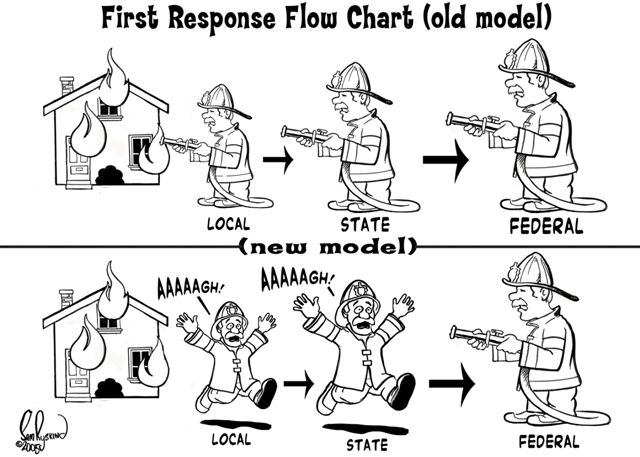
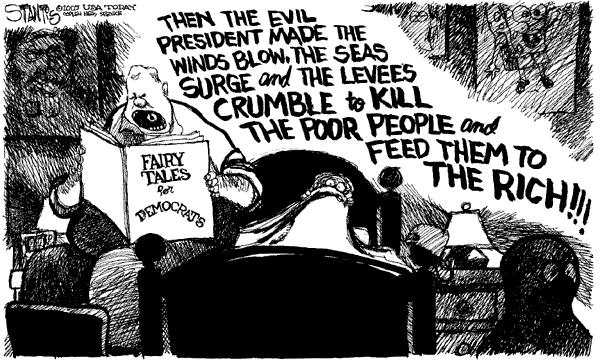
The MSM has pretty much successfully established the meme that the federal government was exceptionally and scandalously slow in its response to Hurricane Katrina's mauling of the Gulf Coast.

The truth is out there, but it is beyond the reach of those who passively consume whatever CBSNBCABCMSNBCCNNetc. and their colleagues in the print and electronic media dish out.

You have to go to media sources like the Pittsburgh Post-Gazette, rejected by MSM elitists as an organ of the Vast Right Wing Conspiracy.

In a September 11 article there, Jack Kelly systematically smacks down many of the falsehoods that the left has been advancing about the disaster and its aftermath. For example:
Jason van Steenwyk is a Florida Army National Guardsman who has been mobilized six times for hurricane relief. He notes that:

"The federal government pretty much met its standard time lines, but the volume of support provided during the 72-96 hour was unprecedented. The federal response here was faster than Hugo, faster than Andrew, faster than Iniki, faster than Francine and Jeanne."

For instance, it took five days for National Guard troops to arrive in strength on the scene in Homestead, Fla. after Hurricane Andrew hit in 1992. But after Katrina, there was a significant National Guard presence in the afflicted region in three.

Journalists who are long on opinions and short on knowledge have no idea what is involved in moving hundreds of tons of relief supplies into an area the size of England in which power lines are down, telecommunications are out, no gasoline is available, bridges are damaged, roads and airports are covered with debris, and apparently have little interest in finding out.

So they libel as a "national disgrace" the most monumental and successful disaster relief operation in world history.
The entire essay is a good read.

Administrivia: Post summaries now available by e-mail

Thanks to FeedBlitz, I'm now offering an e-mail subscription service where each day's worth of C-Pol Blog newsfeed summaries can be delivered to your inbox. No more than one message per day (sometimes none).

To subscribe, enter your e-mail address in the appropriate box on the sidebar, and click "Subscribe me!"

A constitutionalist take on judicial review

A reader asked in an unrelated thread if I, as a constitutionalist, believe in judicial review. It's a good question, worth its own thread, so I'll answer here.

Do I believe in judicial review? I haven't given the matter enough detailed attention, but my shoot-from-the-hip response is: Sort of.

The power of the federal judiciary, enumerated in Article III, Section 2 of the Constitution, is as follows:
The judicial Power shall extend to all Cases, in Law and Equity, arising under this Constitution, the Laws of the United States, and Treaties made, or which shall be made, under their Authority; — to all Cases affecting Ambassadors, other public Ministers and Consuls; — to all Cases of admiralty and maritime Jurisdiction; — to Controversies to which the United States shall be a Party; — to Controversies between two or more States; — between a State and Citizens of another State [Modified by Amendment XI]; — between Citizens of different States; — between Citizens of the same State claiming Lands under Grants of different States, and between a State, or the Citizens thereof, and foreign States, Citizens or Subjects.

In all Cases affecting Ambassadors, other public Ministers and Consuls, and those in which a State shall be Party, the supreme Court shall have original Jurisdiction. In all the other Cases before mentioned, the supreme Court shall have appellate Jurisdiction, both as to Law and Fact, with such Exceptions, and under such Regulations as the Congress shall make.
Amendment XI reads thus:
The Judicial power of the United States shall not be construed to extend to any suit in law or equity, commenced or prosecuted against one of the United States by Citizens of another State, or by Citizens or Subjects of any Foreign State.
That's it. We see here what is intended to be an exhaustive listing of the types of "cases" and "controversies" which may be heard by the federal courts. I see nothing here beyond a grant of power to judge between the parties in such a case or controversy: Party A is correct, Party B is incorrect.

I see no specific grant of power to nullify an act of Congress (which is the meaning of judicial review). However, such a power seems to be implied in the above text, a fact which is admitted by Hamilton in Federalist #81. In answer to this, Hamilton expresses what is in hindsight naive optimism that an independent judiciary poses no real threat to the legislature:
It may in the last place be observed that the supposed danger of judiciary encroachments on the legislative authority, which has been upon many occasions reiterated, is in reality a phantom. Particular misconstructions and contraventions of the will of the legislature may now and then happen; but they can never be so extensive as to amount to an inconvenience, or in any sensible degree to affect the order of the political system. This may be inferred with certainty, from the general nature of the judicial power, from the objects to which it relates, from the manner in which it is exercised, from its comparative weakness, and from its total incapacity to support its usurpations by force. And the inference is greatly fortified by the consideration of the important constitutional check which the power of instituting impeachments in one part of the legislative body, and of determining upon them in the other, would give to that body upon the members of the judicial department. This is alone a complete security. There never can be danger that the judges, by a series of deliberate usurpations on the authority of the legislature, would hazard the united resentment of the body intrusted with it, while this body was possessed of the means of punishing their presumption, by degrading them from their stations. While this ought to remove all apprehensions on the subject, it affords, at the same time, a cogent argument for constituting the Senate a court for the trial of impeachments.
So, it appears that the power of judicial review is constitutional, but that it is currently warped beyond the Founders' vision (as is just about everything in modern government). First, the legislature does not appear willing to use its check on judicial usurpation— namely, the power of impeachment. This has the effect of emboldening justices to judge according to personal fancies rather than according to the principles of the Constitution. Second, the judiciary is used as a weapon by factions within the legislature who are unable to muster a majority for their initiatives. Third, there is now an unspoken assumption that the courts will "fix" bad laws, leading to the passage of countless bad laws.

Considering all of this, it seems to me that judicial review is not the problem. The problem lies in a legislature that abandoned fealty to the Constitution long ago, and that directly and indirectly led the judiciary away from the Constitution as well. All branches of the government bear the blame for the current state of things, but nothing will change until Congress starts insisting on good (i.e. Constitutional) behavior by the other two branches. Congress will not change until the people start insisting on good behavior by their elected representatives and senators. How will the people be motivated to good behavior?


Thoughts?

I never thought I'd see the day...

...when I'd be so happy to see gasoline at $2.71 per gallon. I have no idea whether or not Steve Forbes is right when he insists that a significant portion of the current price of oil is the result of investor speculation, but I do know that I like the direction the price is moving right now.

September 12, 2005

Ben Stein nails one the biggest stories of the Katrina disaster

Ben Stein in an American Spectator essay (emphasis added):
What is the real story of Katrina is (I suggest) not so much that nature wrought fury on land, water, people, property, and animals, not at all anything about racism, not much about federal government incompetence. The real story is that the mainstream media rioted.

They used the storm and its attendant sorrows to continue their endless attack on George W. Bush. Wildly inflated stories about the number of dead and missing, totally made up old wives' tales of racism, breathless accounts of Bush's neglect that are utterly devoid of truth and of historical context -- this is what the mainstream media gave us. The use of floating corpses, of horror stories of plagues, the sad faces of refugees, the long-faced phony accusations of intentional neglect and racism -- anything is grist for the media's endless attempts to undermine the electorate's choice last November. It is sad, but true that the media will use even the most heart breaking truths -- and then add total inventions -- to try to weaken and then evict from office a man who has done nothing wrong, but has instead turned himself inside out to help the real victims.

In the meantime, George Bush does not lash out, does not attack those who falsely accuse him of the most horrible acts and neglect. Instead, he doggedly goes on helping the least among us. I don't know how he does it, but we are very lucky he does. As for truth, it eventually may be salvaged from the flooded neighborhoods of The Crescent City, but not as long as there is a lie to use to hurt an honest man trying to do the best he can, and hundreds of thousands of brave, tireless men and women who do more than point fingers and tell tales. The Katrina story is a disgrace to the people who are "reporting" it while pouring gasoline on a fire. They and their crusade against George Bush are the real stories, and they are dismal ones.
Given that the MSM is the story here, it will never be reported.


Click to view full-sized images

September 9, 2005

Evil Karl Rove masterminds deaths of conservative icons for political gain

John Semmens satire:
Dean Denounces Timing of Rehnquist’s Death

September 9, 2005

Democratic National Committee Chairman Howard Dean complained that the timing of Supreme Court Chief Justice William Rehnquist’s death was “highly suspicious.”

“Last year, Reagan conveniently died just in time to take attention away from Bush’s failed Iraq War and boost Bush’s chances for reelection,” said Dean. “Now, in the midst of Bush’s failure to prevent the extermination of downtrodden, minority New Orleans’ hurricane victims, Justice Rehnquist conveniently dies. Am I the only one who sees a pattern here?”

Dean charged that presidential advisor Karl Rove was masterminding these strategically timed deaths of conservative icons. “Not only do these deaths distract Americans from Bush’s blunders, they also serve as a cover for Rove’s nefarious scheme to suppress Democratic voter turnout in next year’s Congressional elections by evacuating New Orleans hurricane victims to other states,” claimed Dean.

Dean demanded that the Democratic Party be authorized to cast absentee ballots on behalf of the evacuated hurricane victims. “These dispersed people are mostly poor and uneducated,” said Dean. “Many are on welfare. Others are driven to a life of crime. These are the people the Democratic Party represents. Who could object to us casting their ballots for them during this time of turmoil?”

Dean said he will be working with key members of Congress to draft enabling legislation.
It's logically sound, so why can't it be true? Or as Rev. Jackson might say, It's conceivable, thus it's believable.

Moonbat manifesto

Someone has launched an online petition called the "Declaration of New Orleans" that neatly distills pretty much all of the fevered rants the far left has leveled against W since he took office (well, stole office, actually):
To: The President of The United States of America, the United States Congress, and The American People.


In the name of the People of the United States of America, we declare:

That for the last four and a half years President Bush and his administration have served the interests of a few influential citizens rather than the interests of the American People.

That he has acted with contempt for the People and for the Constitution and the laws of the United States.

That an edict of the Supreme Court made him President in 2000 and fraud made him President again in 2004.

That he has pursued an unprecedented expansion of Executive powers that are a grave threat to the rights and liberties of the American People.

That he has made war on sovereign nations that are no threat to the American People.

That his "War on Terror" has cost billions of dollars and thousands of lives without bringing those responsible for the terrorist attacks of September 11, 2001 to justice.

That the failure of his leadership and administration in the present crisis in the City of New Orleans has resulted in the deaths of thousands more.

That he is derelict in every duty of his office.

Therefore, we resolve:

That President George W. Bush and his administration are illegitimate.

That he should resign from office and new elections should be held immediately.

That if he does not resign, the Congress of the United States should act to remove him from office.

That if the Congress should fail to act, the People will exercise their right to abolish this state and will establish a new government that will better secure their rights and liberties.

Sincerely,

The Undersigned
The petition appears to have been a legitimate, earnest attempt by some leftist to vent her hatred against W, but the reality is that the signature list has been completely hijacked by people who are less than sympathetic with her views (people who were probably part of the conspiracy to install the Bush regime over the objections of the American voters).

For my part, I'll say that every single charge is either flat-out wrong, grossly exaggerated, or simply misleading. For example:
That he has acted with contempt for the People and for the Constitution and the laws of the United States.
In RealityWorld, just about every president in the past century or so has acted with contempt for the Constitution and the laws of the U.S.
That he has pursued an unprecedented expansion of Executive powers that are a grave threat to the rights and liberties of the American People.
Certainly not unprecedented. I assume the writer is speaking of things like the PATRIOT Act. Grave threat? Possibly...it depends on which president is wielding said powers. It's gotta mean something that the author of this petition and her fellow travelers are still free to roam the streets, shouting vulgar slogans and threatening the overthrow of the government.

Feel free to toss in your two cents on any of the particular charges listed.

As for the demand that W "should resign from office and new elections should be held immediately," it's hard for me to top this reply from a Free Republic poster:
Today's Constitutional quiz. When a sitting president resigns, what happens next?

A) new elections held immediately.
B) free ice cream for everyone.
C) Cindy Sheehan becomes Secretary of Defense.
D) none of the above.

Is the Left really claiming that W should have claimed dictatorial powers?

That's what he would have had to do in order to get substantial federal help to New Orleans much sooner than he did. As Joe Mariani writes (emphasis added):
The Posse Comitatas [sic] Act of 1878 forbids the President from using the US military to enforce the law without an Act of Congress. Posse comitatus, or "all possible force," refers to the power of a sheriff to call upon every able-bodied man in his county to help apprehend a criminal. (The things you learn from watching old Westerns...) The President can not similarly use "all possible force" to enforce the law, because doing so would be equivalent to declaring martial law in the United States.

Exceptions to the law, aside from suppressing insurrections, include assisting drug enforcement agencies or during emergencies involving nuclear, chemical or biological weapons. Unfortunately (or fortunately, depending on your point of view), there is no exception for a local or state government failing to respond properly to a crisis. State and local officials failed to evacuate the citizens, declined to quell the looting and other crimes being committed, and even refused permission for the Red Cross to bring food and water to the people packed into the Superdome and Convention Center. The Red Cross explains on their web site that "The state Homeland Security Department had requested... that the American Red Cross not come back into New Orleans following the hurricane. Our presence would keep people from evacuating and encourage others to come into the city." Without the governor's permission to act, the federal government was effectively hamstrung.

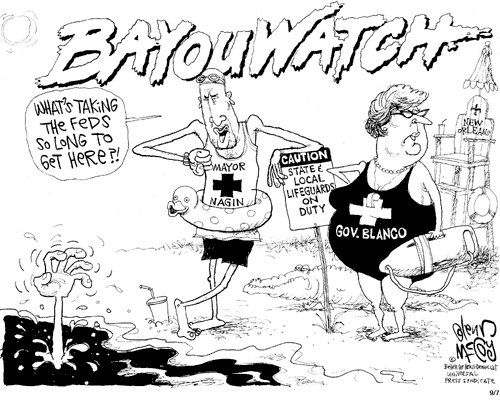
Louisiana Governor Kathy Blanco could have requested federal help, but would not sign the authorization to allow it, even after the situation had descended into total chaos. "Shortly before midnight Friday, the Bush administration sent her a proposed legal memorandum asking her to request a federal takeover of the evacuation of New Orleans," the Washington Post reported. "The administration sought unified control over all local police and state National Guard units reporting to the governor. Louisiana officials rejected the request after talks throughout the night, concerned that such a move would be comparable to a federal declaration of martial law." Governor Blanco decided to maintain final authority over the situation in New Orleans. With that authority comes responsibility for the results -- good or bad.

Every person who complains because the federal government did not take control of the New Orleans situation -- despite the governor's refusal to give permission -- is advocating a far more powerful federal government than we should ever want. The burden of response to local disasters rests on local elected officials while they choose to retain their authority. The federal government cannot intervene unless specifically requested to do so. To suggest otherwise is to invite a military dictatorship.
Is this what the Left really thought Bush should have done? Or was the unending stream of condemnation just political posturing?


Click to view full size

September 8, 2005

Homeowners association mans barricades against Katrina refugees

(Er, excuse me, I mean "evacuees". I meant no disrespect.)

Ocala, Florida:
Tammy Coggins returned to her Majestic Oaks home after a weekend in Atlanta and found the welcome mat pulled out from under her good intentions.

While communities throughout the Sunshine State and elsewhere are welcoming Hurricane Katrina's storm-weary survivors, Coggins and others in the 500-home southwest Ocala subdivision were told by their homeowners association that their deed restrictions prohibited them from doing the same.

[...]

Across the nation, tens of thousands have offered their homes as temporary shelter for those displaced by Katrina. Placement is made via Internet registries such as HurricaneHousing.org, HomeFlood.org and Craig's List where everything from a spare sofa to luxury condominiums are available to victims, often free or for a nominal charge.

The notice was sent after the board learned that a homeowner planned to shelter three families evacuated from New Orleans. Vice President Audrey Andrews said the board's action was "blown out of proportion" and that she apologized only for it gaining news media attention.

"I think our intent was correct," she said. "It's a neighborhood problem (but) it got out . . . If a letter of apology will help, fine."

Andrews said the board was merely enforcing restrictions approved by homeowners as recently as last year.
The homeowners association (H.A.) was letter-perfect in its enforcement of association rules, but stone cold-hearted in the extreme at the same time. The least they could have done was to take a quick vote from its members about a temporary relaxing of the restrictions. Judging from the reaction by subdivision residents, it looks like the votes would have been there.

Has there ever been an instance where an H.A. hasn't gotten too big for its britches and become much more heavyhanded than its founding members ever intended?

The neighborhood where I live has deed restrictions, but no H.A. Enforcement comes through the threat of civil action against a violator, so in general several homeowners must pool their resources to hire a lawyer—a voluntary association created for a specific purpose, and disbanding afterward with no further financial obligation. About three years ago nine of the fourteen households on our street banded together to threaten legal action against two of the other homeowners, who were renting out their houses to multiple unrelated people (college students, BTW). Apart from being a deed restriction violation, such a use of these houses would have seriously affected the value of the houses that weren't violating the restrictions. So, the nine households pitched in equal shares of the legal fees (about $600 per household), and we persuaded the two violators to stop their illegal use of the property.

After it was all over, our lawyer offhandedly suggested that we could more easily prevent such occurrences in the future if we formed an H.A. I said that an H.A. was a cure that was worse than the problem, and happily, most of my neighbors agreed. We all returned to our homes and our lives, and that was that.

So (as Tim tries to get back to the original topic of the post), don't get me started on homeowners associations and their beancounting, fascist boards.

John Roberts, the Stepford Justice

As the media flails around for some dirt that will stick to Chief Justice nominee John Roberts, WaPo's Richard Cohen deserves a prize of some sort for trying to turn Roberts' sterling professional bio into a liability:
I sometimes think the best thing that ever happened to me was, at the time, the worst: I flunked out of college. I did so for the usual reasons -- painfully bored with school and distracted by life itself -- and so I went to work for an insurance company while I plowed ahead at night school. From there I went into the Army, emerging with a storehouse of anecdotes. In retrospect, I learned more by failing than I ever would have by succeeding. I wish that John Roberts had a touch of my incompetence.

Instead, the nominee for chief justice of the United States punched every career ticket right on schedule. He was raised in affluence, educated in private schools, dispatched to Harvard and then to Harvard Law School. He clerked for a U.S. appellate judge (the storied Henry J. Friendly) and later for William H. Rehnquist, then an associate justice. Roberts worked in the Justice Department and then in the White House until moving on to Hogan & Hartson, one of Washington's most prestigious law firms; then he was principal deputy solicitor general, before moving to the bench, where he has served for only two years. His record is appallingly free of failure.
He's too perfect to be Chief Justice of the U.S. Supreme Court! He's probably not even human!

The theory goes that Roberts' lack of failure in life will make him less sensistive to the plight of the less fortunate. Of course, sensitivity has nothing whatsoever to do with the proper constitutional role of a Supreme Court justice, but who's paying attention to irrelevancies like that any more?

(Credit: Captain's Quarters)

September 7, 2005

AP goes out on a limb with judicial nominee speculation

AP headline, September 6:
Next Bush Nominee May Be a Conservative

(Credit: BOTW)

Dissecting moonbats

James Lileks does a wonderful job of mocking the "incandescent lunacy" of the left, which is trying everything in its bag of tricks to pin all Sadness and Woe on the president.

He ends with two lessons we can take away from Katrina and its aftermath:
You're on your own. At least keep an emergency kit on hand, the sort of thing Tom Ridge proposed, and which made the smart set hardy-har-har because it contained duct tape.

Don't rely on the government. Four years after Sept. 11, it's apparent that some local governments are not well-oiled machines when it comes to disasters -- more like a box of sand and busted gears. Blame for that can be promiscuously distributed.

Lesson two: The next terrorist attack will not unite us for a warm, hug-filled fortnight. The hard left won't wait 24 hours before blaming Bush, and the country will enjoy the sight of prominent pundits angrier at the president than at the men who nuked Des Moines.

Weighing the odds

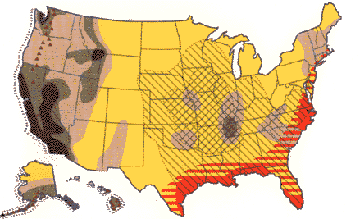
This map shows that few places in the US are completely free of natural disaster risk:


Of course, the map focuses on only a few kinds of natural disasters. Just in case you're feeling secure because your in a low risk area for earthquakes, hurricanes and tornadoes (and tsunamis and volcanoes, for that matter), the Natural Disaster Education Coalition reminds us that there's also drought, fires, flooding, heat waves, landslides, severe thunderstorms (even without tornadoes, there's still a risk of high winds and hail), and heavy snowstorms.

So... anyone still feel left out? I'm sure we can come up with something else.

Maybe we'll send you our love bugs.

Of course, fear of natural disasters is not what we're aiming for. When choosing where to live, we should at least conclude that the odds of Very Bad Things happening are in our favor. You can't say that about a place like New Orleans.


(Credit: PapaCool)

Chinese activist against forced abortion and sterilization "seized"

On August 27 I wrote about Guangcheng Chen, a blind peasant from Liying in Shandong province, who was slowly but steadily building a legal case against the city's blatant use of forced abortion and sterilization. The central government officially does not approve of such techniques as a means of enforcing the national "one child" policy, but in reality, provincial officials can be punished if centrally-determined population targets are not met, so it is actually not uncommon that they resort to such techniques to meet the targets.

Today's WaPo reports that less than two weeks later, Chen was "seized" in Beijing in a manner reminiscent of organized crime:
Several men in plain clothes grabbed Chen when he left an apartment building on Tuesday afternoon, witnesses said. The men did not identify themselves, and Chen resisted, shouting for help as they dragged him across a parking lot and pushed him headfirst into an unmarked car with tinted windows, the witnesses said.

A small group of people, upset by seeing the rough treatment, surrounded the vehicle and prevented it from driving away. As two men held Chen down in the back seat, he could be heard screaming and appeared to be in pain.

Residents called Beijing police. Two uniformed officers arrived, consulted with the men who had seized Chen, then cleared a way for the car to leave. The officers said the men who seized Chen were police from China's Shandong province, where Linyi is located. Tu Bisheng, a friend who was with Chen at the time, said local officials from Linyi were also present.

"We feel this is extremely inappropriate," said Li Heping, one of the lawyers working with Chen. He said the Linyi officials appeared to be "taking revenge on him for trying to protect the rights of local citizens and exercising his right to criticize the government."
The article mentions that provincial authorities are quite powerful, and often disobey the central government, but rarely so brazenly. Shandong officials knew that Chen had found some sympathetic ears in the central government, so they simply decided that he would not be permitted to meet with them.

In my opinion, we're witnessing but one episode in the slow, painful evolution of Chinese civil rights. Although many in the central government are sympathetic to his cause, it does not appear that any are willing to intervene on his behalf at this time. It's remarkable that Chen was allowed to carry on as long as he did; I'm certain that just ten years ago he wouldn't have dared to open his mouth in criticism.

In recent years China has taken its first few tentative steps toward creating a stable legal system that respects the civil rights of its citizens, but it may be a generation or more before we see satisfactory results. Much of that progress will depend on Beijing's ability to rein in local officials. Two weeks from now, I'd love to read in the WaPo that certain government officials in Liying have been arrested on charges of corruption and abuse of power. I have doubts that it will happen, but if it did, it would give me greater hope about China's future.


(Credit: Ray D.)

September 6, 2005

Another reason to abandon embryonic stem cell research

LifeNews, September 5 (excerpt):
Scientists are intensely concerned about a discovery that embryonic stem cells cultured in the lab develop genetic mutations over time that are cancerous. The new development may mean embryonic stem cells may never be able to help patients suffering from various diseases.

Unless such cells can be kept fresh until use and thoroughly checked for problems, embryonic stem cells may never be used. However, the longer they are kept and they more they divide, the more errors in their genetic code appear, giving rise to cancer.

"These mutations we are finding are a much bigger problem," says Aravinda Chakravarti of the Johns Hopkins University in a report in the journal Nature Genetics.

Chakravarti and his colleagues examined embryonic stem cell lines created before August 2001, and eligible for federal funding under President Bush's limits on using taxpayer funds to destroy human life.

They compared the original embryonic stem cells with those produced from those lines. Out of nine cell lines, eight developed one or more genetic changes commonly observed in human cancers, the Johns Hopkins team reports.