C-Poll

The latest C-Poll is closed. You can read all about it here!

Showing posts with label Bailouts. Show all posts

June 23, 2010

“Cash for Clunkers”, revisited: New home sales plunge to lowest level on record

The Associated Press reports that another major chunk of the façade known as the “economic recovery” has crumbled:

Sales of new homes collapsed in May, sinking 33 percent to the lowest level on record as potential buyers stopped shopping for homes once they could no longer receive government tax credits.

The bleak report from the Commerce Department is the first sign of how the expiration of federal tax credits could affect the nation's housing market.

The credits expired April 30. That's when a new-home buyer would have had to sign a contract to qualify.

"We fear that the appetite to buy a home has disappeared alongside the tax credit," Paul Dales, U.S. economist with Capital Economics," wrote in a note. "After all, unemployment remains high, job security is low and credit conditions are tight."

Sound familiar?  Last summer, the “Cash for Clunkers” program created an artificially high demand for automobiles, almost certainly spurring purchases by people who otherwise wouldn’t have (or shouldn’t have) done so.  Once the C4C program ended, auto sales dropped through the floor.

Here we go again.  The federal tax credits for new home purchases is gone, and sales have dropped to a level never before seen in the 47 years that the government has been tracking this statistic. 

Just like we saw with C4C, it is likely that many who bought a home in recent months should not have done so.  How many of them will be in foreclosure in just a few short years?

Remember these examples each time you are told that we’re in the midst of an economic recovery.

Given the fresh storm clouds gathering on the horizon, now may not be the best time to buy a home, with or without a tax credit incentive.

February 22, 2010

McCain: It’s not my fault! They made me vote for it!

Senator John McCain, just now realizing that conservatives consider his vote for the TARP financial industry bailout to be a political liability, offers this defense (Arizona Republic, February 22):

Under growing pressure from conservatives and "tea party" activists, Sen. John McCain of Arizona is having to defend his record of supporting the government's massive bailout of the financial system.

In response to criticism from opponents seeking to defeat him in the Aug. 24 Republican primary, the four-term senator says he was misled by then-Treasury Secretary Henry Paulson and Federal Reserve Chairman Ben Bernanke. McCain said the pair assured him that the $700 billion Troubled Asset Relief Program would focus on what was seen as the cause of the financial crisis, the housing meltdown.

So.  Bush administration officials assured you that the money would be used in a particular way.  Then, you and your staff combed through the proposed legislation and found that yes, safeguards were in place to ensure that the money would indeed be used in the way specified by the officials.  Thus, with confidence you cast your vote in favor of the TARP legislation.

Wait.  What’s that?  You didn’t read the legislation before voting on it?  You simply relied on administration assurances that the the money would be spent to combat the housing crisis?

And now it’s their fault that you cast your vote for a bill that had no such restrictions on the money?

You think this defense is going to mollify your critics?

Again and again, you remind us that if Sarah Palin hadn’t been on the ticket, your loss to Barack Obama in 2008 would have been epic.

September 19, 2009

“Cash for Clunkers” was never about economic stimulus

The Boston Globe reports today that – surprise! – President Obama’s “Cash for Clunkers” program did little good for (and perhaps will end up doing harm to) those it purported to benefit:
It has been nearly a month since the car-buying frenzy of the Cash for Clunkers program ended, and many area auto dealers are longing for the good old days of July and August.
Like consumers nationwide, Massachusetts residents rushed to take advantage of the federal voucher program, which offered them up to $4,500 on old gas-guzzlers to be put toward the purchase of new, more fuel-efficient vehicles. About $65 million worth of vouchers were handed out statewide during the monthlong program that ended Aug. 24.
But once the federal money dried up, so did the sales rally. Now, customers at dealerships like Silko Honda in Raynham are few and far between, and inventory is once again accumulating.
Manager Adam Silverleib said business was “pretty intense’’ as a result of the federal stimulus program, with the dealership hustling to accommodate customers and handle the piles of paperwork required for them to receive reimbursement on vouchers. “Now we’re kind of back to where we were in the spring,’’ he said.
In an attempt to draw customers back to showrooms, some dealers are offering new incentives, albeit none as enticing as a $4,500 for a rusting junker. Silko, for example, is promoting 2.9 percent financing on new Accords, along with other deals on its website.
Nationwide, customers snatched up 700,000 new cars, most of them foreign-made, and the government ended up paying out nearly $3 billion toward the purchases. But from the start, analysts predicted that Cash for Clunkers would not boost sales for the year. September’s sales swoon seems to be making their case. Car sales are usually slow after Labor Day, but because of the recession consumers this year are especially reluctant to say yes to major purchases. To make matters worse for dealers, most are still waiting for voucher reimbursements.
“It was probably, in the end, a complete waste of taxpayer money,’’ said John Wolkonowicz, a senior auto analyst at IHS Global Insight, Lexington forecasting firm. “The dealers, who were supposed to be the primary beneficiaries, many were forced into cash flow problems because the government didn’t pay them in a timely fashion.’’
The Globe, in describing the typical C4C trade-in as a “rusting junker”, is misrepresenting reality. A significant number of the trade-ins were in good working order.
Without the C4C program, many (if not most) of the 700,000 purchasers would not have bought a new car this year. Instead, money that would have remained unspent (because consumers were reluctant to make a major purchase in this economy) or that would have been spent on other sectors of the economy ended up being reallocated to these purchases.  How many of these purchasers went even further into debt to take advantage of an irresistible offer? 
So, economically speaking, the C4C program didn’t really do any favors for anyone but those who were already planning to buy a car this year.
What about the dealers? C4C made its appearance in the midst of an economy where the public simply wasn’t interested in buying new cars. There’s no denying that the dealers were hurting.
Setting aside the C4C administrative problems (denied or delayed reimbursements), times were briefly good for the dealers. As the Globe excerpt above shows, a lot of stale inventory was moved off the lots.
But the demand was completely artificial, and once the incentives ended, the dealerships became ghost towns again. This was little more than the burst of energy that comes with a sugar rush, and now the post-sugar crash has come.
In the long term, C4C did not do the dealers (or the manufacturers they represent) any favors.
What about the economically disadvantaged? Even with the incentives, they were still pretty much priced out of the market.  If they want to have their own wheels, they still have to go the used-car route.
But wait! Nearly three-quarters of a million cars that would have been destined for used car lots were deliberately destroyed, regardless of condition! Used car inventories are down, driving up the prices of the used cars that remain.
Far from doing the disadvantaged buyers any favors, C4C may have ended up putting a car even further out of reach for them.
So. Cui bono? Who benefits?
No doubt, the president expected to reap a political benefit from appearing to help those who are suffering in the current economy, but…
He could have done this without requiring that every trade-in be destroyed.
Cash For Clunkers was never about economic stimulus, but rather about the Obama administration’s “green” agenda, which is predicated on the unproven assumption that mankind’s activities are deleteriously affecting our planet’s climate.
There are many on the environmental left who believe that eliminating private ownership of automobiles is a good first step toward restoring the balance between man and nature.  This idea appears to have found fertile soil among some members of the Obama administration.
It may seem far-fetched to suspect the administration of working toward this goal, but think about it: If someone wanted to eliminate private ownership of cars, and he wanted to do it in a way that wouldn’t be politically disastrous, how would he do it differently?
The problems created or exacerbated by the C4C program won’t be obvious until later, and by then Obama will be able to shift the blame elsewhere.
(Credits: Photos found here and here)
-----
9/21 UPDATE: A commenter reminded me of another prominent victim of the C4C program: charities that rely on used-car donations.  See, for example, this August 9 USA Today article.

July 20, 2009

Visualizing the cost of the government’s economic “rescue” plan

The inspector general for the Troubled Assets Relief Program (TARP) is preparing to submit a report to Congress tomorrow estimating the ultimate cost of all of the financial bailouts currently underway and in the works. Fox News reports IG Neil Barofsky’s stunning prediction in a July 20 article (emphasis added):
The total price tag for federal support stemming from the financial crisis could reach $23.7 trillion in the long run, the government's top bailout watchdog says in a new report to Congress.
Neil Barofsky, the inspector general for the Troubled Asset Relief Program, plans to deliver his report Tuesday to the House Oversight and Government Reform Committee.
The $23.7 trillion figure is admittedly a high-ball number and reflects the total potential gross exposure, but Barofsky in his prepared testimony notes that the TARP -- which started as a $700 billion bailout -- has expanded well beyond that.
[…] In supporting documentation obtained by FOXNews.com, the inspector general's office explains that the $23.7 trillion spans about 50 "initiatives or programs" created by federal agencies in the wake of the economic crisis.
The estimate covers commitments that could come from programs at the Federal Reserve, Treasury Department, Federal Deposit Insurance Corporation, the Federal Housing Finance Agency, the Federal Housing Administration, the Department of Veterans Affairs and other agencies.
Almost 24 trillion dollars!
Chances are that few of us have had reason to try to get our minds around a number that big, so let’s go through a little visualization exercise.
A stack of 3000 newly-printed one-dollar bills stands about a foot tall*. To get the height of 23.7 trillion one-dollar bills, the math looks like this:
23,700,000,000,000 ÷ 3,000 = 7,900,000,000 feet
7.9 billion feet is about 1,496,212 miles. The moon is about 238,857 miles from earth; this stack of money is 6.26 times that distance.
Viewed another way, a dollar bill is about six inches long*. 23.7 trillion one-dollar bills laid end-to-end would stretch 11.85 trillion feet, or about 2.24 million miles, almost 9400 times the distance from the earth to the moon.
Where is this money coming from, folks? Of course, a lot of it will be created out of thin air, but the rest of it will be sucked out of the economy in the name of saving it.
* Dollar bill length and stack height estimates are from 87billion.com, a site established a few years ago to help us visualize the amount of money spent in the War on Terror. The site, however, is woefully inadequate for helping us visualize the cost of the bailout, since the money spent on the war to date is just under $900 billion, a number that used to be impressive.


UPDATE: Here's another visualization of what one trillion dollars looks like. Just multiply the final image by 23.7. (Thanks to jellybean for the link)

May 6, 2009

Way to treat your shareholders, General Motors

Obama administration: "I got a majority stake in GM!"
UAW: "I got a big piece of GM, too!"
Joe Bondholder: "My piece is kinda small, but it's better than nothing."
Joe Shareholder: "I got a rock."

The title of this post implies that this insane idea originated with GM, but given the beneficiaries, and given the fact that this plan will totally destroy investor confidence in the company, I'm seeing the Obama administration's fingerprints all over the place.

Reuters states the facts rather plainly, but can't scare up an adjective stronger than "unusual" to describe the plan:
General Motors on Tuesday detailed plans to all but wipe out the holdings of remaining shareholders by issuing up to 60 billion new shares in a bid to pay off debt to the U.S. government, bondholders and the United Auto Workers union.

The unusual plan, which was detailed in a filing with U.S. securities regulators, would only need the approval of the U.S. Treasury to proceed since the U.S. government would be the majority shareholder of a new GM, the company said.

The flood of new stock issuance that could be unleashed has been widely expected by analysts who have long warned that GM's shares could be worthless whether the company restructures out of court or in bankruptcy.

The debt-for-equity exchanges detailed in the filing with the Securities and Exchange Commission would leave GM's stock investors with just 1 percent of the equity in a restructured carmaker, ending a long run when the Dow component was seen as a bellwether for the strength of the broader U.S. economy.

GM shares closed on Tuesday at $1.85 on the New York Stock Exchange. The stock would be worth just over 1 cent if the first phase of GM's restructuring moves forward as described.

Once GM has issued new shares to pay off its debt to the U.S. government, bondholders and its major union, it said it would then undertake a 1-for-100 reverse stock split.

Such a move would take the nominal value of the stock back to near where it had been before the flood of new shares. But in the process, GM's existing shareholders would see their stake in the 100-year-old automaker all but wiped out.

March 31, 2009

Benito Mussolini speaks out on Obama's auto industry rescue plan

Well, okay, to my knowledge Mussolini never met Obama, but there is a very good chance that he would see in our president a fellow traveler. Consider the Mussolini quote embedded in this item from the WSJ's John Fund, speaking of the Obama administration's auto industry plan.
[T]he Obama White House is now clearly deep into industrial policy by forcing out General Motors chief Rick Wagoner and most of his board. Mr. Wagoner, who joined GM in 1977, agreed to leave as one of the White House's conditions for more federal aid. The moves give President Obama political cover as he contemplates just how much taxpayer money to pour into the auto industry.

But the moves also represent another step on the road to the dystopia that Ayn Rand depicted in her novel "Atlas Shrugged." Rand envisioned an America in which bureaucrats dictated terms to both management and labor as it allocated state favors. As Michael Vadum of the Capital Research Center notes, such state managerialism is a peculiarly foreign concept to America. He quotes the Italian dictator Mussolini as saying: "Fascism should more appropriately be called corporatism because it is a merger of state and corporate power." That merger is now underway here, at least until Mr. Obama and his Democrats get through the next couple of elections with the help of a grateful UAW.

New house bill would let Geithner set ALL salaries in bailed-out companies

The wise are cautious and avoid danger;
fools plunge ahead with great confidence.

The Bible, Proverbs 14:16

The assaults on the pillars of the old Republic keep coming. The inglorious death of the 90% AIG tax didn't deter the architects of our New National Order; they simply regrouped and attacked from another direction.

House Democrats have now introduced a bill that goes far beyond the scope of the AIG bill. Now, the federal government is not only claiming jurisdiction over executive compensation at companies that receive bailout funds, they're claiming jurisdiction over the compensation of all employees at these companies. Retroactively, of course.

Here's how Byron York describes it in the Washington Examiner today:
The new legislation, the "Pay for Performance Act of 2009," would impose government controls on the pay of all employees -- not just top executives -- of companies that have received a capital investment from the U.S. government. It would, like the tax measure, be retroactive, changing the terms of compensation agreements already in place. And it would give Treasury Secretary Timothy Geithner extraordinary power to determine the pay of thousands of employees of American companies.

The purpose of the legislation is to "prohibit unreasonable and excessive compensation and compensation not based on performance standards," according to the bill's language. That includes regular pay, bonuses -- everything -- paid to employees of companies in whom the government has a capital stake, including those that have received funds through the Troubled Assets Relief Program, or TARP, as well as Fannie Mae and Freddie Mac.

The measure is not limited just to those firms that received the largest sums of money, or just to the top 25 or 50 executives of those companies. It applies to all employees of all companies involved, for as long as the government is invested. And it would not only apply going forward, but also retroactively to existing contracts and pay arrangements of institutions that have already received funds.

In addition, the bill gives Geithner the authority to decide what pay is "unreasonable" or "excessive." And it directs the Treasury Department to come up with a method to evaluate "the performance of the individual executive or employee to whom the payment relates."
When the Soviets tried to orchestrate the minutiae of their economy, we mocked them for it, and rightly so. Central control of a nation's economy has never worked anywhere. N.E.V.E.R.

And yet, our rulers plunge forward with great confidence. Maybe it will be different this time.

Click.

Lady Liberty is on the rack, and the ratchet has just been been turned another notch. She cries out in pain, but few speak up for her. Her tormentors yawn disinterestedly. They have so much to do; why must they waste their time drawing out her death?

Okay, maybe the preceding was a little melodramatic, but I hope you get my point. It seems abundantly clear to me that our country and its institutions -- everything that made America so attractive to the immigrants of past generations -- will be unrecognizable once the Obama administration and Congress have fulfilled their dreams for us. They are destroying, not building.

March 27, 2009

GOP lawmaker blames Dems for his own ignorance of Constitution

Representative Paul Ryan, Wisconsin Republican, was happy to join the torch-and-pitchfork mob that wants to seize the bonuses that were legally paid to AIG executives. It wasn't until later that he realized that he shouldn'ta hadn'ta gone and done that. Politico, March 26:
A top Republican now has buyer's remorse about his vote last week in favor of a punitive tax increase on AIG employees.

Wisconsin Rep. Paul Ryan, the top Republican on the budget committee, said Thursday he would have voted against the 90 percent tax increase if he had known that legal scholars would deem it unconstitutional.

"Now, that I know — which I didn't at the time — that this is unconstitutional, I wouldn't have voted the same way," Ryan said during a taping of C-SPAN's "Newsmakers" on Thursday — the show is set to air on Sunday.
Why did he need to hear from "legal scholars" to know that a targeted punitive tax was unconstitutional? I'm not legal scholar, but I have read the Constitution, and a plain reading of Article I, Section 9 makes it clear that Congress is prohibited from doing this kind of thing.

Ryan should have known this -- he really has no excuse. Or does he? Yes, he can blame the Democrats!
Ryan blames confusion about the constitutionality of the plan on Democrats for rushing the bill through the House.

"You rush this thing to the floor. Nobody had time to review it," Ryan said on the C-SPAN program, adding that lawmakers "got conflicting advice on it" before the vote.
It's their fault that my ignorance of the Constitution made it easy for the Dems to draw me into their mob frenzy!

While he now understands that the AIG tax bill is unconstitutional, he still thinks the AIG execs shouldn't receive their bonuses.
But the conservative still agrees with the underlying principle behind the bill.

"The message was sent that should have been sent," Ryan said. "These bonuses were completely ridiculous. They rewarded failure."
If only Congress had the power to punish every "completely ridiculous" -- but completely legal -- act done by private citizens.

March 18, 2009

Dodd falls on his sword, sort of (UPDATE: Just kidding -- it's Obama's fault)

CNN's Political Ticker reports that Sen. Chris Dodd has finally admitted what was already well-known:
Senate Banking committee Chairman Christopher Dodd told CNN’s Dana Bash and Wolf Blitzer Wednesday that he was responsible for adding the bonus loophole into the stimulus package that permitted AIG and other companies that received bailout funds to pay bonuses.

On Tuesday, Dodd denied to CNN that he had anything to do with the adding of that provision.
Go to the link to see the video.

Sen. Charles Grassley could not be reached for comment.


UPDATE: This just keeps getting better and better. Dodd says he did it, but he's not taking responsibility. CNN this evening:
Dodd acknowledged his role in the change after a Treasury Department official told CNN the administration pushed for the language.

Both Dodd and the official, who asked not to be named, said it was because administration officials were afraid the government would face numerous lawsuits without the new language.

Dodd, a Democrat, told CNN's Dana Bash and Wolf Blitzer that Obama administration officials pushed for the language to an amendment designed to limit bonuses and "golden parachutes" at those companies.

"The administration had expressed reservations," Dodd said. "They asked for modifications. The alternative was losing the amendment entirely."

On Tuesday, Dodd denied to CNN that he had anything to do with adding the language, which has been used by officials at bailed-out insurance giant AIG to justify paying millions of dollars in bonuses to executives after receiving federal money.

He said Wednesday that the "grandfather clause" language "seemed like innocent modifications" at the time.

"I agreed reluctantly," Dodd said. "I was changing the amendment because others were insistent."
He agreed reluctantly, he says. Then again, just yesterday he lied about whether or not he was involved in the first place, so take that assurance with a grain of salt.

Apparently, AIG didn't pay enough protection money to the Dems in Congress

The Center for Responsive Politics' OpenSecrets website is a treasure trove of information on where the money is flowing in politics. A glance at contributions by AIG employees yields some interesting insights.

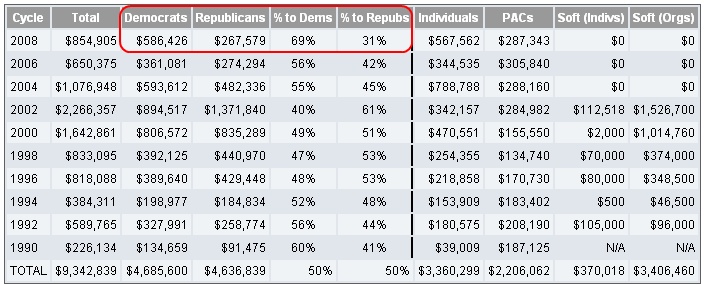
The first chart shows overall contributions, organized by election cycle and recipients' party. Until 1992, AIG contributions favored the Republicans, but since then, each election has tipped the balance even more in the Democrats' favor. In the just-concluded cycle, Democrats reaped 69% of AIG contributions.

(Click each image to enlarge)

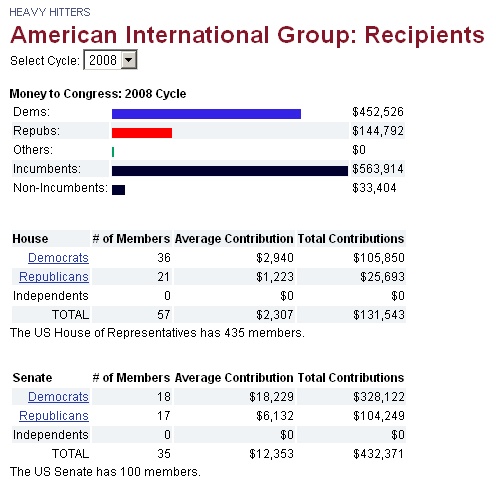
In congressional elections, Democrats took in over 75% of AIG contributions. Not surprising, since Democrats control both houses, and Congress holds life-or-death regulatory power over corporations like AIG.


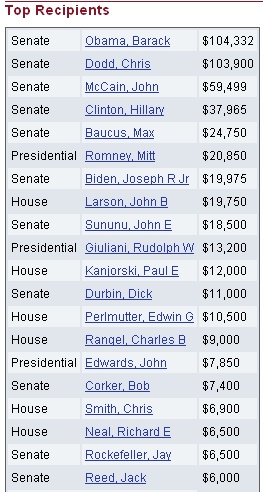
So, which members of Congress were the greatest benefactors of AIG largesse? Some familiar names top the list, all of them senators (at the time). The top recipients were also presidential candidates at one time or another in the cycle, so they naturally drew greater attention, with Barack Obama the clear winner in contributions.


Interestingly, close behind Obama in contributions was Senator Chris Dodd. Although his presidential campaign fizzled early, he still managed to far outpace the third-place recipient (McCain). There's no reason this should be puzzling. Dodd is chairman of the powerful Senate Banking, Housing and Urban Affairs Committee, which happens to have regulatory power over corporations like AIG.

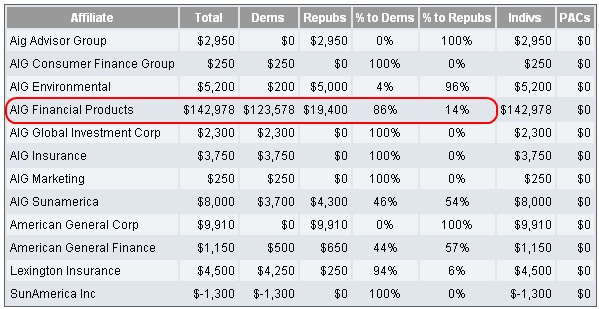
AIG's troubled Financial Products affiliate, where most of the corporation's hemorraghing has occurred, is responsible for the vast majority of employee contributions to Democrats, with that unit favoring the Dems 86%-14%. OpenSecrets doesn't detail the individual recipients of the Financial Products contributions, but simple logic dictates that Dodd was a prime beneficiary.


Perhaps Financial Products thought that it was getting its money's worth when Dodd included an amendment in the stimulus package specifically allowing companies like AIG to pay out contractually-obligated merit bonuses using bailout money.

Dodd, however, apparently felt like he had no choice but to join the dogpile of phony outrage when AIG went ahead and did what the Dodd amendment specifically authorized.

Sigh. What's this country coming to? It used to be that when businessmen bought a politician, he stayed bought.

March 17, 2009

Attempts to recover AIG bonuses via taxation are unconstitutional

Fox News reports on one popular idea bouncing around Congress as the torch-and-pitchfork mob tries to figure out a way to punish AIG for honoring their executive compensation contracts (emphasis added):
Senate and House lawmakers on Monday night returned to the idea of imposing heavy taxes to recover the bonus money.

"You can write a tax provision targeted specifically at 98 percent of the taxable proceeds," Dodd said, adding that it wouldn't violate the terms of the AIG contracts.

Rep. Carolyn Maloney D-N.Y, the chair of the Joint Economic Committee, also called for a 100 percent tax on bonuses not related to commissions. And Rep. Gary Peters, D-Mich., introduced a bill to recover practically all of the money through hefty taxes.

"If (AIG CEO Edward) Liddy does nothing, we will act and will take this money back and return it to its rightful owners, the American taxpayers. We will take this money back by taxing virtually all of it," Sen. Chuck Schumer, D-N.Y., said Tuesday. "So let the recipients of these large and unseemly bonuses, be warned. If you don't return it on your own, we will do it for you."

But while Dodd on Tuesday said lawmakers would continue to pursue this avenue, he added: "I don't know whether or not as a practical matter it will produce the kind of results we're looking for. We're all searching for a way to get this money back and one way or another we're going to figure out how to do it."

Nevertheless, Senate Majority Leader Harry Reid vowed to recover a sizeable chunk of the money.

"Remember, we, as a Congress, are not defenseless. We can also do things," the Nevada Democrat said Tuesday, announcing he has tasked Senate Finance Committee Chairman Max Baucus, D-Mont., with crafting a proposal to recover the bonuses.

Reid said Baucus "is going to make a proposal that I think will certainly send a message to you people at AIG and all others who try to benefit from the hardships the American people face ... AIG recipients of these bonuses will not be able to keep all their money, and that's an understatement."

Emotions are running at a fever pitch, and perhaps that's why our distinguished legislators have overlooked the simple fact that their taxation idea is unconstitutional.

One clause of Article I, Section 9 of the U.S. Constitution states simply: "No Bill of Attainder or ex post facto Law shall be passed." That section applies to the U.S. Congress. Section 10 extends the same prohibition to the states.

An ex post facto law retroactively criminalizes an activity that was legal at the time the activity occurred. The payment of the AIG bonuses certainly was legal, seeing that the payments were specifically authorized by those now pretending to be in a lather over them.

By attempting to seize the bonuses, Congress is in effect criminalizing the payments after the fact.


Not that Congress has been too keen on following the Constitution, but will any influential politician have the guts to stand up and point this out? Or will they, seeking to save their political skins, cower in the shadows?


UPDATE: On the Free Republic post of this article, someone noted that this idea also qualifies as an unconstitutional Bill of Attainder, since the proposed law in effect declares a specific group of people guilty of a crime, and punishes them without a trial.

Political hypocrites feign surprised outrage at AIG bonuses

President Obama and members of Congress say they are shocked -- shocked! -- that AIG would dare use stimulus money to pay executive bonuses.

The problem is that Congress passed, and Obama signed, the law specifically authorizing this.

From But As For Me:
Thanks to our stimulus spending bill search engine and browser, we discovered that Obama granted AIG a free legal pass to give high bonuses because of the following stipulation in Obama’s stimulus bill he personally orchestrated and signed into law:

From page H1412 of the Final Stimulus Bill, “SEC. 111. EXECUTIVE COMPENSATION AND CORPORATE GOVERNANCE:

“(iii) The prohibition required under clause (i) shall not be construed to prohibit any bonus payment required to be paid pursuant to a written employment contract executed on or before February 11, 2009, as such valid employment contracts are determined by the Secretary or the designee of the Secretary.”

This amendment provides an exception for contractually obligated bonuses agreed on before Feb. 11, 2009, which exempts the very AIG bonuses Obama is condemning every single chance he gets. The amendment is in the final version and is law.

Sen. Dodd was AIG’s largest single recipient of campaign donations during the 2008 election cycle with $103,100, according to opensecrets.org — According to the Wall Street Journal, Sen. Dodd placed this section into the final stimulus bill, making him responsible, along with Obama, for AIG receiving these bonuses.


As we saw earlier, the Democrats may be leading the torch-and-pitchfork mob, but some Republicans are tagging along as well.

No good will come of populist demagoguery like this. Shame on them all.

March 11, 2009

Premise of the Obama stimulus: Spend money on things that are unprofitable

From "Reality Check", the March 11 edition of the Daily Reckoning's daily e-newsletter [emphasis added]:
Meanwhile, Congress has gotten into the spirit of the Boondoggle Age. It sent a $410 billion spending bill to Obama for his signature. Included in the bill were 7,991 "earmarks," or pet projects that didn't make it into previous bailout, stimulus and boondoggles programs. Included in the spending bill, for example, is a program to pay for eyeglasses for people who are supposed to be blind...and to increase funding for Amtrak. The passenger train system has been losing money for as long as it has existed. According to classical economics (and plain good sense) Amtrak makes us all poorer. It takes valuable resources - labor, steel, electricity and so forth - and turns it into a service - transportation - which consumers judge to be worth less than the resources that went to provide it. Yet, that is the whole theory of the Obama stimulus program!  Spend money on things that are unprofitable. (If they were profitable, they wouldn't need public funding.) Somehow, wasting wealth is supposed to make us all better off.

February 25, 2009

Bernanke to borrowers: You picked a good time to take out an irresponsible loan

Let me get this right.

A borrower takes out a mortgage, knowing full well that he is buying more house than he can really afford in the long run.

Even in the best of economic times, this fellow stood a good chance of defaulting. But in the economic tsunami currently overwhelming the housing market, his mortgage is just one piece of debris among many.

Even though he, with premeditation, took out a loan that he knew he could not repay, should he have his fortunes restored at the expense of the taxpayers?

You betcha, says Federal Reserve Chairman Bernanke.

CNNMoney reports today:
Federal Reserve Chairman Ben Bernanke said Wednesday that the embattled housing market has crippled the economy, and at-risk homeowners need a bailout - even if they knew they couldn't afford their home in the first place.

"Some borrowers presumably knew what they were getting into," Bernanke said before the House Financial Services Committee. "But from a public policy point of view, the large amount of foreclosures are detrimental not just to the borrower and lender but to the broader system."

"In many of these situations we have to trade off the moral hazard issue against the greater good," he added.

Are we witnessing the abolition of personal responsibility in financial matters? For how long? Barney Frank agrees that "moral hazard needs to take a back seat for the time being". "For the time being" -- whatever that means.

That giant sucking sound you hear is the draining away of the livelihood of our children and grandchildren -- all of whom will be footing the bill for our current drunken spending spree:
"I'm worried that the [government's] policies will only delay the inevitable -- a full correction of the market -- while saddling future generations with trillions of dollars in debt," said Rep. Scott Garrett, R-N.J.

February 20, 2009

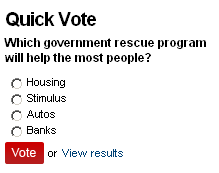
CNN 'rescue' poll assumes too much, misses half of story

CNN/Money is running the following online poll today:


At the moment, "Housing" has a significant lead at 52%, and it is not likely to give up its lead.

I'm amazed at how much is assumed by the poll question. For example, the assumption that all of the listed programs will 'help' people.

Sure, many individuals will be able to benefit from, say, a government-subsidized mortgage adjustment. But is that the whole story?

Where will the money for that mortgage adjustment come from? How many other people will be harmed (through the confiscation of their assets) so that this person can be helped?

What is the net number of people that will be helped by these bailouts? It's quite possible that the net will be negative.

I apologize. The only real negative here is my selfish attitude. I must remember the words of our soon-to-be dear leader when he taught us last October:
"My attitude is that if the economy's good for folks from the bottom up, it's gonna be good for everybody. I think when you spread the wealth around, it's good for everybody."
Never mind. I'm okay now. Forget I said anything.

February 19, 2009

Rick Santelli's most excellent rant on Obama's mortgage bailout

Updates at bottom of post:
  • Kudlow piles on
  • White House yelps
  • Santelli the rock star


There's quite a buzz on the 'net today about CNBC floor reporter Rick Santelli's inspired rant at the Chicago Board of Trade this morning. He not only tells it like it is regarding the folly of Obama's mortgage bailout, he does it in fine style.

Here's the transcript, thanks to Freedom Eden:
Transcript
RICK SANTELLI: The government is promoting bad behavior. Because we certainly don't want to put stimulus forth and give people a whopping $8 or $10 in their check, and think that they ought to save it, and in terms of modifications... I'll tell you what, I have an idea.

You know, the new administration's big on computers and technology-- How about this, President and new administration? Why don't you put up a website to have people vote on the Internet as a referendum to see if we really want to subsidize the losers' mortgages; or would we like to at least buy cars and buy houses in foreclosure and give them to people that might have a chance to actually prosper down the road, and reward people that could carry the water instead of drink the water?

TRADER ON FLOOR: That's a novel idea.

(Applause, cheering)

JOE KERNEN: Hey, Rick... Oh, boy. They're like putty in your hands. Did you hear...?

SANTELLI: No they're not, Joe. They're not like putty in our hands. This is America! How many of you people want to pay for your neighbor's mortgage that has an extra bathroom and can't pay their bills? Raise their hand.

(Booing)

President Obama, are you listening?

TRADER: How 'bout we all stop paying our mortgage? It's a moral hazard.

KERNEN: It's like mob rule here. I'm getting scared. I'm glad I'm...

CARL QUINTANILLA: Get some bricks and bats...

SANTELLI: Don't get scared, Joe. They're already scaring you. You know, Cuba used to have mansions and a relatively decent economny. They moved from the individual to the collective. Now, they're driving '54 Chevys, maybe the last great car to come out of Detroit.

KERNEN: They're driving them on water, too, which is a little strange to watch.

SANTELLI: There you go.

KERNEN: Hey Rick, how about the notion that, Wilbur pointed out, you can go down to 2% on the mortgage...

SANTELLI: You could go down to -2%. They can't afford the house.

KERNEN: ...and still have 40%, and still have 40% not be able to do it. So why are they in the house? Why are we trying to keep them in the house?

SANTELLI: I know Mr. Summers is a great economist, but boy, I'd love the answer to that one.

REBECCA QUICK: Wow. Wilbur, you get people fired up.

SANTELLI: We're thinking of having a Chicago Tea Party in July. All you capitalists that want to show up to Lake Michigan, I'm gonna start organizing.

(Whistling, cheering)

QUICK: What are you dumping in, what are you dumping in this time? Housing...?

SANTELLI: We're going to be dumping in some derivative securities. What do you think about that?

QUINTANILLA: Mayor Daley is marshalling the police right now.

KERNEN: Rabble-rouser.

QUINTANILLA: The National Guard.

After Jason Roney of Sharmac Capital makes some comments, it's back to Santelli.
QUINTANILLA: You know, Rick, one of our producers says if Roland Burris steps down, man, "Senator Santelli," the junior senator from Illinois. It's a possibility. I'm just saying...

SANTELLI: Do you think I want to take a shower every hour? The last place I'm ever gonna live or work is D.C.

KERNEN: Have you raised any money for Blago?

SANTELLI: No, but I think that somebody's gonna have to start raising money for us.

QUICK: Hey, Rick? Can you do that one more time, just get the mob behind you again?

QUINATILLA: Have the camera pull way out.

QUICK: Yeah, pull way out. Everybody listen to Rick Santelli.

KERNEN: He can't... I don't think... You can't just do it at will, can you Rick? I mean, you have to say something.

QUICK: No, do it at will. Let's see.

SANTELLI: Listen, all's I know is, is that there's only about 5% of the floor population here right now, and I talk loud enough they can all hear me. So if you want to ask 'em anything, let me know. These guys are pretty straight forward, and my guess is, a pretty good statistical cross-section of America, the silent majority.

QUICK: Not so silent majority today. So Rick, are they opposed to the housing thing, to the stimulus package, to everything out there?

SANTELLI: You know, they're pretty much of the notion that you can't buy your way into prosperity, and if the multiplier that all of these Washington economists are selling us is over... that we never have to worry about the economy again. The government should spend a trillion dollars an hour because we'll get 1.5 trillion back.

WILBUR ROSS: Rick, I congratulate you on your new incarnation as a revolutionary leader.

SANTELLI: Somebody needs one. I'll tell you what, if you read our founding fathers, people like Benjamin Franklin and Jefferson,... What we're doing in this country now is making them roll over in their graves.
-----
UPDATE: Lawrence Kudlow followed up with a good rant of his own on Thursday:
President Obama’s massive mortgage-bailout plan is nothing more than a thinly disguised entitlement program that redistributes income from the responsible 92 percent of home-owning mortgage holders who pay their bills on time to the irresponsible defaulters who bought more than they could ever afford. This is Obama’s spread-the-wealth program in action.

Team Obama is rewarding bad behavior. It is enlarging moral hazard. It is expanding its welfarist approach to economic policy. And with a huge expansion of government-owned zombie lenders Fannie Mae and Freddie Mac, Team Obama is taking a giant step toward nationalizing the mortgage market.
-----
UPDATE: The Obama administration is certainly not feelin' the love, as Politico reports:
The White House is lashing out publicly and personally at a CNBC reporter whose attack on President Barack Obama’s anti-foreclosure plan caught fire on the Internet on Thursday.

White House press secretary Robert Gibbs jumped at the chance to go after the CNBC journalist, Rick Santelli, when a question about his bracing critique was asked at Friday’s news briefing.

“I’ve watched Mr. Santelli on cable the past 24 hours or so. I’m not entirely sure where Mr. Santelli lives or in what house he lives but the American people are struggling every day to meet their mortgages, stay in their jobs, pay their bills, send their kids to school,” Gibbs said. “I think we left a few months ago the adage that if it was good for a derivatives trader that it was good for Main Street. I think the verdict is in on that,” the press secretary said, poking directly at the cable journalist, who reports from the trading floor at the Chicago Board of Trade.

Gibbs insisted Santelli was misinformed when he said Obama’s program would amount to a transfer of money from prudent taxpayers to those who had taken reckless risks.
So, Mr. Gibbs... If the money is not coming from the prudent taxpayers, where is it coming from?

-----
UPDATE: CNBC's Becky Quick notes the response to Santelli's outburst:
"Dear CNBC,
Santelli is the man.
good day,
aston
p.s. The rest of you are morons."

That's an actual e-mail that a viewer just sent us, at 11:22 this morning. There are about 5,000 others just like it that have flooded our e-mail box since yesterday morning, when Rick Santelli issued the shot heard round the world. And that's just in the Squawk e-mail box. Close to 1.4 million people have relived the moment on CNBC.com ... hundreds of thousands more have checked out bootleg copies on YouTube and other Web sites.

February 13, 2009

Abomination of Legislation passes House without GOP support -- Not entirely noble, but still the right choice

ABC News today:
The House passed the $787 billion economic stimulus bill by a vote of 246-183, although a week of negotiations and lobbying by President Obama failed to convince a single Republican to support the bill.

Instead of voting for the gargantuan package of tax cuts and public works spending, key Republicans made last ditch speeches denouncing the bill. Seven Democrats also voted against it.
House Minority Leader John Boehner, in explaining GOP opposition to the bill, says something rather curious:

"It's disappointing the way this process has worked, and the outcome," House Minority Leader John Boehner, waving the bulky report in his hands, said on the House floor. "Bad process leads to bad policy and that's what we have in my view. ... I hope it works but I surely have my doubts. ... This is the epitome of what I came here to stop."

"I'm going to vote no and I'm going to hope that next time. ... You'll include us and you'll include our ideas," the Ohio Republican said, clearly addressing Democratic leaders.

Am I reading this correctly? Is Boehner saying that this abomination of legislation is the result of bad process? That if, somehow, the Republicans and their ideas had been included in the process, they wouldn't be united in opposition?

Suppose that House Dems had included the Republicans, and that many Republican "ideas" ended up being included in the final bill -- let's say the final result was 40% Republican ideas and 60% Democrat ideas. Would the 40% the Republicans got be enough to get them to vote Yea, in spite of the mindboggling shortcomings of the 60% the Democrats got?

If you've got a better "spin" on Boehner's remarks, I'd love to hear it.

And now, it's on to the Senate, where it's almost certain that the GOP opposition will not be unanimous.

What Congress thinks qualifies for emergency funding

Senate Minority Leader Mitch McConnell highlights some of the lowlights of the "stimulus" bill. Apparently, things like these are so critical to our economy's survival that, as President Obama assures us, "we don't have a moment to spare" in rushing this bill into law.

Taxpayers Take Home “$8 A Week” While They Pay Billions For Golf Cart Tax Breaks, New Cars For Government Bureaucrats, ACORN-Eligible Block Grants, Fish Hatcheries, An Arts Endowment, And The Census

*** Due to the unfinished nature of the product currently available for review on the House Rules Committee website, page numbers are likely to change.

• Tax Benefits For Golf Carts, Electric Motorcycles and ATVs: (Pg. 60 of the Tax Division of Conference Report, lines 9-16, “(2) SPECIFIED VEHICLE.—The term ‘specified vehicle’ means any vehicle which—‘‘(A) is a low speed vehicle within the meaning of section 571.3 of title 49, Code of Federal Regulations (as in effect on the date of the enactment of the American Recovery and Reinvestment Tax Act of 2009), or ‘‘(B) has 2 or 3 wheels.”)

• $300 Million For Federal Employee Company Cars: (Pg. 90 of the Appropriations Division of the Conference Report, lines 7-13, “For capital expenditures and necessary expenses of acquiring motor vehicles with higher fuel economy, including: hybrid vehicles; electric vehicles; and commercially-available, plug-in hybrid vehicles, $300,000,000, to remain available until September 30, 2011”)

• $1 Billion For ACORN-Eligible Block Grants: (Pg. 261 of the Appropriations Division of the Conference Report, lines 11-18, “For an additional amount for “Community Development Fund” $1,000,000,000 to remain available until September 30, 2010 to carry out the community development block grant program under title I of the Housing and Community Development Act of 1974 (42 U.S.C. 5301 et seq.)”)

• $50 Million For An Arts Endowment: (Pg. 143 of the Appropriations Division of the Conference Report, lines 11-25, and lines 1-3 of Pg. 144, “For an additional amount for “Grants and Administration”, $50,000,000, to be distributed in direct grants to fund arts projects and activities which preserve jobs in the non-profits arts sector threatened by declines in philanthropic and other support during the current economic downturn: Provided, That 40 percent of such funds shall be distributed to State arts agencies and regional arts organizations in manner similar to the agency’s current practice and 60 percent of such funds shall be for competitively selected arts projects and activities according to sections 2 and 5(c) of the National Foundation on the Arts and Humanities Act of 1965 (20 U.S.C. 951, 954(c)): Provided further, That matching requirements under section 5(e) of such Act shall be waived.”)

• $165 Million For Fish Hatcheries: (Pg. 133 of the Appropriations Division of the Conference Report, lines 21-25, and lines 1-2 of Pg. 134, For an additional amount for “Resource Management”, for deferred maintenance, construction, and capital improvement projects on national wildlife refuges and national fish hatcheries and for high priority habitat restoration projects, $165,000,000.”)

• $1 Billion For The Census: (Pg. 36 of the Appropriations Division of the Conference Report, lines 1-4, Bureau of the Census, Periodic Censuses and Programs. For an additional amount for “Periodic Censuses and Programs,” $1,000,000,000.”)

TAXPAYERS LEFT WITH “ABOUT $8 A WEEK”

ASSOCIATED PRESS: “Next year, the measure could yield workers about $8 a week.” (“Economic stimulus package on track for final votes,” Associated Press, 02/12/09)

(Via Red State)

Another reason to fear Friday the 13th


How appropriate that on Friday the 13th -- a day associated by many with ill fortune -- Congress is preparing to pass an $800 BILLION "stimulus" bill that is in reality little more than an attempt to stimulate the reelection chances of our senators and representatives (via strategic bribery of the electorate).

Our congressfolks are undoubtedly intimately aware of the sections in the 1000-page bill that are directly related to their pet projects, but it is also quite likely that they have little significant knowledge of everything else that is in there. But, as CNSNews reports today, that won't stop many of them from voting for it [typos in original]:
Sen. Frank Lautenberg (D-N.J.) predicted on Thursday that none of his Senate colleagues would "have the chance" to read the entire final version of the $790-billion stimulus bill before the bill comes up for a final vote in Congress.

“No, I don’t think anyone will have the chance to [read the entire bill],” Lautenberg told CNSNews.com.

The final bill, crafted by a House-Senate conference committee, was posted on the Website of the House Appropriations Committe late Thurday in two PDF files.

[...] Both Republicans and Democrats told CNSNews.com they were eager to read the unseen bill--once they could get get their hands on a copy of the final legislation.

Nonetheless, members from both sides of the aisle in both the House and Senate admitted they doubted they would have adequate time to read the bill before they actually voted for it.

“Certainly I hope to have the opportunity to go through [the bill] before the vote takes place,” said Sen. Bob Corker (R-Tenn.) told CNSNews.com. “But that’s something I’ve found doesn’t always happen around here.”
Whether from principle or from the fact that this gives them political cover, some Republicans have stated this as one of the reasons they will vote against "Porkulus" (one of the popular derogatory nicknames for the bill on the internet: pork + stimulus = porkulus).

Whatever their reason for voting against, more power to them. This bill must die.


UPDATE: For good measure, here's what Rep. John Shadegg has to say about it over at RedState:
How fitting is it that the stimulus bill is coming to a strong-arm vote on Friday the 13th?

This entire process has been a horror story. The exclusion of Republicans. The pork and paybacks for special interests. The secret, closed-door meetings. The mammoth bill text kept hidden until hours before the vote.

But of course the greatest horror is not the process – it is the product. At the end of the day we have an economic stimulus without economic stimulus. A recovery package that the non-partisan Congressional Budget Office says will shrink the GDP. An historic transfer of wealth and power to the federal government – which the government has no plans of returning to the people.

Commonsense Americans have been expressing their concern, frustration and outrage for weeks. But Nancy Pelosi and Harry Reid – and yes, President Obama – have not listened.

With the clock ticking before this vote, we must continue sounding the alarm. We must raise our voices. We may lose the day – but do not let history record that we went down without a fight.

Congressional Switchboard: (202) 224-3121