C-Poll

The latest C-Poll is closed. You can read all about it here!

Showing posts with label Eco-Nannies. Show all posts

January 19, 2015

DNA, GMOs, and the Left's dilemma

io9 reports January 18 on a fascinating study by Oklahoma State University:
A recent survey conducted by the Oklahoma State University Department of Agricultural Economics found that 80.44% of respondents supported a government policy mandating labels on foods containing DNA. Not GMOs. DNA, the genetic material contained in every living thing known to science and practically every food, GMO or otherwise.
The results smack of satire, but they're real. The Food Demand Survey (FooDs) is an online poll of a representative sample of the U.S. population, conducted every month by Oklahoma State agricultural economist Jayson Lusk and research specialist Susan Murray. The most recent month's survey included a question regarding the institution of government policies concerning food. The results, which you can read in full here, indicate that "a large majority (82%) support mandatory labels on GMOs." What's curious, note Lusk and Murray, is that roughly "the same amount (80%) also support mandatory labels on foods containing DNA."
Even though the survey's sampling method does not appear to be ideal, the result does seem to reflect the human social tendency to jump onto issue bandwagons with little or no factual knowledge of the issues.  If someone we know and admire (be it a friend or some celebrity) is passionately for or against something, it's easy and natural to tag along.

There is a common superstition that all "chemicals" in food are bad.  "DNA" sounds like a chemical (which, of course, it is), so you bet I want to be informed when chemicals with ominous-sounding three-letter acronyms are present in my food!  Indeed, many who embrace the concept of "organic" foods seem to think that it is too much work to ponder the scientific pros and cons of various additives that have been part of our food supply for generations.

The GMO (Genetically Modified Organism) controversy is another good example of hysteria driven by scientific illiteracy.  Foods with one or more GMO ingredients have been dubbed "Frankenfoods" -- a reference to Frankenstein's monster -- by many activists.  I doubt they wish us to carry the analogy too far, given that the townspeople's reaction to the creature was irrational and emotion-driven.  The analogy the activists WANT us to take from the story is the notion that we must never tamper with nature, ever, for any reason.  A large majority of Americans are emotionally drawn to this argument, which almost certainly accounts for the fact that 82% support the proposed GMO labeling requirement, despite the fact that there is little or no scientific evidence that any of the GMOs approved for consumption are harmful to humans in any way.

To me, the curious twist to the anti-GMO crusade is that its activist core appears to reside in to the part of the political left boasting an average education level higher than that of the general population.  They have every reason to be familiar with the scientific truth behind GMOs, but they're the ones that appear to be driving the emotional opposition.

How can this be?  Some on the right are fond of observing that when Soviet communism collapsed, unreconstructed Marxists in the west appear to have adopted the environmental movement as the platform for continuing the advancement of their socioeconomic agenda.  There is strong circumstantial evidence to support this notion.  First, the environmental movement started to blossom dramatically even as the dust was still settling from the collapse of the communist bloc. Second -- and this is more significant to me -- virtually every policy prescription advanced to solve the environmental crisis du jour happens to align perfectly with the socioeconomic goals of the Marxist left: crippling regulation, punishing taxation, global wealth redistribution, etc.

This also appears to be the underbelly of the activist left's opposition to GMOs: it's driven by ideology, not by science illiteracy.  You see, GMOs can be patented...by corporations!  If we allow GMOs into our food supply, that benefits greedy capitalists.  So, even if someone comes up with something like "golden rice", which has a scientifically demonstrable benefit to human health, it must be opposed at all costs


The dilemma for the educated activists on the left is that their numbers aren't anywhere near what is needed to successfully advance their anticapitalist agenda, so they have no choice but to harness the ignorance of those whose convictions about food are driven more by superstition than by facts.  Thus, even though these activists often scorn the scientific illiteracy of average Americans, expediency keeps their mouths shut as GMO myths continue to run rampant in the mass media, in blogs, and on Facebook.


December 9, 2009

EPA declares plant food to be a public health threat

[Cross-posted from C-Pol’s companion site, The Global Warming Heretic]

A bit late in reporting on this, but hey, this is a blog, not a news service.  But just for the record, here’s what happened on Monday, as reported by the Associated Press:
The Obama administration took a major step Monday toward imposing the first federal limits on climate-changing pollution from cars, power plants and factories, declaring there was compelling scientific evidence that global warming from manmade greenhouse gases endangers Americans' health.
Does anyone else see a logical disconnect here?  Not the Environmental Protection Agency, because they’ve consciously named carbon dioxide a dangerous pollutant.  A gas that occurs naturally, the existence of which is essential for plant life – is a dangerous pollutant.

And notice – only “manmade” carbon dioxide seems to be capable of causing global warming.  Oh, and how is it a danger to public health?  They don’t say here, but it’s obvious that they’re playing the Six Degrees game.

So, what kind of powers has the EPA amassed for itself by this “finding”?  The article gives us a taste:
The price could be steep for both industry and consumers. The EPA finding clears the way for rules that eventually could force the sale of more fuel-efficient vehicles and require plants to install costly new equipment — at a cost of billions or even many tens of billions of dollars — or shift to other forms of energy.
It almost certainly goes beyond this.  If human generated carbon dioxide emissions are as dangerous as the EPA says they are, there is no logical or moral reason why the EPA shouldn’t extend its regulatory tentacles into every aspect of our lives.

In other words, this finding will serve as the greatest mechanism ever devised for state control of American people and resources, all in complete, deliberate mockery of the constitutional limits on the powers of the federal government.

It’s almost as if that was the plan.

September 19, 2009

“Cash for Clunkers” was never about economic stimulus

The Boston Globe reports today that – surprise! – President Obama’s “Cash for Clunkers” program did little good for (and perhaps will end up doing harm to) those it purported to benefit:
It has been nearly a month since the car-buying frenzy of the Cash for Clunkers program ended, and many area auto dealers are longing for the good old days of July and August.
Like consumers nationwide, Massachusetts residents rushed to take advantage of the federal voucher program, which offered them up to $4,500 on old gas-guzzlers to be put toward the purchase of new, more fuel-efficient vehicles. About $65 million worth of vouchers were handed out statewide during the monthlong program that ended Aug. 24.
But once the federal money dried up, so did the sales rally. Now, customers at dealerships like Silko Honda in Raynham are few and far between, and inventory is once again accumulating.
Manager Adam Silverleib said business was “pretty intense’’ as a result of the federal stimulus program, with the dealership hustling to accommodate customers and handle the piles of paperwork required for them to receive reimbursement on vouchers. “Now we’re kind of back to where we were in the spring,’’ he said.
In an attempt to draw customers back to showrooms, some dealers are offering new incentives, albeit none as enticing as a $4,500 for a rusting junker. Silko, for example, is promoting 2.9 percent financing on new Accords, along with other deals on its website.
Nationwide, customers snatched up 700,000 new cars, most of them foreign-made, and the government ended up paying out nearly $3 billion toward the purchases. But from the start, analysts predicted that Cash for Clunkers would not boost sales for the year. September’s sales swoon seems to be making their case. Car sales are usually slow after Labor Day, but because of the recession consumers this year are especially reluctant to say yes to major purchases. To make matters worse for dealers, most are still waiting for voucher reimbursements.
“It was probably, in the end, a complete waste of taxpayer money,’’ said John Wolkonowicz, a senior auto analyst at IHS Global Insight, Lexington forecasting firm. “The dealers, who were supposed to be the primary beneficiaries, many were forced into cash flow problems because the government didn’t pay them in a timely fashion.’’
The Globe, in describing the typical C4C trade-in as a “rusting junker”, is misrepresenting reality. A significant number of the trade-ins were in good working order.
Without the C4C program, many (if not most) of the 700,000 purchasers would not have bought a new car this year. Instead, money that would have remained unspent (because consumers were reluctant to make a major purchase in this economy) or that would have been spent on other sectors of the economy ended up being reallocated to these purchases.  How many of these purchasers went even further into debt to take advantage of an irresistible offer? 
So, economically speaking, the C4C program didn’t really do any favors for anyone but those who were already planning to buy a car this year.
What about the dealers? C4C made its appearance in the midst of an economy where the public simply wasn’t interested in buying new cars. There’s no denying that the dealers were hurting.
Setting aside the C4C administrative problems (denied or delayed reimbursements), times were briefly good for the dealers. As the Globe excerpt above shows, a lot of stale inventory was moved off the lots.
But the demand was completely artificial, and once the incentives ended, the dealerships became ghost towns again. This was little more than the burst of energy that comes with a sugar rush, and now the post-sugar crash has come.
In the long term, C4C did not do the dealers (or the manufacturers they represent) any favors.
What about the economically disadvantaged? Even with the incentives, they were still pretty much priced out of the market.  If they want to have their own wheels, they still have to go the used-car route.
But wait! Nearly three-quarters of a million cars that would have been destined for used car lots were deliberately destroyed, regardless of condition! Used car inventories are down, driving up the prices of the used cars that remain.
Far from doing the disadvantaged buyers any favors, C4C may have ended up putting a car even further out of reach for them.
So. Cui bono? Who benefits?
No doubt, the president expected to reap a political benefit from appearing to help those who are suffering in the current economy, but…
He could have done this without requiring that every trade-in be destroyed.
Cash For Clunkers was never about economic stimulus, but rather about the Obama administration’s “green” agenda, which is predicated on the unproven assumption that mankind’s activities are deleteriously affecting our planet’s climate.
There are many on the environmental left who believe that eliminating private ownership of automobiles is a good first step toward restoring the balance between man and nature.  This idea appears to have found fertile soil among some members of the Obama administration.
It may seem far-fetched to suspect the administration of working toward this goal, but think about it: If someone wanted to eliminate private ownership of cars, and he wanted to do it in a way that wouldn’t be politically disastrous, how would he do it differently?
The problems created or exacerbated by the C4C program won’t be obvious until later, and by then Obama will be able to shift the blame elsewhere.
(Credits: Photos found here and here)
-----
9/21 UPDATE: A commenter reminded me of another prominent victim of the C4C program: charities that rely on used-car donations.  See, for example, this August 9 USA Today article.

July 12, 2009

Mark Steyn: Environmentalism and health care are perfect instruments of despotic rule

Excerpt from a July 11 Mark Steyn essay (emphasis added):
Beginning with FDR, wily statists justified the massive expansion of federal power under ever more elastic definitions of the commerce clause. For Obama-era control freaks, the environment and health care are the commerce clause supersized. They establish the pretext for the regulation of everything: If the government is obligated to cure you of illness, it has an interest in preventing you from getting ill in the first place — by regulating what you eat, how you live, the choices you make from the moment you get up in the morning. Likewise, if everything you do impacts “the environment,” then the environment is an all-purpose umbrella for regulating everything you do. It’s the most convenient and romantic justification for what the title of Paul Rahe’s new book rightly identifies as “soft despotism.”

April 1, 2009

When dish detergents are outlawed, only outlaws will have clean dishes

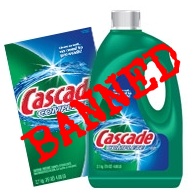
Eco-nannies in Spokane County, Washington thought they had scored a major victory when the county banned the sale of detergents containing more than 0.5% phosphates. This eliminated popular brands like Cascade and Electrasol, and left consumers with brands that supposedly are more eco-friendly but are not so popular.

The reason these eco-friendly brands aren't popular is....

...wait for it....

...they don't actually clean your dishes.

This flies in the face of altogether reasonable customer expectations about dishwasher detergents. The outcome was predictable. Associated Press, March 28:
The quest for squeaky-clean dishes has turned some law-abiding people in Spokane into dishwater-detergent smugglers. They are bringing Cascade or Electrasol in from out of state because the eco-friendly varieties required under Washington state law don't work as well. Spokane County became the launch pad last July for the nation's strictest ban on dishwasher detergent made with phosphates, a measure aimed at reducing water pollution. The ban will be expanded statewide in July 2010, the same time similar laws take effect in several other states.

But it's not easy to get sparkling dishes when you go green.

Many people were shocked to find that products like Seventh Generation, Ecover and Trader Joe's left their dishes encrusted with food, smeared with grease and too gross to use without rewashing them by hand. The culprit was hard water, which is mineral-rich and resistant to soap.

As a result, there has been a quiet rush of Spokane-area shoppers heading east on Interstate 90 into Idaho in search of old-school suds.
The ban will be expanded to the entire state next year, so look for a thriving black market to develop, thanks to entrepreneurs who are willing (for a small fee, natch) to save people the inconvenience of having to drive to Idaho.

This law has a loophole big enough to drive a contraband-laden truck through it: only the sale of such detergents is banned. It's still legal to drive outside the ban zone, buy some Cascade, and bring it home.

The ban's chief proponents acknowledge that the law is easily and routinely bypassed. Easy prediction: Eco-nannies hate it when the general public doesn't take them seriously, so it won't be long before the loophole is closed.

Then, whenever you get invited to a dinner party in Washington, if your food is served on a clean plate, just wink at the host and keep your mouth shut.

"Psst! Did you see the plates and glasses? Do you think they...?"
"Hush
, sweetheart. Don't ask, don't tell."