 |
| Via Being Libertarian (Facebook) |
Showing posts with label Free Market Interference. Show all posts
Showing posts with label Free Market Interference. Show all posts
December 16, 2017

February 5, 2015
The fatal shortcoming of Obama's proposal for free community college for all
A February 4 op-ed in the Wall Street Journal notes that Obama's "free community college" proposal ignores a fundamental, immutable economic principle:
The spirit behind President Obama’s recent proposal to make community college free is understandable, but he has fallen victim to the fallacy of composition. He has made the mistake of believing that if one person benefits from an action, then everyone else who takes the same action will also benefit. Economics teaches us otherwise.Unless our economy magically creates positions for this excess supply of labor, what we'll end up with is overtrained restaurant workers.
Although getting an associate degree or some college education at a community college may benefit any one person, in the aggregate a policy that increases the supply of people with associate degrees can backfire unless it has been designed to fill an existing excess demand. Otherwise such a policy will merely exacerbate an existing excess supply of labor with that level of educational attainment.
October 24, 2013
Obamacare: Just wait until it's the only choice
When a private company provides a mediocre product, customers can "punish" the company by denying it their business. Are we sure we want to entrust our lives and health to a bureaucracy that will pay no penalty for being wrong?
I ask because the Affordable Care Act in its current form is almost certainly not the end game of our current president and his fellow travelers. Once we get to single-payer health care in this country, we will have no alternative but to endure debacles like the online health insurance marketplace which, despite three years of work and half a billion dollars of investment, should not have gone live earlier this month.
Washington Post, October 21:
I ask because the Affordable Care Act in its current form is almost certainly not the end game of our current president and his fellow travelers. Once we get to single-payer health care in this country, we will have no alternative but to endure debacles like the online health insurance marketplace which, despite three years of work and half a billion dollars of investment, should not have gone live earlier this month.
Washington Post, October 21:
Days before the launch of President Obama’s online health insurance marketplace, government officials and contractors tested a key part of the Web site to see whether it could handle tens of thousands of consumers at the same time. It crashed after a simulation in which just a few hundred people tried to log on simultaneously.
Despite the failed test, federal health officials plowed ahead.
When the Web site went live Oct. 1, it locked up shortly after midnight as about 2,000 users attempted to complete the first step, according to two people familiar with the project.
As new details emerged about early warning signs of serious deficiencies in HealthCare.gov, Obama on Monday gave a consumer-friendly defense of the health-care law, insisting that the problems many Americans have faced in trying to enroll in insurance plans will be fixed quickly.
March 29, 2012
How San Francisco’s $10.24 minimum wage hurts the people it allegedly helps
NBC Bay Area, March 29 brings us another example of the tyranny of good intentions:
Signs posted at Subway sandwich shops sadly inform San Francisco patrons -- we hear Willie Brown is a big fan -- that "all SUBWAY Restaurants in SF County DO NOT PARTICIPATE IN Subway National $5.00 Promotions," according to the newspaper.Apparently the economic concept is too difficult for the compassionate left to grasp: Raising the minimum wage also raises the cost of items sold at businesses that employ minimum-wage workers. As these workers go out and spend their raise, the extra income is consumed by the price increases, and the employees are not much better off than they were before.
[…] Apparently, the city's new minimum wage, raised to $10.24 as of Jan. 1, make $5 footlongs an impossible business model.
When employers are allowed to pay wages at a level where each employee’s labor is a net economic benefit to the business, prices remain stable (absent other upward pressures on costs, such as government regulations or taxes).
The best way for a low-wage employee to better his life is to make himself more valuable to his employer through merit, or to get some training and find a better job. When he does that, and the employer has the freedom to pay the employee what his labor is worth, everybody wins.
January 4, 2011
Further proof that ObamaCare is not about health care: New law effectively bans new physician-owned hospitals
Weekly Standard, January 3:
Under the headline, "Construction Stops at Physician Hospitals," Politico reports today that "Physician Hospitals of America says that construction had to stop at 45 hospitals nationwide or they would not be able to bill Medicare for treatments." Stopping construction at doctor-owned hospitals might not seem like the best way to boost the economy or to promote greater access and choice in health care, but that exactly what Obamacare is doing.
Kenneth Artz of the Heartland Institute explains, "Section 6001 of the health care law effectively bans new physician-owned hospitals (POHs) from starting up, and it keeps existing ones from expanding." Politico adds, "Friday [New Year's Eve] marked the last day physician-owned hospitals could get Medicare certification covering their new or expanded hospitals, one of the latest provisions of the reform law to go into effect."
December 9, 2010
Quick Quote: James Madison on the federal leviathan
“It will be of little avail to the people, that the laws are made by men of their own choice, if the laws be so voluminous that they cannot be read, or so incoherent that they cannot be understood; if they be repealed or revised before they are promulgated, or undergo such incessant changes that no man, who knows what the law is to-day, can guess what it will be to-morrow. Law is defined to be a rule of action; but how can that be a rule, which is little known, and less fixed?”
— James Madison, The Federalist #62
— James Madison, The Federalist #62
November 4, 2010
San Francisco food nannies know what’s best for the city’s remaining children
San Francisco has long been the gathering place for people who aren’t interested in having children. Thus, it was with some surprise that I read this week about an action taken by the San Francisco Board of Supervisors to manage the restaurant food choices of families with young children.
Los Angeles Times, November 2:
Given that SF officials don’t appear to have much experience raising real-life kids, allow me to clue them in: The availability of toys in a kids meal affects the choice of restaurant much more than it affects the choice of food.
The Center for Consumer Freedom adds that this is more about the parents’ choices than it is about the kids’ choices:
with some surprise that I read this week about an action taken by the San Francisco Board of Supervisors to manage the restaurant food choices of families with young children.Los Angeles Times, November 2:
San Francisco's board of supervisors has voted, by a veto-proof margin, to ban most of McDonald's Happy Meals as they are now served in the restaurants.Supervisor Eric Mar, who sponsored the measure, described it in magnificently Orwellian fashion:
The measure will make San Francisco the first major city in the country to forbid restaurants from offering a free toy with meals that contain more than set levels of calories, sugar and fat.
The ordinance would also require restaurants to provide fruits and vegetables with all meals for children that come with toys.
“We're part of a movement that is moving forward an agenda of food justice.”Well, if this is all about “food justice”, we can’t let ourselves be sidetracked by petty issues like the right of parents to make informed choices about their children’s diet.
Given that SF officials don’t appear to have much experience raising real-life kids, allow me to clue them in: The availability of toys in a kids meal affects the choice of restaurant much more than it affects the choice of food.
The Center for Consumer Freedom adds that this is more about the parents’ choices than it is about the kids’ choices:
But there’s nothing wrong with the occasional fast food dinner. And that much has always been up to parental discretion: It’s not very often you see a child hop in the car, drive to McDonald’s, and charge a Happy Meal to his own credit card. Yet San Francisco seems to think parents are no match for the “I’m Lovin’ It” jingle.The supervisors seem well aware of the ridicule their nannying efforts are provoking around the country. Nevertheless, they hope their action will end up starting a cascade that ends up undermining parental rights everywhere. From the L.A. Times article linked above:
Supervisor Bevan Dufty, whose swing vote provided the veto-proof majority, said critics should not dismiss the legislation as a nutty effort by San Franciscans. "I do believe the industry is going to take note of this. I don't care how much they say, 'It's San Francisco, they're wacked out there.' "It’s San Francisco—they’re wacked out there. We’re not buying into their nutty efforts.
July 23, 2010
MSM starting to report on the “unintended consequences” of Obamacare
“Unintended consequences” – a phrase almost certain to become clichéd in the coming months and years as people and businesses start digging into (and reacting to) the deepest, darkest parts of the new health care law.
AP reports July 23 that the law is already starting to have a negative impact on one class of people:
The law is almost certainly riddled with landmines like this. The average congressperson can neither confirm nor deny this, primarily because the average congressperson hasn’t actually read the law he or she voted to enact.Some major health insurance companies have stopped issuing certain types of policies for children, an unintended consequence of President Barack Obama's health care overhaul law, state officials said Friday.
Florida Insurance Commissioner Kevin McCarty said in his state UnitedHealthcare and Blue Cross Blue Shield have stopped issuing new policies that cover children individually. Oklahoma Insurance Commissioner Kim Holland said a couple of local insurers in her state have done likewise.
[…] Starting later this year, the health care overhaul law requires insurers to accept children regardless of medical problems — a major early benefit of the complex legislation. Insurers are worried that parents will wait until kids get sick to sign them up, saddling the companies with unpredictable costs.
[…] "Our plans are very concerned about this," said Alissa Fox, a top Washington lobbyist for the Blue Cross Blue Shield Association. "If the law says that insurers have to take you any time, any place, some people will see that as an opportunity to wait until their children get sick to buy coverage."
There is nothing in the law that would stop a hospital from buying a policy for a uninsured child who came into the emergency room, she added.
June 23, 2010
“Cash for Clunkers”, revisited: New home sales plunge to lowest level on record

Sales of new homes collapsed in May, sinking 33 percent to the lowest level on record as potential buyers stopped shopping for homes once they could no longer receive government tax credits.
The bleak report from the Commerce Department is the first sign of how the expiration of federal tax credits could affect the nation's housing market.
The credits expired April 30. That's when a new-home buyer would have had to sign a contract to qualify.
"We fear that the appetite to buy a home has disappeared alongside the tax credit," Paul Dales, U.S. economist with Capital Economics," wrote in a note. "After all, unemployment remains high, job security is low and credit conditions are tight."
Sound familiar? Last summer, the “Cash for Clunkers” program created an artificially high demand for automobiles, almost certainly spurring purchases by people who otherwise wouldn’t have (or shouldn’t have) done so. Once the C4C program ended, auto sales dropped through the floor.
Here we go again. The federal tax credits for new home purchases is gone, and sales have dropped to a level never before seen in the 47 years that the government has been tracking this statistic.
Just like we saw with C4C, it is likely that many who bought a home in recent months should not have done so. How many of them will be in foreclosure in just a few short years?
Remember these examples each time you are told that we’re in the midst of an economic recovery.
Given the fresh storm clouds gathering on the horizon, now may not be the best time to buy a home, with or without a tax credit incentive.
March 26, 2010
Quick Quote: Milton Friedman on why business is none of the government’s business
“The economic miracle that has been the United States was not produced by socialized enterprises, by government-union-industry cartels or by centralized economic planning. It was produced by private enterprises in a profit-and-loss system. And losses were at least as important in weeding out failures as profits in fostering successes. Let government succor failures, and we shall be headed for stagnation and decline.”
-- Milton Friedman
March 23, 2010
Quick Quote: Frédéric Bastiat on wealth redistribution
There’s an abundance of data supporting this from the experience of Communist societies, but certain western academics and politicians remain convinced that the problem resides in the execution of the philosophy, not in the philosophy itself.
If it were to be asserted on principle, admitted in practice, sanctioned by law, that every man has a right to the property of another, the gift would have no merit—charity and gratitude would be no longer virtues. Besides, such a doctrine would suddenly and universally arrest labor and production, as severe cold congeals water and suspends animation; for who would work if there was no longer to be any connection between labor and the satisfying of our wants?Feel free to draw your own applications to the financially destructive, liberty-smothering health care boondoggle that just passed.
-- Frédéric Bastiat, Essays on Political Economy
March 10, 2010
That giant sucking sound you hear…
…is your hard-earned money going into the coffers of the federal government and into the pockets of those who do business (directly or indirectly, through contracts or lobbying) with the federal government.
Washington Examiner, March 10:
Here are the rankings, according to Forbes.6 of the 10 richest counties in U.S. are in DC area
Loudoun ranks as the richest county in the United States, immediately followed by Fairfax and Howard counties, while Montgomery, traditionally one of the wealthiest, is now 10th.
Forbes magazine ranked eight other Washington-area counties in its list of the nation's 25 wealthiest counties, far more than any other area in the country. The rankings are based on 2008 median household income data from the U.S. Census Bureau.
Loudoun's median household income was $110,643, while Fairfax's was $106,785 and Howard's came in at $101,710.
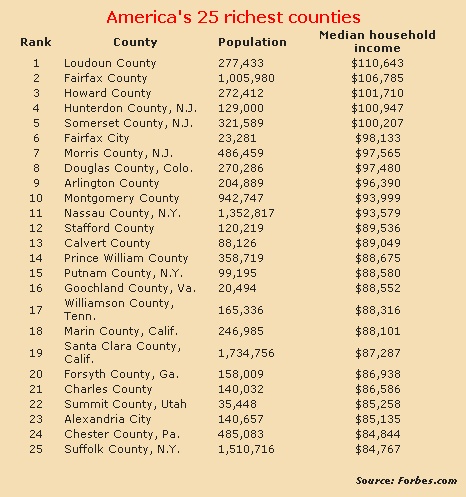
In my youth my family lived in four of the top ten counties, but we certainly dragged the median down in each case.
February 4, 2010
Modern liberals probably wouldn’t give the time of day to a classical liberal
I tend to call myself a constitutionalist conservative, but my views on government and liberty align quite nicely with what was once known as liberalism.
"A [classical] liberal is fundamentally fearful of concentrated power. His objective is to preserve the maximum degree of freedom for each individual separately that is compatible with one man's freedom not interfering
with other men's freedom. He believes that this objective requires that power be dispersed. He is suspicious of assigning to government any functions that can be performed through the market, both because this substitutes coercion for voluntary cooperation in the area in question and because, by giving government an increased role, it threatens freedom in other areas."
— Milton Friedman
Reference: Capitalism and Freedom (U. of Chicago Press, 1962), p. 39
December 9, 2009
Obama administration intends to rule by fiat if Congress doesn’t submit?
[Cross-posted from C-Pol’s companion site, The Global Warming Heretic]
According to a Fox News story today, administration officials acknowledge privately that the EPA’s newly-claimed powers allow the executive branch to function as a dictatorship if it so chooses.
And that economic chaos is a virtual certainty if the administration resorts to fiat rule through the EPA. Who would want to invest in an economy where regulations are changing suddenly and radically (and almost always to the detriment of businesses)?
According to a Fox News story today, administration officials acknowledge privately that the EPA’s newly-claimed powers allow the executive branch to function as a dictatorship if it so chooses.
The Obama administration is warning Congress that if it doesn't move to regulate greenhouse gases, the Environmental Protection Agency will take a "command-and-control" role over the process in a way that could hurt business.So. Obama would prefer that Congress take the actions that the administration demands of it. But if Congress fails to get its act together, the administration will publicly hold Congress responsible for the economic chaos that will follow.
The warning, from a top White House economic official who spoke Tuesday on condition of anonymity, came on the eve of EPA Administrator Lisa Jackson's address to the international conference on climate change in Copenhagen, Denmark.
Jackson, however, tried to strike a tone of cooperation in her address Wednesday, explaining that the EPA's new powers to regulate greenhouse gases will be used to complement legislation pending in Congress, not replace it.
"This is not an 'either-or' moment. It's a 'both-and' moment," she said.
But while administration officials have long said they prefer Congress take action on climate change, the economic official who spoke with reporters Tuesday night made clear that the EPA will not wait and is prepared to act on its own.
And it won't be pretty.
"If you don't pass this legislation, then ... the EPA is going to have to regulate in this area," the official said. "And it is not going to be able to regulate on a market-based way, so it's going to have to regulate in a command-and-control way, which will probably generate even more uncertainty."
And that economic chaos is a virtual certainty if the administration resorts to fiat rule through the EPA. Who would want to invest in an economy where regulations are changing suddenly and radically (and almost always to the detriment of businesses)?
September 19, 2009
“Cash for Clunkers” was never about economic stimulus
 The Boston Globe reports today that – surprise! – President Obama’s “Cash for Clunkers” program did little good for (and perhaps will end up doing harm to) those it purported to benefit:
It has been nearly a month since the car-buying frenzy of the Cash for Clunkers program ended, and many area auto dealers are longing for the good old days of July and August.The Globe, in describing the typical C4C trade-in as a “rusting junker”, is misrepresenting reality. A significant number of the trade-ins were in good working order.
Like consumers nationwide, Massachusetts residents rushed to take advantage of the federal voucher program, which offered them up to $4,500 on old gas-guzzlers to be put toward the purchase of new, more fuel-efficient vehicles. About $65 million worth of vouchers were handed out statewide during the monthlong program that ended Aug. 24.
But once the federal money dried up, so did the sales rally. Now, customers at dealerships like Silko Honda in Raynham are few and far between, and inventory is once again accumulating.
Manager Adam Silverleib said business was “pretty intense’’ as a result of the federal stimulus program, with the dealership hustling to accommodate customers and handle the piles of paperwork required for them to receive reimbursement on vouchers. “Now we’re kind of back to where we were in the spring,’’ he said.
In an attempt to draw customers back to showrooms, some dealers are offering new incentives, albeit none as enticing as a $4,500 for a rusting junker. Silko, for example, is promoting 2.9 percent financing on new Accords, along with other deals on its website.
Nationwide, customers snatched up 700,000 new cars, most of them foreign-made, and the government ended up paying out nearly $3 billion toward the purchases. But from the start, analysts predicted that Cash for Clunkers would not boost sales for the year. September’s sales swoon seems to be making their case. Car sales are usually slow after Labor Day, but because of the recession consumers this year are especially reluctant to say yes to major purchases. To make matters worse for dealers, most are still waiting for voucher reimbursements.
“It was probably, in the end, a complete waste of taxpayer money,’’ said John Wolkonowicz, a senior auto analyst at IHS Global Insight, Lexington forecasting firm. “The dealers, who were supposed to be the primary beneficiaries, many were forced into cash flow problems because the government didn’t pay them in a timely fashion.’’
Without the C4C program, many (if not most) of the 700,000 purchasers would not have bought a new car this year. Instead, money that would have remained unspent (because consumers were reluctant to make a major purchase in this economy) or that would have been spent on other sectors of the economy ended up being reallocated to these purchases. How many of these purchasers went even further into debt to take advantage of an irresistible offer?
So, economically speaking, the C4C program didn’t really do any favors for anyone but those who were already planning to buy a car this year.
What about the dealers? C4C made its appearance in the midst of an economy where the public simply wasn’t interested in buying new cars. There’s no denying that the dealers were hurting.
Setting aside the C4C administrative problems (denied or delayed reimbursements), times were briefly good for the dealers. As the Globe excerpt above shows, a lot of stale inventory was moved off the lots.
But the demand was completely artificial, and once the incentives ended, the dealerships became ghost towns again. This was little more than the burst of energy that comes with a sugar rush, and now the post-sugar crash has come.
In the long term, C4C did not do the dealers (or the manufacturers they represent) any favors.
What about the economically disadvantaged? Even with the incentives, they were still pretty much priced out of the market. If they want to have their own wheels, they still have to go the used-car route.
But wait! Nearly three-quarters of a million cars that would have been destined for used car lots were deliberately destroyed, regardless of condition! Used car inventories are down, driving up the prices of the used cars that remain.
Far from doing the disadvantaged buyers any favors, C4C may have ended up putting a car even further out of reach for them.
So. Cui bono? Who benefits?
No doubt, the president expected to reap a political benefit from appearing to help those who are suffering in the current economy, but…
He could have done this without requiring that every trade-in be destroyed.
Cash For Clunkers was never about economic stimulus, but rather about the Obama administration’s “green” agenda, which is predicated on the unproven assumption that mankind’s activities are deleteriously affecting our planet’s climate.
 There are many on the environmental left who believe that eliminating private ownership of automobiles is a good first step toward restoring the balance between man and nature. This idea appears to have found fertile soil among some members of the Obama administration.
It may seem far-fetched to suspect the administration of working toward this goal, but think about it: If someone wanted to eliminate private ownership of cars, and he wanted to do it in a way that wouldn’t be politically disastrous, how would he do it differently?
The problems created or exacerbated by the C4C program won’t be obvious until later, and by then Obama will be able to shift the blame elsewhere.
(Credits: Photos found here and here)
-----
9/21 UPDATE: A commenter reminded me of another prominent victim of the C4C program: charities that rely on used-car donations. See, for example, this August 9 USA Today article.
July 20, 2009
Visualizing the cost of the government’s economic “rescue” plan
 The inspector general for the Troubled Assets Relief Program (TARP) is preparing to submit a report to Congress tomorrow estimating the ultimate cost of all of the financial bailouts currently underway and in the works. Fox News reports IG Neil Barofsky’s stunning prediction in a July 20 article (emphasis added):
The total price tag for federal support stemming from the financial crisis could reach $23.7 trillion in the long run, the government's top bailout watchdog says in a new report to Congress.Almost 24 trillion dollars!
Neil Barofsky, the inspector general for the Troubled Asset Relief Program, plans to deliver his report Tuesday to the House Oversight and Government Reform Committee.
The $23.7 trillion figure is admittedly a high-ball number and reflects the total potential gross exposure, but Barofsky in his prepared testimony notes that the TARP -- which started as a $700 billion bailout -- has expanded well beyond that.
[…] In supporting documentation obtained by FOXNews.com, the inspector general's office explains that the $23.7 trillion spans about 50 "initiatives or programs" created by federal agencies in the wake of the economic crisis.
The estimate covers commitments that could come from programs at the Federal Reserve, Treasury Department, Federal Deposit Insurance Corporation, the Federal Housing Finance Agency, the Federal Housing Administration, the Department of Veterans Affairs and other agencies.
Chances are that few of us have had reason to try to get our minds around a number that big, so let’s go through a little visualization exercise.
A stack of 3000 newly-printed one-dollar bills stands about a foot tall*. To get the height of 23.7 trillion one-dollar bills, the math looks like this:
23,700,000,000,000 ÷ 3,000 = 7,900,000,000 feet
7.9 billion feet is about 1,496,212 miles. The moon is about 238,857 miles from earth; this stack of money is 6.26 times that distance.Viewed another way, a dollar bill is about six inches long*. 23.7 trillion one-dollar bills laid end-to-end would stretch 11.85 trillion feet, or about 2.24 million miles, almost 9400 times the distance from the earth to the moon.
Where is this money coming from, folks? Of course, a lot of it will be created out of thin air, but the rest of it will be sucked out of the economy in the name of saving it.
* Dollar bill length and stack height estimates are from 87billion.com, a site established a few years ago to help us visualize the amount of money spent in the War on Terror. The site, however, is woefully inadequate for helping us visualize the cost of the bailout, since the money spent on the war to date is just under $900 billion, a number that used to be impressive.
UPDATE: Here's another visualization of what one trillion dollars looks like. Just multiply the final image by 23.7. (Thanks to jellybean for the link)
July 9, 2009
Federal minimum wage increase is a kick in the gut to businesses that are already hurting
Later this month the third of three increases in the federal minimum wage will go into effect.
Businesses that depend on minimum-wage employees are already feeling the effects of the economic slowdown. They’re already skating on the edge of profitability, and it seems that a sudden spike in labor costs may sink many businesses, or at least make it very difficult for them to hire new employees.
To retain existing workers, employers may have no choice but to balance the increased labor costs by cutting back on hours, resulting in an empty victory for employees.
In the current economic climate, it would be bad business to pass the increased costs to customers whose budgets are growing ever tighter.
This month’s minimum wage increase was scheduled in 2007, long before the current crisis was apparent. How hard would it be for Congress to admit that the timing is bad, and postpone the increase until a time when the retail sector isn’t so fragile?
N.B. I’ve long been on record as opposing the very idea of a mandated minimum wage. I haven’t wavered on that issue. This essay is dealing with reality as it is, not reality as I wish it would be.
July 7, 2009
Americans deserve to know how much protectionism and subsidies are costing them
I agree with Sallie James at Cato – this idea is pretty good. The Atlantic’s James Gibney thinks we could use a little education about why the products we buy cost what they do [emphasis added]:
Before you start spooning up your next bowl of Frosted Flakes, ponder this: driven partly by the demand for ethanol, the price of the corn in your flakes is about 40 percent higher than it was a few years ago; the sugar easily cost you more than double the world price; and your milk is at least 15 percent more expensive than it would be in many other countries.
Americans pay much more than they should for their food. Thanks to a thicket of subsidies and tariffs that support American farmers and tilt the growing field against cheaper foreign producers, we get ripped off twice: first as taxpayers who ante up for roughly $25 billion in agricultural subsidies each year ($4 billion for milk alone in 2006); then as consumers who pay higher prices at the checkout counter because we can't take advantage of low-price imports.
[…]
So, how can we get more Americans to look up from their feedbags and demand that Congress restore some sense to the marketplace? I recommend a little truth-in-packaging. Just as food manufacturers now list their products' ingredients and nutritional value, they should also disclose their "free-market" value.
To wit, every product whose ingredients benefit from a subsidy should include the following language on the label:
"This product has been subsidized by the U.S. government at taxpayer expense. For more information, please visit usda.gov."
And every product that benefits from tariff protection should have the following language on the label:
"This product is protected from foreign competition by U.S. import tariffs. Its price is higher as a result. For more information, please visit usitc.gov."
Subscribe to:
Posts (Atom)