 |
| Via Being Libertarian (Facebook) |
Showing posts with label Business. Show all posts
Showing posts with label Business. Show all posts
December 16, 2017

February 22, 2016
The FBI v Apple
I'm not a big fan of Apple in general, but props to them for their principled refusal to open Pandora's Box by creating a custom version of the OS that bypasses the security features on the San Bernardino terrorist's iPhone.
There's no such thing as a one-time crack. Even if the government itself doesn't exploit the cracked version of the OS (and they'd hardly miss an opportunity to exploit it), it's not unlikely that it will escape into the wild somehow.
There's no such thing as a one-time crack. Even if the government itself doesn't exploit the cracked version of the OS (and they'd hardly miss an opportunity to exploit it), it's not unlikely that it will escape into the wild somehow.
 |
| Image Source |
July 31, 2015
The anticapitalist left's ironic dependence on the fruits of capitalism (cont'd)
Illustrated marvelously in this Banksy canvas wall print available at... drum roll, please... Walmart:


May 22, 2015

February 5, 2015
The fatal shortcoming of Obama's proposal for free community college for all
A February 4 op-ed in the Wall Street Journal notes that Obama's "free community college" proposal ignores a fundamental, immutable economic principle:
The spirit behind President Obama’s recent proposal to make community college free is understandable, but he has fallen victim to the fallacy of composition. He has made the mistake of believing that if one person benefits from an action, then everyone else who takes the same action will also benefit. Economics teaches us otherwise.Unless our economy magically creates positions for this excess supply of labor, what we'll end up with is overtrained restaurant workers.
Although getting an associate degree or some college education at a community college may benefit any one person, in the aggregate a policy that increases the supply of people with associate degrees can backfire unless it has been designed to fill an existing excess demand. Otherwise such a policy will merely exacerbate an existing excess supply of labor with that level of educational attainment.
March 29, 2012
How San Francisco’s $10.24 minimum wage hurts the people it allegedly helps
NBC Bay Area, March 29 brings us another example of the tyranny of good intentions:
Signs posted at Subway sandwich shops sadly inform San Francisco patrons -- we hear Willie Brown is a big fan -- that "all SUBWAY Restaurants in SF County DO NOT PARTICIPATE IN Subway National $5.00 Promotions," according to the newspaper.Apparently the economic concept is too difficult for the compassionate left to grasp: Raising the minimum wage also raises the cost of items sold at businesses that employ minimum-wage workers. As these workers go out and spend their raise, the extra income is consumed by the price increases, and the employees are not much better off than they were before.
[…] Apparently, the city's new minimum wage, raised to $10.24 as of Jan. 1, make $5 footlongs an impossible business model.
When employers are allowed to pay wages at a level where each employee’s labor is a net economic benefit to the business, prices remain stable (absent other upward pressures on costs, such as government regulations or taxes).
The best way for a low-wage employee to better his life is to make himself more valuable to his employer through merit, or to get some training and find a better job. When he does that, and the employer has the freedom to pay the employee what his labor is worth, everybody wins.
February 21, 2011
Business-hostile California spurs economic growth... in neighboring Arizona and Oregon
Reuters reported February 18 that California-based Intel is planning to invest up to $8 BILLION in new manufacturing facilities in Arizona and Oregon. I wonder why they didn't think it worthwhile to invest the money a little closer to home base?
Intel Corp plans to build a $5 billion, cutting-edge microchip factory in Arizona by 2013, sharply ramping up its U.S. manufacturing capacity as part of a major global expansion.I'm sure that California's neighbors will be happy if the state keeps making it hard for businesses to do business there.
The state-of-the-art plant, which will crank out microchips with next-generation 14 nanometer line-widths, is expected to bring thousands of jobs to the cash-strapped western U.S. state, which is offering more incentives to lure businesses.
[...] Intel said in October it plans to spend $6 billion to $8 billion on high-tech manufacturing facilities in Arizona and Oregon, creating as many as 8,000 construction jobs.
January 10, 2011
Chevy Volt, "Car of the Year"? About as meaningless as an Academy Award

The Volt's selection for the Car of the Year award wasn't much of a surprise. Reviews by the automotive press have largely praised the vehicle's design, and the Volt has taken several other awards already, including Motor Trend magazine's Car of the Year.The auto industry declaring an automobile to be critically acclaimed is about as meaningful as the film industry awarding honors to various of its own products.
Oscar-winning movies often end up being complete duds with the unwashed masses. I'm sure that we philistines will fail to get sucked in by the hype swirling around the Car of the Year as well.
November 4, 2010
San Francisco food nannies know what’s best for the city’s remaining children
San Francisco has long been the gathering place for people who aren’t interested in having children. Thus, it was with some surprise that I read this week about an action taken by the San Francisco Board of Supervisors to manage the restaurant food choices of families with young children.
Los Angeles Times, November 2:
Given that SF officials don’t appear to have much experience raising real-life kids, allow me to clue them in: The availability of toys in a kids meal affects the choice of restaurant much more than it affects the choice of food.
The Center for Consumer Freedom adds that this is more about the parents’ choices than it is about the kids’ choices:
with some surprise that I read this week about an action taken by the San Francisco Board of Supervisors to manage the restaurant food choices of families with young children.Los Angeles Times, November 2:
San Francisco's board of supervisors has voted, by a veto-proof margin, to ban most of McDonald's Happy Meals as they are now served in the restaurants.Supervisor Eric Mar, who sponsored the measure, described it in magnificently Orwellian fashion:
The measure will make San Francisco the first major city in the country to forbid restaurants from offering a free toy with meals that contain more than set levels of calories, sugar and fat.
The ordinance would also require restaurants to provide fruits and vegetables with all meals for children that come with toys.
“We're part of a movement that is moving forward an agenda of food justice.”Well, if this is all about “food justice”, we can’t let ourselves be sidetracked by petty issues like the right of parents to make informed choices about their children’s diet.
Given that SF officials don’t appear to have much experience raising real-life kids, allow me to clue them in: The availability of toys in a kids meal affects the choice of restaurant much more than it affects the choice of food.
The Center for Consumer Freedom adds that this is more about the parents’ choices than it is about the kids’ choices:
But there’s nothing wrong with the occasional fast food dinner. And that much has always been up to parental discretion: It’s not very often you see a child hop in the car, drive to McDonald’s, and charge a Happy Meal to his own credit card. Yet San Francisco seems to think parents are no match for the “I’m Lovin’ It” jingle.The supervisors seem well aware of the ridicule their nannying efforts are provoking around the country. Nevertheless, they hope their action will end up starting a cascade that ends up undermining parental rights everywhere. From the L.A. Times article linked above:
Supervisor Bevan Dufty, whose swing vote provided the veto-proof majority, said critics should not dismiss the legislation as a nutty effort by San Franciscans. "I do believe the industry is going to take note of this. I don't care how much they say, 'It's San Francisco, they're wacked out there.' "It’s San Francisco—they’re wacked out there. We’re not buying into their nutty efforts.
June 23, 2010
If corporate earnings appear to be improving right now…
…it may very well be that businesses are shifting as much income and production as possible to this year. Arthur Laffer writes in the Wall Street Journal June 6:
On or about Jan. 1, 2011, federal, state and local tax rates are scheduled to rise quite sharply. President George W. Bush's tax cuts expire on that date, meaning that the highest federal personal income tax rate will go 39.6% from 35%, the highest federal dividend tax rate pops up to 39.6% from 15%, the capital gains tax rate to 20% from 15%, and the estate tax rate to 55% from zero. Lots and lots of other changes will also occur as a result of the sunset provision in the Bush tax cuts.
Tax rates have been and will be raised on income earned from off-shore investments. Payroll taxes are already scheduled to rise in 2013 and the Alternative Minimum Tax (AMT) will be digging deeper and deeper into middle-income taxpayers. And there's always the celebrated tax increase on Cadillac health care plans. State and local tax rates are also going up in 2011 as they did in 2010. Tax rate increases next year are everywhere.
Now, if people know tax rates will be higher next year than they are this year, what will those people do this year? They will shift production and income out of next year into this year to the extent possible. As a result, income this year has already been inflated above where it otherwise should be and next year, 2011, income will be lower than it otherwise should be.
Laffer believes that allowing the tax cuts to expire will result in an economic collapse next year that will dwarf what we’ve seen so far. To be sure, a sudden, massive tax increase in the middle of a weak economy will not end well.
April 17, 2010
Government-authored spyware – what a great idea!

Tom’s Guide reports:
Big Brother is watching you. Actually, it's the RIAA and the MPAA, especially if you're parked on a BitTorrent client. The Electronic Frontier Foundation reports that both organizations--along with a few others--want to take the file-monitoring process a huge step further by infiltrating consumer PCs and deleting the infringing content off their hard drives. How? Through "anti-infringement" spyware developed and enforced by the government.
This is no joke.
"There are several technologies and methods that can be used by network administrators and providers...these include [consumer] tools for managing copyright infringement from the home (based on tools used to protect consumers from viruses and malware)," reads a caption in a joint comment (pdf) filed by the MPAA and RIAA.
The joint comment goes on to suggest other means of copyright enforcement including a mandatory scan on all internet connections to interdict transfers of illegal content, physical searches at all borders of personal media players, laptops, and USB sticks. There's even an indication that the parties want to enforce international bullying to force other countries to put similar policies in place.
A couple of observations are in order.
First, the only reason the RIAA and MPAA could even dream of getting the federal government to do something like this is that they know the fedgov recognizes no meaningful limits on its power. Industries take advantage of this fact all of the time – using the government as a bludgeon against one’s competitors has become a time-honored tradition in this country – but the RIAA/MPAA proposal goes beyond what we normally see.
Many people who will complain that this is an unconstitutional invasion of privacy and a denial of due process will, the next day, demand that the government provide health care, jobless benefits, welfare, etc. We can’t have it both ways. Either the federal government is bound by the U.S. Constitution, or it isn’t.
Second, is there any real difference between government-authored spyware on our computers and government-installed surveillance cameras in our homes? Both would have the same official purpose – crime prevention. I wonder if RIAA and MPAA executives would consent to government video surveillance of their mansions, “just in case” they decided to do something illegal.
March 26, 2010
Quick Quote: Milton Friedman on why business is none of the government’s business
“The economic miracle that has been the United States was not produced by socialized enterprises, by government-union-industry cartels or by centralized economic planning. It was produced by private enterprises in a profit-and-loss system. And losses were at least as important in weeding out failures as profits in fostering successes. Let government succor failures, and we shall be headed for stagnation and decline.”
-- Milton Friedman
March 23, 2010
Big Nanny stands ready to criticize your food choices
AP (via Yahoo) reports on one of the mandates buried in the health care “reform” signed today by the president:
So, what’s the next phase of the campaign? How about “informed consent”? Customers will not receive their food until they sign a form affirming that they are aware of the calorie impact of their meal.

But what if customers STILL won’t make good food choices? Is it really outlandish to predict that the government will eventually start regulating the maximum calorie content of restaurant meals?
One last thought: as the above excerpt shows, only restaurant chains with 20 or more locations are subject to the labeling requirements. This means that obese people can continue to patronize local non-chain restaurants in blissful (and deadly, if you believe the nannies) ignorance, regardless of the gastronomical atrocities on said restaurants’ menus.
This is an implicit acknowledgment of the fact that compliance with these regulations is awfully expensive. But, if we accept the notion of the federal government as our food-choice nanny, we cannot protest when the regulations are eventually made universal, even at the expense of the financial stability of our favorite local eatery. As Hillary Clinton famously said in 1994 regarding the financial impact of the Clinton administration’s attempt to nationalize the health care industry: “I can't be responsible for every undercapitalized small business in America.”
A requirement tucked into the massive U.S health care bill will make calorie counts impossible for thousands of restaurants to hide and difficult for consumers to ignore. More than 200,000 fast food and other chain restaurants will have to include calorie counts on menus, menu boards and even drive-throughs.“The idea is to make sure that customers process the calorie information as they are ordering.” But what if, despite the new labeling, the customer still ignores the calorie information? The administration (led by Gen. Michelle Obama) has declared war on obesity, so I can’t imagine it standing by idly as customers continue to order the foods they like.
The new law, which applies to any restaurant with 20 or more locations, directs the Food and Drug Administration to create a new national standard for menu labeling, superseding a growing number of state and city laws. President Barack Obama signed the health care legislation Tuesday.
The idea is to make sure that customers process the calorie information as they are ordering. Many restaurants currently post nutritional information in a hallway, on a hamburger wrapper or on their Web site. The new law will make calories immediately available for most items.
"The nutrition information is right on the menu or menu board next to the name of the menu item, rather than in a pamphlet or in tiny print on a poster, so that consumers can see it when they are making ordering decisions," says Sen. Tom Harkin, chairman of the Health, Education, Labor and Pensions Committee, who wrote the provision.
So, what’s the next phase of the campaign? How about “informed consent”? Customers will not receive their food until they sign a form affirming that they are aware of the calorie impact of their meal.
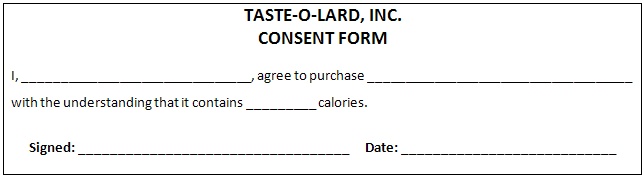
But what if customers STILL won’t make good food choices? Is it really outlandish to predict that the government will eventually start regulating the maximum calorie content of restaurant meals?
One last thought: as the above excerpt shows, only restaurant chains with 20 or more locations are subject to the labeling requirements. This means that obese people can continue to patronize local non-chain restaurants in blissful (and deadly, if you believe the nannies) ignorance, regardless of the gastronomical atrocities on said restaurants’ menus.
This is an implicit acknowledgment of the fact that compliance with these regulations is awfully expensive. But, if we accept the notion of the federal government as our food-choice nanny, we cannot protest when the regulations are eventually made universal, even at the expense of the financial stability of our favorite local eatery. As Hillary Clinton famously said in 1994 regarding the financial impact of the Clinton administration’s attempt to nationalize the health care industry: “I can't be responsible for every undercapitalized small business in America.”
March 10, 2010
That giant sucking sound you hear…
…is your hard-earned money going into the coffers of the federal government and into the pockets of those who do business (directly or indirectly, through contracts or lobbying) with the federal government.
Washington Examiner, March 10:
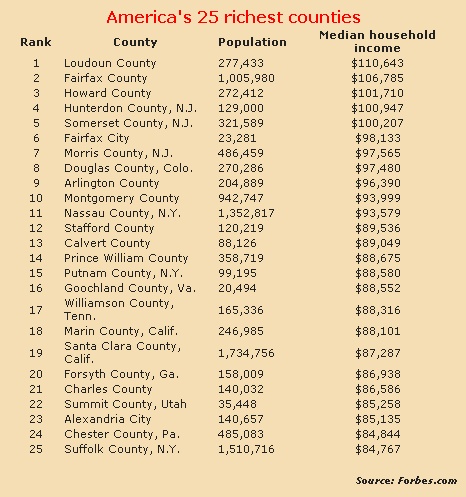
Here are the rankings, according to Forbes.6 of the 10 richest counties in U.S. are in DC area
Loudoun ranks as the richest county in the United States, immediately followed by Fairfax and Howard counties, while Montgomery, traditionally one of the wealthiest, is now 10th.
Forbes magazine ranked eight other Washington-area counties in its list of the nation's 25 wealthiest counties, far more than any other area in the country. The rankings are based on 2008 median household income data from the U.S. Census Bureau.
Loudoun's median household income was $110,643, while Fairfax's was $106,785 and Howard's came in at $101,710.
In my youth my family lived in four of the top ten counties, but we certainly dragged the median down in each case.
September 19, 2009
“Cash for Clunkers” was never about economic stimulus
 The Boston Globe reports today that – surprise! – President Obama’s “Cash for Clunkers” program did little good for (and perhaps will end up doing harm to) those it purported to benefit:
It has been nearly a month since the car-buying frenzy of the Cash for Clunkers program ended, and many area auto dealers are longing for the good old days of July and August.The Globe, in describing the typical C4C trade-in as a “rusting junker”, is misrepresenting reality. A significant number of the trade-ins were in good working order.
Like consumers nationwide, Massachusetts residents rushed to take advantage of the federal voucher program, which offered them up to $4,500 on old gas-guzzlers to be put toward the purchase of new, more fuel-efficient vehicles. About $65 million worth of vouchers were handed out statewide during the monthlong program that ended Aug. 24.
But once the federal money dried up, so did the sales rally. Now, customers at dealerships like Silko Honda in Raynham are few and far between, and inventory is once again accumulating.
Manager Adam Silverleib said business was “pretty intense’’ as a result of the federal stimulus program, with the dealership hustling to accommodate customers and handle the piles of paperwork required for them to receive reimbursement on vouchers. “Now we’re kind of back to where we were in the spring,’’ he said.
In an attempt to draw customers back to showrooms, some dealers are offering new incentives, albeit none as enticing as a $4,500 for a rusting junker. Silko, for example, is promoting 2.9 percent financing on new Accords, along with other deals on its website.
Nationwide, customers snatched up 700,000 new cars, most of them foreign-made, and the government ended up paying out nearly $3 billion toward the purchases. But from the start, analysts predicted that Cash for Clunkers would not boost sales for the year. September’s sales swoon seems to be making their case. Car sales are usually slow after Labor Day, but because of the recession consumers this year are especially reluctant to say yes to major purchases. To make matters worse for dealers, most are still waiting for voucher reimbursements.
“It was probably, in the end, a complete waste of taxpayer money,’’ said John Wolkonowicz, a senior auto analyst at IHS Global Insight, Lexington forecasting firm. “The dealers, who were supposed to be the primary beneficiaries, many were forced into cash flow problems because the government didn’t pay them in a timely fashion.’’
Without the C4C program, many (if not most) of the 700,000 purchasers would not have bought a new car this year. Instead, money that would have remained unspent (because consumers were reluctant to make a major purchase in this economy) or that would have been spent on other sectors of the economy ended up being reallocated to these purchases. How many of these purchasers went even further into debt to take advantage of an irresistible offer?
So, economically speaking, the C4C program didn’t really do any favors for anyone but those who were already planning to buy a car this year.
What about the dealers? C4C made its appearance in the midst of an economy where the public simply wasn’t interested in buying new cars. There’s no denying that the dealers were hurting.
Setting aside the C4C administrative problems (denied or delayed reimbursements), times were briefly good for the dealers. As the Globe excerpt above shows, a lot of stale inventory was moved off the lots.
But the demand was completely artificial, and once the incentives ended, the dealerships became ghost towns again. This was little more than the burst of energy that comes with a sugar rush, and now the post-sugar crash has come.
In the long term, C4C did not do the dealers (or the manufacturers they represent) any favors.
What about the economically disadvantaged? Even with the incentives, they were still pretty much priced out of the market. If they want to have their own wheels, they still have to go the used-car route.
But wait! Nearly three-quarters of a million cars that would have been destined for used car lots were deliberately destroyed, regardless of condition! Used car inventories are down, driving up the prices of the used cars that remain.
Far from doing the disadvantaged buyers any favors, C4C may have ended up putting a car even further out of reach for them.
So. Cui bono? Who benefits?
No doubt, the president expected to reap a political benefit from appearing to help those who are suffering in the current economy, but…
He could have done this without requiring that every trade-in be destroyed.
Cash For Clunkers was never about economic stimulus, but rather about the Obama administration’s “green” agenda, which is predicated on the unproven assumption that mankind’s activities are deleteriously affecting our planet’s climate.
 There are many on the environmental left who believe that eliminating private ownership of automobiles is a good first step toward restoring the balance between man and nature. This idea appears to have found fertile soil among some members of the Obama administration.
It may seem far-fetched to suspect the administration of working toward this goal, but think about it: If someone wanted to eliminate private ownership of cars, and he wanted to do it in a way that wouldn’t be politically disastrous, how would he do it differently?
The problems created or exacerbated by the C4C program won’t be obvious until later, and by then Obama will be able to shift the blame elsewhere.
(Credits: Photos found here and here)
-----
9/21 UPDATE: A commenter reminded me of another prominent victim of the C4C program: charities that rely on used-car donations. See, for example, this August 9 USA Today article.
July 9, 2009
Federal minimum wage increase is a kick in the gut to businesses that are already hurting
Later this month the third of three increases in the federal minimum wage will go into effect.
Businesses that depend on minimum-wage employees are already feeling the effects of the economic slowdown. They’re already skating on the edge of profitability, and it seems that a sudden spike in labor costs may sink many businesses, or at least make it very difficult for them to hire new employees.
To retain existing workers, employers may have no choice but to balance the increased labor costs by cutting back on hours, resulting in an empty victory for employees.
In the current economic climate, it would be bad business to pass the increased costs to customers whose budgets are growing ever tighter.
This month’s minimum wage increase was scheduled in 2007, long before the current crisis was apparent. How hard would it be for Congress to admit that the timing is bad, and postpone the increase until a time when the retail sector isn’t so fragile?
N.B. I’ve long been on record as opposing the very idea of a mandated minimum wage. I haven’t wavered on that issue. This essay is dealing with reality as it is, not reality as I wish it would be.
July 7, 2009
Americans deserve to know how much protectionism and subsidies are costing them
I agree with Sallie James at Cato – this idea is pretty good. The Atlantic’s James Gibney thinks we could use a little education about why the products we buy cost what they do [emphasis added]:
Before you start spooning up your next bowl of Frosted Flakes, ponder this: driven partly by the demand for ethanol, the price of the corn in your flakes is about 40 percent higher than it was a few years ago; the sugar easily cost you more than double the world price; and your milk is at least 15 percent more expensive than it would be in many other countries.
Americans pay much more than they should for their food. Thanks to a thicket of subsidies and tariffs that support American farmers and tilt the growing field against cheaper foreign producers, we get ripped off twice: first as taxpayers who ante up for roughly $25 billion in agricultural subsidies each year ($4 billion for milk alone in 2006); then as consumers who pay higher prices at the checkout counter because we can't take advantage of low-price imports.
[…]
So, how can we get more Americans to look up from their feedbags and demand that Congress restore some sense to the marketplace? I recommend a little truth-in-packaging. Just as food manufacturers now list their products' ingredients and nutritional value, they should also disclose their "free-market" value.
To wit, every product whose ingredients benefit from a subsidy should include the following language on the label:
"This product has been subsidized by the U.S. government at taxpayer expense. For more information, please visit usda.gov."
And every product that benefits from tariff protection should have the following language on the label:
"This product is protected from foreign competition by U.S. import tariffs. Its price is higher as a result. For more information, please visit usitc.gov."
Subscribe to:
Posts (Atom)