C-Poll

The latest C-Poll is closed. You can read all about it here!

Showing posts with label Federalism. Show all posts

January 25, 2017

President Donald J. Trump, champion of the Constitution

Not.


Please cite the section of the Constitution which grants the federal government the power to "send in the Feds" to combat crime that is manifestly a local law enforcement issue.  If the local police can't get a handle on it, any escalation of the issue is the responsibility of the state of Illinois.

The federal government can't step in unless it turns into insurrection.

November 6, 2013

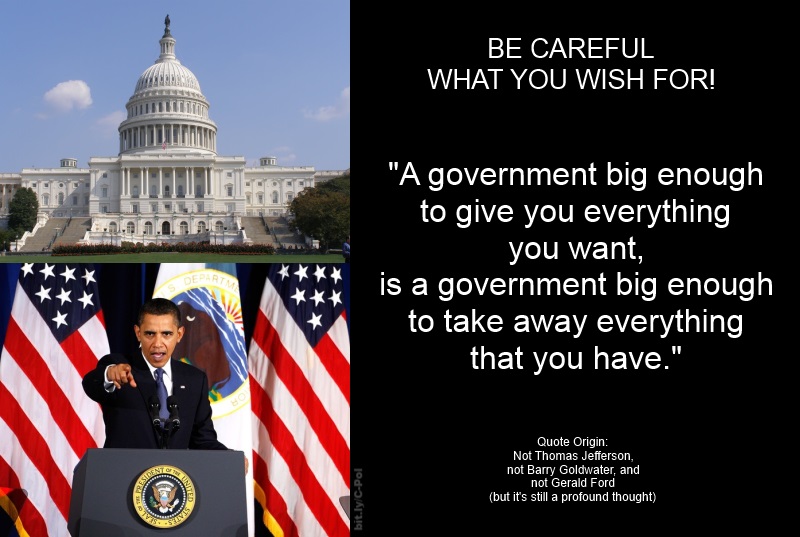
Be careful what you wish for (Or: This won't end well)


(Click image to view larger version)
This excellent point is usually attributed to Thomas Jefferson, but the curators of all things Jefferson at Monticello insist that there is no evidence he is the source.  They also note that other claimed sources, such as Barry Goldwater and Gerald Ford, are also spurious, although they are known to have employed the quote in their speeches.

As far as documentary evidence goes, the earliest written examples of the quote date back to the early 1950s; the original sage seems to have vanished into the mists of history.

Regardless of the quote's parentage, the point remains valid and deeply profound.  In my opinion, we are likely to see its validation in many unpleasant ways in the coming years and decades.

July 20, 2011

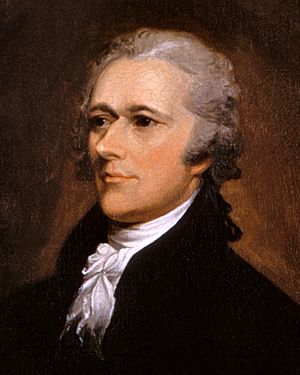
Quick Quote - Alexander Hamilton on the balance between state and federal power

Hamilton certainly did not envision a future where the states  willingly surrendered any leverage they had over the federal government.

"This balance between the National and State governments ought to be dwelt on with peculiar attention, as it is of the utmost importance. It forms a double security to the people. If one encroaches on their rights they will find a powerful protection in the other. Indeed, they will both be prevented from overpassing their constitutional limits by a certain rivalship, which will ever subsist between them."

Alexander Hamilton, speech to the New York Ratifying Convention, 1788

The causes are various, but one of the most egregious was the states’ ratification of the 17th Amendment, making the Senate a matter of popular vote rather than state appointment.

Whatever the reasons, the states now are for the most part submissive to the will of the federal government, and We The People are overwhelmingly the losers.

(Via Patriot Post)

May 18, 2011

Is there a difference between earmarks at the federal level and at the state level?

In a May 15 article, The Daily Caller (TDC) seems to be trying to whip up some controversy regarding possible GOP presidential candidate Michele Bachmann’s apparent inconsistency on the earmarks issue.

Given that Bachmann is a TEA party favorite, this is a serious charge.  TDC notes that she has secured nearly $4 million in earmarks for her district since she was first elected to Congress in 2007.  She also argued to exclude transportation projects from a GOP-championed earmarks moratorium.

These facts are enough to raise eyebrows among TEA partiers and constitutionalists.  I’d like to know how she defends these actions.  Do they undermine the credibility of her TEA Party Caucus on Capitol Hill?

While the answers to these questions are important, TDC raises another issue that got under my skin:

Bachmann’s penchant for earmarks dates back to her days in the Minnesota state Senate. Despite her reputation as a fiscal conservative, from 2001-2006, then-state Senator Bachmann proposed more than $60 million in earmarks, including a $710,000 “Bond For Centerville Local Improvements Around Highway 14? and a $40,000,000 “Bond for Lino Lakes And Columbus Township Highway Interchanges.”

Doug Sachtleben, Bachmann’s communications director, sought to explain the earmarks, arguing that voters resent “taking money from taxpayers in one state to pay for a host of wasteful projects in other states.” He added that voters “also expect that things like road projects should be done at the state level, where voters can have a say through the selling of bonds.” These are not absurd arguments — bridges have to get built somehow — but Tea Party activists may find the argument that earmarks are fine at the state level as appealing as Mitt Romney’s argument that individual health care mandates are fine so long as they are enacted at the state level.

When it comes to government, I believe in the principle of subsidiarity – namely, that any activity that ought to be taken on by government should be taken on by the lowest level of government that can get the job done. 

Road and bridge construction is most certainly not in the constitutional domain of the federal government.  So, what about the other levels? 

Some necessary infrastructure is within the financial means of municipal and county governments.  But the reality is that major projects – highway interchanges, bridges, etc. – can quickly wipe out the treasuries of smaller cities and towns (and the counties containing them).  The money has to come from a higher level.

But think about this: What is a county?  It is an administrative subdivision of… the state government!  Counties are entities created by the state enabling it to govern regions more efficiently.  Likewise, cities are state-created entities.  So, it could be argued that spending at the city, county or state level could all be considered state spending.

This fact – and the principle of subsidiarity – are what make the final sentence in the above excerpt so nonsensical.  Are there TEA partiers who think that the state should not fund highway projects (whether at the request of a local representative or not)?  If there are any, I’d like to hear the logic behind such a position.  I suspect, though, that the author’s “Tea Party activists” are made of straw.

One final thought on the excerpt’s final sentence: There is no equivalence between state funding of transportation infrastructure (a legitimate government concern) and state funding of health care (not a legitimate government concern).

January 28, 2011

Further proof that the Obama has no clue whatsoever about the separation of powers

(or no respect for it, at the very least)

CNSNews, January 28:
Teen Dating Violence Is A ‘Cabinet-Level Priority,’ Attorney General Holder Says

(CNSNews.com) - Stemming teen dating violence and safeguarding children is a "Cabinet-level priority" of the Obama administration, Attorney General Eric Holder told a gathering at the Justice Department on Friday.

[...] "That’s what the National Advisory Committee -- and today’s meeting – is all about.  By working together, I believe we can empower adolescents to understand and to develop healthy relationships before violence and abuse can begin. And I am confident that we can help more young people identify signs of abuse, and assist them in locating services."

The goal of Friday's meeting is to work on a "strategic, comprehensive action plan," Holder said in his prepared remarks.
Are there any local issues that the Obama administration refuses to meddle in simply because they're none of the federal government's business?

December 9, 2010

Quick Quote: James Madison on the federal leviathan

“It will be of little avail to the people, that the laws are made by men of their own choice, if the laws be so voluminous that they cannot be read, or so incoherent that they cannot be understood; if they be repealed or revised before they are promulgated, or undergo such incessant changes that no man, who knows what the law is to-day, can guess what it will be to-morrow. Law is defined to be a rule of action; but how can that be a rule, which is little known, and less fixed?”

— James Madison, The Federalist #62

March 10, 2010

That giant sucking sound you hear…

…is your hard-earned money going into the coffers of the federal government and into the pockets of those who do business (directly or indirectly, through contracts or lobbying) with the federal government.

Washington Examiner, March 10:

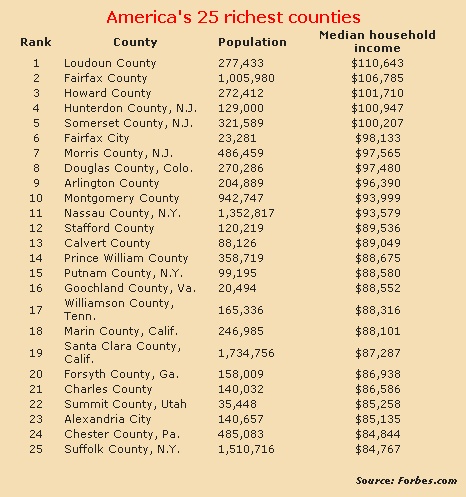
6 of the 10 richest counties in U.S. are in DC area

Loudoun ranks as the richest county in the United States, immediately followed by Fairfax and Howard counties, while Montgomery, traditionally one of the wealthiest, is now 10th.

Forbes magazine ranked eight other Washington-area counties in its list of the nation's 25 wealthiest counties, far more than any other area in the country. The rankings are based on 2008 median household income data from the U.S. Census Bureau.

Loudoun's median household income was $110,643, while Fairfax's was $106,785 and Howard's came in at $101,710.

Here are the rankings, according to Forbes.

In my youth my family lived in four of the top ten counties, but we certainly dragged the median down in each case.

February 4, 2010

Modern liberals probably wouldn’t give the time of day to a classical liberal

I tend to call myself a constitutionalist conservative, but my views on government and liberty align quite nicely with what was once known as liberalism.

"A [classical] liberal is fundamentally fearful of concentrated power. His objective is to preserve the maximum degree of freedom for each individual separately that is compatible with one man's freedom not interfering with other men's freedom. He believes that this objective requires that power be dispersed. He is suspicious of assigning to government any functions that can be performed through the market, both because this substitutes coercion for voluntary cooperation in the area in question and because, by giving government an increased role, it threatens freedom in other areas."

— Milton Friedman

Reference: Capitalism and Freedom (U. of Chicago Press, 1962), p. 39

November 2, 2009

Quick Quote: Thomas Jefferson on nanny government

And now, a word from the founder of the Democratic Party:
Were we directed from Washington when to sow, and when to reap, we should soon want bread.

– Autobiography, 1821
Reference: Jefferson: Writings, Peterson ed., Library of America (74)

July 9, 2009

Quick Quote: Thomas Jefferson on what makes good government

And now, a word from the founder of the Democratic Party:
[A] wise and frugal government...shall restrain men from injuring one another, shall leave them otherwise free to regulate their own pursuits of industry and improvement, and shall not take from the mouth of labor the bread it has earned. This is the sum of good government.

– First inaugural address, 1801

Reference: Jefferson: Writings, Peterson ed., Library of America (494)

June 17, 2009

Quick Quote: Thomas Jefferson on wealth redistribution

And now, a word from the founder of the Democratic Party:

"To take from one, because it is thought his own industry and that of his fathers has acquired too much, in order to spare to others, who, or whose fathers, have not exercised equal industry and skill, is to violate arbitrarily the first principle of association, the guarantee to everyone the free exercise of his industry and the fruits acquired by it."

-- Thomas Jefferson, letter to Joseph Milligan, 1816

Reference: Vindicating the Founders, West (136); original Writings of Thomas Jefferson, Bergh, ed., vol. 14 (466)


(Found at Patriot Post)

February 26, 2009

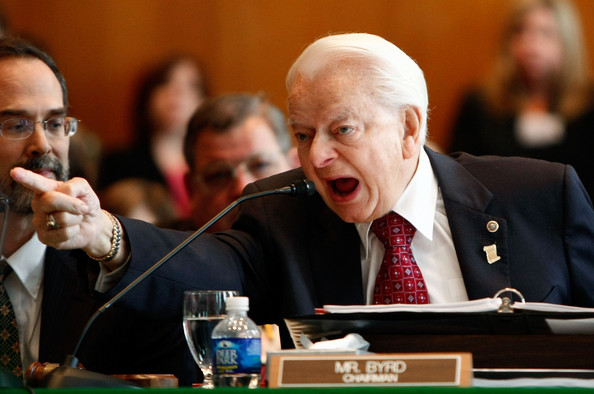
Sen. Robert Byrd: Convenient constitutionalist


West Virginia senator Robert Byrd usually busies himself diverting a disproportionate amount of federal expenditures into his state (and thereby getting an increasing number of public works named after him there).

Every once in a while, though, he erupts in a fit of constitutionalism, correctly calling attention to some abuse of the clearly-delineated restrictions on federal power.

For example, yesterday the senator criticized the Obama administration for violating the constitutional separation of powers, as Politico reported:

Sen. Robert Byrd (D-W.Va.), the longest-serving Democratic senator, is criticizing President Obama’s appointment of White House “czars” to oversee federal policy, saying these executive positions amount to a power grab by the executive branch.

In a letter to Obama on Wednesday, Byrd complained about Obama’s decision to create White House offices on health reform, urban affairs policy, and energy and climate change. Byrd said such positions “can threaten the Constitutional system of checks and balances. At the worst, White House staff have taken direction and control of programmatic areas that are the statutory responsibility of Senate-confirmed officials.”

While it's rare for Byrd to criticize a president in his own party, Byrd is a stern constitutional scholar who has always stood up for the legislative branch in its role in checking the power of the White House. Byrd no longer holds the powerful Appropriations chairmanship, so his criticism does not carry as much weight these days. Byrd repeatedly clashed with the Bush administration over executive power, and it appears that he's not limiting his criticism to Republican administrations.

Byrd also wants Obama to limit claims of executive privilege while also ensuring that the White House czars don’t have authority over Cabinet officers confirmed by the Senate.
Byrd's criticism appears to be on the mark, but in my opinion his motives are not entirely pure.

The third paragraph is key: "Byrd is a stern constitutional scholar who has always stood up for the legislative branch in its role in checking the power of the White House."

In other words, "constitutional scholar" Byrd stands up for the Constitution only when the power of the legislative branch is threatened.

You'll rarely (if ever) hear his thundering protests when Congress itself routinely steps out of its constitutional sandbox.

That said, we'll take whatever we can get.

February 19, 2009

The Bizarro World of the U.S. Constitution

Vince Leibowitz, who runs the left-wing Texas politics website Capitol Annex, writes for Pegasus News:

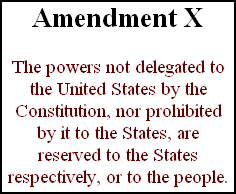
A bizarre House Concurrent Resolution filed Tuesday by three members of the Texas House of Representatives would have the state claim “sovereignty” under the Tenth Amendment to the Constitution over every power not specifically authorized the federal government in the U.S. Constitution and demands that Congress repeal any law requiring “states to comply under threat of civil or criminal penalties or sanctions or that requires states to pass legislation or lose federal funding be prohibited or repealed.”

Although the resolution, HCR 50, has no force of law whatsoever and, if passed, amounts to no more than an toothless demand made of congress on fancy paper sent by the Secretary of State, it could send the lower chamber of the legislature into a dizzying turmoil were it to ever hit the floor.

I can understand why Mr. Leibowitz considers the Tenth Amendment to the U.S. Constitution to be bizarre. Think about it: in all of your years in grade school (especially if you went to public schools) and college, how many times did you ever hear the Tenth Amendment even mentioned, much less explained?

Many areas of the Constitution are no-go zones nowadays. The Tenth Amendment has long been walled off and hermetically sealed in some sub-basement of one of those zones.

The Texas resolution is little more than a symbolic protest of the fact that the federal government has essentially demolished a great number of the meaningful constitutional limits on its power. Once free of those limits, the federal tentacles have spread into just about every aspect of life in this country -- such as governance, commerce, health care, and even our choices about how we spend our personal time. This is evidenced by Leibowitz' sample list of federal programs that would be threatened if Congress went bizarre itself and submitted to the demands of HCR 50.

The limits of the Tenth Amendment probably could not be restored without an extremely long, painful and disruptive process of destruction and reconstruction that the citizens of this country -- regardless of political alignment -- have absolutely no stomach for.

I'm sure the sponsors of the HCR 50 know this. Perhaps they are like me, indulging every once in a while in some nostalgia about an America that is gone forever.

August 6, 2004

My favorite Supreme Court justice


Magic mirror on the wall,
who's the most Constitution-friendly justice of all?

If you listen enough to the rhetoric of the left, you know the party line that Antonin Scalia is Public Enemy #1, and that Clarence Thomas routinely takes his marching orders from him.  I hadn't really pondered the question of which justice has the greatest fealty to the 'strict construction' philosophy of constitutional interpretation (to paraphrase Horton the elephant, the Constitution says what it means and means what it says -- no ifs, ands, buts, penumbras or emanations about it).  If someone had buttonholed me on the street and demanded an answer, I might have said Scalia, since he's the one who gets all of the press (Thomas doesn't actually exist, since everyone in the media knows that there's no such thing as a black conservative).

As it turns out, though, a law.com article reveals that Thomas boldly and routinely goes where Scalia is often reluctant to go.  In his biography of Thomas, Ken Foskett quotes Scalia as saying that Thomas "doesn't believe in stare decisis, period."  Foskett considers this to be a "bombshell", although Steve at Southern Appeal says the fact is well-known in the legal community.

Stare decisis, Latin for "to stand by decided matters", refers to the doctrine that gives weight to judicial precedents.  If there is a string of Supreme Court decisions on a matter, Scalia is much more likely to uphold the issue on the basis of the precedents, even if he is uneasy with the soundness of the constitutional reasoning behind the precedents.

Thomas, on the other hand, believes that if a previous decision is constitutionally suspect, it has no weight whatsoever.  Continuing Scalia's quote:
"If a constitutional line of authority is wrong, he would say let's get it right," says Scalia. "I wouldn't do that."
As much as I admire Scalia, Thomas is in the right here.  If you're driving from Washington to New York and you see an exit sign for Atlanta, the solution is not to keep driving and hope everything turns out right.

I understand even more now why the left hates Thomas so much.  Not only is he conservative, he's also one of the best friends the Constitution has had in recent generations.

(Credit: The Corner)