In extraordinary news, the scientific journal Pattern Recognition in Physics has been unexpectedly terminated, a “drastic decision” taken just ten months after it started.
The publisher appears to be shocked that in a recent special issue the scientists expressed doubt about the accelerated warming predicted by the IPCC. For the crime of not bowing before the sacred tabernacle, apparently the publishers suddenly felt the need to distance themselves, and in the most over-the-top way. The reasons they gave had nothing to do with the data, the logic, and they cite no errors. There can be no mistake, this is about enforcing a permitted line of thought.
I must say, it’s a brilliant (if a tad expensive) way to draw attention to a scientific paper. It’s the Barbara-Streisland [sic] moment in science. Forget “withdrawn”, forget “retracted”, the new line in the sand is to write a paper so hot they have to terminate the whole journal! Skeptics could hardly come up with a more electric publicity campaign.
Showing posts with label Climate Change. Show all posts
Showing posts with label Climate Change. Show all posts
January 18, 2014
Ah, such delicious irony!
A publisher of peer-reviewed scientific
journals, named in honor of a man famous for challenging the consensus
of the day, pulls the plug on one of its journals after an
issue that challenges the consensus of the day. JoNova, January 18:

January 3, 2013
Another study questions human contribution to climate change
Anthony Watts reports January 3 on research suggesting that allegations regarding mankind's role in climate change are mostly hot air. I look forward to a rational, nonemotional, scientific debate on the merits of these findings.
From the journal Earth System Dynamics billed as “An Interactive Open Access Journal of the European Geosciences Union” comes this paper which suggests that the posited AGW forcing effects simply isn’t statistically significant in the observations, but other natural forcings are.
“…We show that although these anthropogenic forcings share a common stochastic trend, this trend is empirically independent of the stochastic trend in temperature and solar irradiance. Therefore, greenhouse gas forcing, aerosols, solar irradiance and global temperature are not polynomially cointegrated. This implies that recent global warming is not statistically significantly related to anthropogenic forcing. On the other hand, we find that greenhouse gas forcing might have had a temporary effect on global temperature.”This is a most interesting paper, and potentially a bombshell, because they have taken virtually all of the significant observational datasets (including GISS and BEST) along with solar irradiance from Lean and Rind, and CO2, CH4, N2O, aerosols, and even water vapor data and put them all to statistical tests (including Lucia’s favorite, the unit root test) against forcing equations. Amazingly, it seems that they have almost entirely ruled out anthropogenic forcing in the observational data, but allowing for the possibility they could be wrong, say:
“…our rejection of AGW is not absolute; it might be a false positive, and we cannot rule out the possibility that recent global warming has an anthropogenic footprint. However, this possibility is very small, and is not statistically significant at conventional levels.”
March 11, 2011
How much more evidence do we need that belief in global warming borders on fundamentalist religion for many?
Fundamentalist Christians are often mocked for suggesting that this or that natural disaster is a sign of God’s judgment on the people living in the affected area.
As I took in the news this morning about the horrific results of the earthquake in Japan, at one point I wondered: How long before someone blames this on global warming? Not quite ready to believe that anybody would be so absurd, I dismissed the thought and went on with my day.
As it turns out, the Church of Global Warming has taught its disciples well. The Daily Caller reports that a lot of tweets are coming up on Twitter like the following:
AliceTMBFan said “2 hours of geography earlier talking about Japan has left me thinking…maybe global warming is way more serious then we thought…”
Arbiterofwords tweeted “I’m worried that Japan earthquake, on top of other recent natural ‘disasters’, is a sign we’ve passed point of no return for climate change.”
MrVikas said “Events like the #Japan #earthquake and #tsunami MUST keep #climate change at forefront of policy thought: http://bit.ly/cZe8To #environment
Tayyclayy noted her frustration by tweeting “An earthquake with an 8.9 magnitude struck Japan.. And some say climate change isn’t real?!”
DanFranklin postulated “Never really believed all this global warming talk, but after the earthquake in NZ and today in Japan. Maybe we’ve ruined the world.”
And TeamIanHarding tweeted “While Japan witnessed an earthquake we were talking about the problems that global warming leads to in school. Think. Pray. And change.”
Back when I actively maintained my old Global Warming Heretic blog, I complained that proponents of the global warming (or climate change, if you insist) hypothesis had rigged the debate so that absolutely nothing that happened in the real world could undermine their case – whatever happened, it affirmed the hypothesis.
Is it any surprise, then, that a totally natural event – slippage along a tectonic plate boundary – is somehow confirmation of the notion that humans really ought to stop driving SUVs?
July 27, 2010
The Case of the Vanishing Oil Spill: A Parable
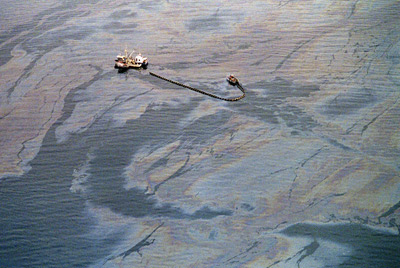
For 86 days, oil spewed into the Gulf of Mexico from BP's damaged well, dumping some 200 million gallons of crude into sensitive ecosystems. BP and the federal government have amassed an army to clean the oil up, but there's one problem -- they're having trouble finding it.
At its peak last month, the oil slick was the size of Kansas, but it has been rapidly shrinking, now down to the size of New Hampshire.
[…] The numbers don't lie: two weeks ago, skimmers picked up about 25,000 barrels of oily water. Last Thursday, they gathered just 200 barrels.
Still, it doesn't mean that all the oil that gushed for weeks is gone. Thousands of small oil patches remain below the surface, but experts say an astonishing amount has disappeared, reabsorbed into the environment.
"[It's] mother nature doing her job," said Ed Overton, a professor of environmental studies at Louisiana State University.
The well has been capped for only two weeks, and already nature has done an “astonishing” amount of the work that the cleanup folks had expected to do.
This says a lot about our planet’s ability to accommodate shocks to the ecosystem.
Think about it. Experts have been taken completely by surprise by the way the Gulf of Mexico is cleaning itself up.
And yet, we’re told by many that the science is settled concerning climate change, and that there remains no credible opposition to the notion that we’re nearing a tipping point of irreversible damage to our planet. What’s really astonishing is the hubris of “experts” who think their knowledge of climate is anywhere near the level needed to make predictions like that.
Pause and reflect.
(Image found here)
Subscribe to:
Posts (Atom)