 |
| Via Being Libertarian (Facebook) |
Showing posts with label Constitution. Show all posts
Showing posts with label Constitution. Show all posts
December 16, 2017

December 6, 2017

November 21, 2017
The purpose of the 'Commerce Clause' in the US Constitution
In modern times, the US government has arrogated to itself the right to regulate all aspects of commerce that occur within our borders, from the largest mega-corporations all the way down to the most humble sole-proprietor businesses. When the government bothers to justify its assumed powers at all, there is usually some reference to the "commerce clause" in the US Constitution.
The underlined text in the following image shows, in its entirety, the power the Constitution grants the US government regarding commerce:

"The Congress shall have Power...To regulate Commerce
Congress regulates commerce with other nations and with the Indian tribes, because the US government is granted the right to regulate commercial interactions that cross the national borders of our country. Since the US government is the sole agent in our country's official interactions with other countries, it makes sense that the government should have a say in any commerce that might affect our country's relations with other countries.
When it comes to commerce that remains within the borders of our country, however, the language of the text is different: Congress has power to regulate commerce among (or between) the states. Businesses within those states are engaging in commerce with one another. The states are legally considered to be peers with one another, so what happens when there are disputes between states relating to these commercial interactions?
Congress is assigned the role of binding arbitrator, ensuring that no state will take unfair advantage of another as goods and services cross its borders. Congress does not have the power to dictate the size and shape of the grommets that are manufactured in Colorado, or to force Grommets, Inc. to grant its employees paid leave for yoga retreats. Rather, Congress has the power to prevent Texas (where rival company Also Grommets, Inc. is located) from erecting protectionist regulatory barriers that make it difficult for Grommets, Inc. to get its goods to market.
That is the original purpose of the US government's interstate commerce regulatory power. Anything else the government does in the arena of internal commerce is almost certainly a usurpation.

"[W]e have abundant reason to be convinced, that the spirit for Trade which pervades these States is not to be restrained; it behooves us then to establish just principles; and this, any more than other matters of national concern, cannot be done by thirteen heads differently constructed and organized. The necessity, therefore, of a controuling power is obvious; and why it should be withheld is beyond my comprehension."
– George Washington, letter to James Warren, Mount Vernon, October 7, 1785; Fitzpatrick 28:290
(Image and quote via the George Washington Facebook page)
The underlined text in the following image shows, in its entirety, the power the Constitution grants the US government regarding commerce:

"The Congress shall have Power...To regulate Commerce
- with foreign Nations,
- and among the several States,
- and with the Indian Tribes"
Congress regulates commerce with other nations and with the Indian tribes, because the US government is granted the right to regulate commercial interactions that cross the national borders of our country. Since the US government is the sole agent in our country's official interactions with other countries, it makes sense that the government should have a say in any commerce that might affect our country's relations with other countries.
When it comes to commerce that remains within the borders of our country, however, the language of the text is different: Congress has power to regulate commerce among (or between) the states. Businesses within those states are engaging in commerce with one another. The states are legally considered to be peers with one another, so what happens when there are disputes between states relating to these commercial interactions?
Congress is assigned the role of binding arbitrator, ensuring that no state will take unfair advantage of another as goods and services cross its borders. Congress does not have the power to dictate the size and shape of the grommets that are manufactured in Colorado, or to force Grommets, Inc. to grant its employees paid leave for yoga retreats. Rather, Congress has the power to prevent Texas (where rival company Also Grommets, Inc. is located) from erecting protectionist regulatory barriers that make it difficult for Grommets, Inc. to get its goods to market.
That is the original purpose of the US government's interstate commerce regulatory power. Anything else the government does in the arena of internal commerce is almost certainly a usurpation.

"[W]e have abundant reason to be convinced, that the spirit for Trade which pervades these States is not to be restrained; it behooves us then to establish just principles; and this, any more than other matters of national concern, cannot be done by thirteen heads differently constructed and organized. The necessity, therefore, of a controuling power is obvious; and why it should be withheld is beyond my comprehension."
– George Washington, letter to James Warren, Mount Vernon, October 7, 1785; Fitzpatrick 28:290
(Image and quote via the George Washington Facebook page)
January 25, 2017
President Donald J. Trump, champion of the Constitution
Not.

Please cite the section of the Constitution which grants the federal government the power to "send in the Feds" to combat crime that is manifestly a local law enforcement issue. If the local police can't get a handle on it, any escalation of the issue is the responsibility of the state of Illinois.
The federal government can't step in unless it turns into insurrection.

Please cite the section of the Constitution which grants the federal government the power to "send in the Feds" to combat crime that is manifestly a local law enforcement issue. If the local police can't get a handle on it, any escalation of the issue is the responsibility of the state of Illinois.
The federal government can't step in unless it turns into insurrection.

November 11, 2016
Most people don't really believe in free speech

Here is the Churchill quote in context:
Everyone is in favor of free speech. Hardly a day passes without its being extolled, but some people's idea of it is that they are free to say what they like, but if anyone else says anything back, that is an outrage.
June 18, 2016
"A well-regulated militia": the Left's delusion about the Second Amendment

This image, which is making its way around Facebook in the wake of the Orlando nightclub massacre, zeros in on the part of the Constitution's Second Amendment that is the most confusing to modern eyes.
Before we, too, zero in on this phrase, consider for a moment what the Bill of Rights (the first ten amendments) actually was. Why were these amendments added all at once, and so soon after the adoption of the Constitution? Because they were adopted as a condition of the approval of the Constitution by several of the states.
There was widespread suspicion that the proposed Constitution didn't go far enough to explicitly curtail the powers of the central government. The dissenters felt that individual rights would quickly fall prey to expanding government power in the absence of explicit declarations of the inviolable rights of individuals.
The Bill of Rights is the answer to these concerns, and the promise of these was sufficient to get all of the states to sign on to the Constitution.
Here, then, is the complete text of the Second Amendment:
A well regulated Militia, being necessary to the security of a free State, the right of the people to keep and bear Arms, shall not be infringed.Noting the neighboring words "security" and "State", many on the Left would have us believe that the phrase "well regulated Militia" is referring to the military and to state and local law-enforcement agencies -- that this amendment guarantees the government the ability to undertake any and all efforts necessary to protect the country (military) and maintain public order (local law enforcement).
But why, in the midst of a collection of amendments designed to guarantee individual rights, would the Founders drop in a grant of government power that, in essence, had the potential to render the rest of the Bill of Rights moot?
Does anyone honestly think that the dissenters would have gone along with this new government if this were the case? All of human history testifies that when the people of a country have no means to resist the tyranny of their government, their government will sooner or later drift into tyranny.
So what, then, did the phrase "well regulated Militia" mean to 18th-century American eyes?
The militia were the ones who were expected to grab their guns and take action whenever the need arose. Most importantly to the contemporary debate, though, all able-bodied males, regardless of occupation, were considered part of the militia, whether or not they had ever served in the armed forces. This in itself argues for the notion that this amendment was not a restrictive one.
What about "well regulated"? Surely this phrase shows that arms-bearing must be done under the supervision of the government, doesn't it? Actually, no. At the time, the phrase "well regulated" was used interchangeably with "well trained" or "orderly".
Well, then, what about "security of a free State"? In context, "state" is obviously referring to the nation itself, not to the government. There are two ways of seeing the phrase "free state": (1) a nation as a whole free from the control of other nations (this is the modern understanding of the term), and (2) a nation comprised of individuals who are free from the oppression of their government.
If we accept the notion of the entire Bill of Rights being a Bill of Individual Rights, that second interpretation of "free state" gains a considerable amount of weight.
So. Taking the Second Amendment as a whole, I see this paraphrased declaration: A nation of citizens in the possession of and well-trained in the use of firearms is an effective bulwark both against conquest by other nations and against oppression by that nation's government. Therefore, the central government shall take no steps to interfere with the right of the citizens to keep and bear such firearms.
A well-armed, well-trained citizenry is necessary to secure the freedom of said citizenry.
April 8, 2016
The Left, the Founders, and the Constitution
Well, of course the left understands the U.S. Constitution better than its authors did.

September 8, 2015
Pointless Petition du jour: The meaning of inauguration oaths taken by public office holders
Secular jihadists have set their sights on the inauguration oath typically taken by many public office holders. Here is a new petition -- undoubtedly inspired by the Kim Davis kerfuffle -- at whitehouse.gov:

I think it's worth pondering the purpose of inauguration oaths.
The whole point of an oath is to increase the credibility of a promise. The oath-taker is essentially calling judgment down upon him/herself if the promise isn't kept. When the oath-taker is considered to be sincere in such an oath, it generally adds weight to the promise being made. If the oath-taker doesn't believe in a higher power, the oath is pointless both to the one doing the promising and to the one being promised.
In this light, swearing on the Constitution (as the petition demands) is even more pointless, regardless of one's belief system -- what does "I swear by the Constitution that I will obey the Constitution" even mean?
The real issue is not that many people prefer to add meaning to their oath by placing their hand on the text that underlies their moral value system; the real issue is that the oath itself is effectively meaningless to the oath-taker.
At one time, the inauguration oath served a real purpose in a culture where the moral value system of Christianity served as an actual constraint on the behavior of the citizenry and (in many cases) public officials. Now that Christianity is being systematically purged from the culture, even pro forma declarations of religious sentiment among public officials are becoming less common.
So, again: is there any point to inauguration oaths any more? It's not like most oath-takers are actually sincere in the affirmations being made (or fear any repercussions of violating those affirmations), so why undergo the ritual in the first place?

I think it's worth pondering the purpose of inauguration oaths.
The whole point of an oath is to increase the credibility of a promise. The oath-taker is essentially calling judgment down upon him/herself if the promise isn't kept. When the oath-taker is considered to be sincere in such an oath, it generally adds weight to the promise being made. If the oath-taker doesn't believe in a higher power, the oath is pointless both to the one doing the promising and to the one being promised.
In this light, swearing on the Constitution (as the petition demands) is even more pointless, regardless of one's belief system -- what does "I swear by the Constitution that I will obey the Constitution" even mean?
 |
| Image source: Bizarro |
At one time, the inauguration oath served a real purpose in a culture where the moral value system of Christianity served as an actual constraint on the behavior of the citizenry and (in many cases) public officials. Now that Christianity is being systematically purged from the culture, even pro forma declarations of religious sentiment among public officials are becoming less common.
So, again: is there any point to inauguration oaths any more? It's not like most oath-takers are actually sincere in the affirmations being made (or fear any repercussions of violating those affirmations), so why undergo the ritual in the first place?
August 29, 2015
Donald Trump frightens me, and so do his followers
Donald Trump frightens me, and so do his followers. I'm going on my general observations of the
Trump phenomenon, so in the unlikely event you're a Trump fan AND you're a constitutionalist, my apologies for lumping you in with the rest -- I'm curious to know how both sentiments can coexist. With that said...
Trump, like Obama before him, and like any good demagogue, has the ability to connect deeply with the emotions of his followers, rather than their minds. It seems that Trump's fans would allow him to be every bit the tyrant he's essentially pledged to be (and must be to "fix" our country outside of the constitutional boundaries of the president's powers)...as long as he delivers on his promise to secure the borders.
I've often argued that George W. Bush, whatever other qualities he may have had, was no friend of the Constitution. Chancellor Trump would be much, much worse in this regard.
If Trump wins the nomination, our country will lose in the end -- no matter who takes the general election.
 |
| Image source |
Trump, like Obama before him, and like any good demagogue, has the ability to connect deeply with the emotions of his followers, rather than their minds. It seems that Trump's fans would allow him to be every bit the tyrant he's essentially pledged to be (and must be to "fix" our country outside of the constitutional boundaries of the president's powers)...as long as he delivers on his promise to secure the borders.
I've often argued that George W. Bush, whatever other qualities he may have had, was no friend of the Constitution. Chancellor Trump would be much, much worse in this regard.
If Trump wins the nomination, our country will lose in the end -- no matter who takes the general election.
July 31, 2015
Are the denizens of the 'progressive' left champions of democracy?
Although the progressives fancy themselves to champion democracy, they are accomplishing some of the greatest strides in their cultural revolution through the least democratic means -- through presidential executive action and through the decisions of a few federal judges. In other words, through oligarchy, not through democracy.
The people's representatives are in Congress. The left pretty much has no use for the people's representatives. Under progressive rule, the laws come from everywhere BUT the place mandated by our Constitution.
Just like pretty much every left-wing uprising that has ever occurred, the revolutionaries claim to be acting on behalf of the masses, but the masses don't always have the right opinions, do they?
(Note: I realize that under our Constitution, the U.S. is a republic, not a democracy. Just going with the progressive lingo here.)
The people's representatives are in Congress. The left pretty much has no use for the people's representatives. Under progressive rule, the laws come from everywhere BUT the place mandated by our Constitution.
Just like pretty much every left-wing uprising that has ever occurred, the revolutionaries claim to be acting on behalf of the masses, but the masses don't always have the right opinions, do they?
(Note: I realize that under our Constitution, the U.S. is a republic, not a democracy. Just going with the progressive lingo here.)
March 20, 2015
Mandatory voting is, quite possibly, one of the worst ideas ever
This week, I was quite surprised to learn from my Facebook newsfeed that quite a few on the left are excited about the notion of mandatory voting for American citizens (at least, I assume they're wanting this just for the citizens). My gut reaction is that this is, quite possibly, one of the worst ideas ever presented as a solution to the phenomenon of low voter participation.
Before explaining why I believe this, I should note that this erupted into the news this week because our Dear Leader just endorsed the notion. Yahoo! News, March 18:
Forcing these 50%+ of voting-age citizens to the polls won't turn them into informed, motivated voters. Any person who takes a half-serious look at human nature should be able to conclude two things: (1) These uninformed, unmotivated folks will look for the easiest way to avoid the failure-to-vote penalty (most likely a fine); and (2) The informed, motivated folks (both left and right) will be ready to help the uninformed, unmotivated folks discharge their duties in the most expedient way possible.
"Just tell me who to vote for, okay?"
This will come down to a contest of which ideological tribe can get the most apathetic sheep to the polls. The Left's giddiness about the mandatory voting proposal is evidence enough that progressives believe that they would win that contest.
Before explaining why I believe this, I should note that this erupted into the news this week because our Dear Leader just endorsed the notion. Yahoo! News, March 18:
Obama floated the idea of mandatory voting in the U.S. while speaking to a civic group in Cleveland on Wednesday. Asked about the corrosive influence of money in U.S. elections, Obama digressed into the related topic of voting rights and said the U.S. should be making it easier — not harder— for people to vote.Yes, it would be grand if citizens took seriously their civic responsibility to participate in our democratic institutions. So, why don't they? The president's speech encapsulates the reasons that I usually see proffered by the Left:
Just ask Australia, where citizens have no choice but to vote, the president said.
"If everybody voted, then it would completely change the political map in this country," Obama said, calling it potentially transformative.
Not only that, Obama said, but universal voting would "counteract money more than anything."Yikes! So...anywhere from a half to two-thirds of voting-age citizens are informed, motivated folks who are systematically kept away from the polls by Republican voter-suppression efforts.
Disproportionately, Americans who skip the polls on Election Day are younger, lower-income and more likely to be immigrants or minorities, Obama said. "There's a reason why some folks try to keep them away from the polls," he said in a veiled reference to efforts in a number of Republican-led states to make it harder for people to vote.
 |
| Seriously? |
Forcing these 50%+ of voting-age citizens to the polls won't turn them into informed, motivated voters. Any person who takes a half-serious look at human nature should be able to conclude two things: (1) These uninformed, unmotivated folks will look for the easiest way to avoid the failure-to-vote penalty (most likely a fine); and (2) The informed, motivated folks (both left and right) will be ready to help the uninformed, unmotivated folks discharge their duties in the most expedient way possible.
"Just tell me who to vote for, okay?"
This will come down to a contest of which ideological tribe can get the most apathetic sheep to the polls. The Left's giddiness about the mandatory voting proposal is evidence enough that progressives believe that they would win that contest.
January 17, 2015
Did a crack just form in the Civil Asset Forfeiture wall? (In which I interrupt my hiatus to bestow cautious praise upon the Obama administration) [UPDATED]
Most long-time C-Pol readers (and you'd have to be long-time readers, given my recent posting frequency) know I'm no fan of the Obama administration, but if this
story is true in its details*, I'll give credit where credit is due. From the WaPo, January 16:
Over the years, this has led to countless cases where people traveling with significant amounts of cash -- with no criminal taint whatsoever -- have had that cash confiscated by the authorities under the official presumption that it's drug cash. Often, the police will simply seize the cash and send the people on their way without filing any charges (remember, filing charges means proving probable cause and following due process, which will almost certainly fail). Victims who have the means to file a legal challenge to get their money back are often faced with the unconstitutional burden of proving their cash was NOT related to drug activities.
This is evil, and I'm at a loss to understand how this practice has endured for three decades, except to observe that this has been a tremendous cash cow for every level of government -- the authorities seizing the goods share the proceeds with other authorities, essentially buying their silence, so the folks who COULD stop the practice have no incentive to do so. This action by AG Holder has already provoked complaints that this would harm the budgets of police departments. Sorry, but this money is as much illegally obtained (by the police) as drug money is (by the pushers). If the assets were forfeited through proper due process, I might have some sympathy for this complaint.
So, props to AG Holder if he is truly ending federal participation in the splitting of the spoils (if I'm misinterpreting the effect of his action, please let me know in the comments). The problem won't end at the state and local levels until voters get angry enough to hold their elected officials accountable. Alas, there are so many issues out there that motivate people's votes, and this one, as terrible as it is, is likely to get lost in the noise. Sigh.
------------------------------------
* January 21 UPDATE: I'm glad I used the disclaimer "if this story is true in its details" because, as Reason's Jacob Sullum notes January 19, Holder's action is much less significant than press reports made it out to be:
Attorney General Eric H. Holder Jr. on Friday barred local and state police from using federal law to seize cash, cars and other property without warrants or criminal charges."Civil Asset Forfeiture" (police seizing alleged drug money or assets purchased with alleged drug money) has been the most-abused weapon in the "War on Drugs" arsenal in the past three decades. The problem is that the assets are far too often seized WITHOUT DUE PROCESS, and often WITHOUT PROBABLE CAUSE that a crime has been committed. It's hard to imagine a more egregious violation of 4th Amendment protections.
Holder’s action represents the most sweeping check on police power to confiscate personal property since the seizures began three decades ago as part of the war on drugs.
Since 2008, thousands of local and state police agencies have made more than 55,000 seizures of cash and property worth $3 billion under a civil asset forfeiture program at the Justice Department called Equitable Sharing.
The program has enabled local and state police to make seizures and then have them “adopted” by federal agencies, which share in the proceeds. It allowed police departments and drug task forces to keep up to 80 percent of the proceeds of adopted seizures, with the rest going to federal agencies.
Over the years, this has led to countless cases where people traveling with significant amounts of cash -- with no criminal taint whatsoever -- have had that cash confiscated by the authorities under the official presumption that it's drug cash. Often, the police will simply seize the cash and send the people on their way without filing any charges (remember, filing charges means proving probable cause and following due process, which will almost certainly fail). Victims who have the means to file a legal challenge to get their money back are often faced with the unconstitutional burden of proving their cash was NOT related to drug activities.
This is evil, and I'm at a loss to understand how this practice has endured for three decades, except to observe that this has been a tremendous cash cow for every level of government -- the authorities seizing the goods share the proceeds with other authorities, essentially buying their silence, so the folks who COULD stop the practice have no incentive to do so. This action by AG Holder has already provoked complaints that this would harm the budgets of police departments. Sorry, but this money is as much illegally obtained (by the police) as drug money is (by the pushers). If the assets were forfeited through proper due process, I might have some sympathy for this complaint.
So, props to AG Holder if he is truly ending federal participation in the splitting of the spoils (if I'm misinterpreting the effect of his action, please let me know in the comments). The problem won't end at the state and local levels until voters get angry enough to hold their elected officials accountable. Alas, there are so many issues out there that motivate people's votes, and this one, as terrible as it is, is likely to get lost in the noise. Sigh.
------------------------------------
* January 21 UPDATE: I'm glad I used the disclaimer "if this story is true in its details" because, as Reason's Jacob Sullum notes January 19, Holder's action is much less significant than press reports made it out to be:
Holder's order applies only to "adoption," which happens when a state or local agency seizes property on its own and then asks the Justice Department to pursue forfeiture under federal law. "Over the last six years," the DOJ says in the press release announcing Holder's new policy, "adoptions accounted for roughly three percent of the value of forfeitures in the Department of Justice Asset Forfeiture Program." By comparison, the program's reports to Congress indicate that "equitable sharing" payments to state and local agencies accounted for about 22 percent of total deposits during those six years. That means adoptions, which the DOJ says represented about 3 percent of deposits, accounted for less than 14 percent of equitable sharing. In other words, something like 86 percent of the loot that state and local law enforcement agencies receive through federal forfeitures will be unaffected by Holder's new policy.Phooey. It's better than nothing, I guess, but it's hardly worth one cheer, much less three.
November 7, 2013

November 6, 2013
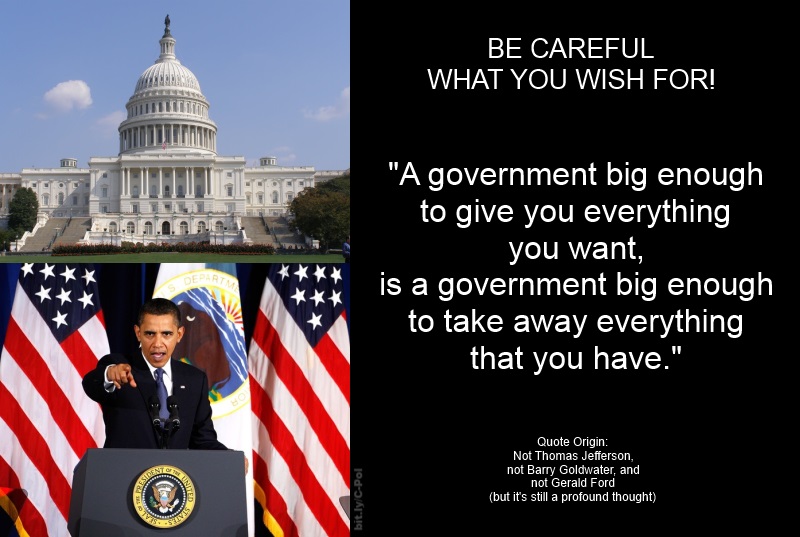
Be careful what you wish for (Or: This won't end well)
 |
| (Click image to view larger version) |
As far as documentary evidence goes, the earliest written examples of the quote date back to the early 1950s; the original sage seems to have vanished into the mists of history.
Regardless of the quote's parentage, the point remains valid and deeply profound. In my opinion, we are likely to see its validation in many unpleasant ways in the coming years and decades.
October 28, 2013
There's a BIG difference between Democrats and Republicans!
Sure, both the Democrats and the Republicans have shown (by their actions, not their words) that they have little interest in the constitutional limits on federal power, but there is a significant difference between the parties.
Democrats want to exercise unlimited, coercive federal power in favor of Democratic spending priorities with the aim of maintaining and advancing Democratic power and privilege, while Republicans want to exercise unlimited, coercive federal power in favor of GOP spending priorities with the aim of maintaining and advancing Democratic power and privilege. Hope that clears things up.
Is it any wonder that TEA partiers and other constitutionalists annoy the heck out of the Republicans as well as the Democrats? Dems like to claim that the TEA party movement (of which I am a sympathizer, but not a participant) is a GOP conspiracy, but the reality is that the Republican Party can't get rid of the TEA partiers quickly enough.
Democrats want to exercise unlimited, coercive federal power in favor of Democratic spending priorities with the aim of maintaining and advancing Democratic power and privilege, while Republicans want to exercise unlimited, coercive federal power in favor of GOP spending priorities with the aim of maintaining and advancing Democratic power and privilege. Hope that clears things up.
Is it any wonder that TEA partiers and other constitutionalists annoy the heck out of the Republicans as well as the Democrats? Dems like to claim that the TEA party movement (of which I am a sympathizer, but not a participant) is a GOP conspiracy, but the reality is that the Republican Party can't get rid of the TEA partiers quickly enough.
October 27, 2013
Do journalists lose their Fourth-Amendment protections when they write articles that make the government look bad?
Washington Times, October 25:
Is anyone here ready to argue that the warrant was anything other than a pretext for an illegal search and seizure to punish Ms. Hudson for her negative reporting?
Maryland State Police and federal agents used a search warrant in an unrelated criminal investigation to seize the private reporting files of an award-winning former investigative journalist for The Washington Times who had exposed problems in the Homeland Security Department’s Federal Air Marshals Service.
Reporter Audrey Hudson said the investigators, who included an agent for Homeland Security’s Coast Guard service, made a pre-dawn raid of her family home Aug. 6 and took her private notes and government documents that she had obtained under the Freedom of Information Act.
The documents, some which chronicled her sources and her work at The Times about problems inside the Homeland Security Department, were seized under a warrant to search for unregistered firearms and a “potato gun” suspected of belonging to her husband, Paul Flanagan, a Coast Guard employee. Mr. Flanagan has not been charged with any wrongdoing since the raid.
Is anyone here ready to argue that the warrant was anything other than a pretext for an illegal search and seizure to punish Ms. Hudson for her negative reporting?
April 15, 2012
Quick Quote: Noah Webster on getting the government we deserve
"When you become entitled to exercise the right of voting for public officers, let it be impressed on your mind that God commands you to choose for rulers, "just men who will rule in the fear of God." The preservation of government depends on the faithful discharge of this Duty; if the citizens neglect their Duty and place unprincipled men in office, the government will soon be corrupted; laws will be made, not for the public good so much as for selfish or local purposes; corrupt or incompetent men will be appointed to execute the Laws; the public revenues will be squandered on unworthy men; and the rights of the citizen will be violated or disregarded. If government fails to secure public prosperity and happiness, it must be because the citizens neglect the Divine Commands, and elect bad men to make and administer the Laws."
— Noah Webster, History of the United States (1832)
Comment: I see this as the continuation of a theme found in George Washington's farewell address. The reason we have a government that has strayed so far from the Constitution is that the voters have not demanded constitutional fidelity.
People tend to vote their values whether they realize it or not. The kind of leaders we tolerate says as much about our values as it does those of the leaders themselves.
I will expand on this further in a future post.
— Noah Webster, History of the United States (1832)
Comment: I see this as the continuation of a theme found in George Washington's farewell address. The reason we have a government that has strayed so far from the Constitution is that the voters have not demanded constitutional fidelity.
People tend to vote their values whether they realize it or not. The kind of leaders we tolerate says as much about our values as it does those of the leaders themselves.
I will expand on this further in a future post.
March 15, 2012
How to know if we really believe in the right to free speech
Mark Steyn, in a recent speech given in Australia:
Anyone can be in favour of free speech for Barney the Dinosaur and the Wiggles, but if you’re not in favour of free speech you find offensive and repellent and loathsome, you’re not in favour of free speech at all. And you’re on the side of creeping totalitarianism.Ironically, a generation ago it was the left that claimed the need to remind conservatives of this truth.
July 20, 2011
Quick Quote - Alexander Hamilton on the balance between state and federal power
Hamilton certainly did not envision a future where the states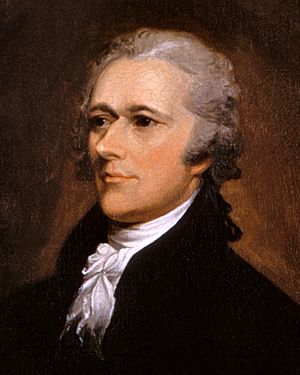
"This balance between the National and State governments ought to be dwelt on with peculiar attention, as it is of the utmost importance. It forms a double security to the people. If one encroaches on their rights they will find a powerful protection in the other. Indeed, they will both be prevented from overpassing their constitutional limits by a certain rivalship, which will ever subsist between them."
–Alexander Hamilton, speech to the New York Ratifying Convention, 1788
The causes are various, but one of the most egregious was the states’ ratification of the 17th Amendment, making the Senate a matter of popular vote rather than state appointment.
Whatever the reasons, the states now are for the most part submissive to the will of the federal government, and We The People are overwhelmingly the losers.
(Via Patriot Post)
Subscribe to:
Posts (Atom)