C-Poll

The latest C-Poll is closed. You can read all about it here!

Showing posts with label Ideas Have Consequences. Show all posts

February 10, 2016

Why most online arguments about politics and religion end in a stalemate

Image source

Scenario: Two people are engaged in mortal ideological combat on Facebook.  Each person argues their point passionately, genuinely baffled that what is manifestly obvious to them does not register at all with the other.  Since The Truth™ is so obvious, each combatant starts wondering why their opponent refuses to concede the point, eventually attributing such incorrigibility to bad character or, even worse, to mental illness. 

What is actually going on here?  Why do most skirmishes like these end with nobody persuaded and with bad feelings all around?

I believe this happens because the actual conflict usually does not lie in the topic itself, but in the long chain of presuppositions that lead rationally and inexorably to each person's view on the topic.  Within the closed system of a person's worldview, the point they're arguing makes complete sense to them, flowing logically from the worldview's foundational principles (i.e. the collection of assumptions forming the filter through which reality is interpreted), many or most of which are accepted as givens.

You won't get them to budge on the topic being debated unless either (a) you can convince them that the point they're arguing is inconsistent with the foundational principles of their worldview, or (b) you can somehow erode their confidence in the foundational principles themselves.

Strategy (a) is possible, but only those who embrace the same worldview are likely to see any success.  If someone of an opposing worldview tries this strategy, the natural reaction is to question the aggressor's motives (thus allowing the target to ignore the argument being made).

Even if strategy (b) has any chance of eventual success, the foundational principles aren't even part of the current debate, so forget about that.

Image source
Imagine a worldview as a tree.  The trunk and roots are the foundational principles; the opinion being argued at the moment is more akin to a cluster of leaves at the end of one of the tree's branches.  Everything between the cluster and the trunk is the chain of presuppositions connecting the opinion to the foundational principles.  Even if someone succeeds in damaging or lopping off that cluster, it'll grow back in due time -- nothing really gained or lost.

Facebook is where I'm most likely to encounter people of significantly differing worldviews.  I've developed an instinct for recognizing when, for my potential opponent, an opinion represents a leafy cluster or something closer to the trunk.  If the former, I'm more likely to refrain from joining the fray, because the most likely outcome is bad feelings and nothing else.  If the latter, I might cautiously engage, in the hope that something worthwhile might transpire.

With the leafy-cluster topics, I will occasionally come across a viewpoint that baffles me so much that I step back and ask myself, How could someone possibly hold such an opinion?  Then, over time, through observation and sometimes through tactfully-worded questioning, I will attempt to discern that opinion's chain of presuppositions.  As I analyze the presuppositions, I usually am forced to reanalyze and reaffirm the presuppositions of my own worldview.

While very rare, the process does occasionally lead me to soften or change my opinions (or at least stop thinking of my opponent as insane).  But -- and this is the point -- I came to this conclusion on my own, not as the result of being outmaneuvered in an online argument.

March 20, 2015

Mandatory voting is, quite possibly, one of the worst ideas ever

This week, I was quite surprised to learn from my Facebook newsfeed that quite a few on the left are excited about the notion of mandatory voting for American citizens (at least, I assume they're wanting this just for the citizens).  My gut reaction is that this is, quite possibly, one of the worst ideas ever presented as a solution to the phenomenon of low voter participation.

Before explaining why I believe this, I should note that this erupted into the news this week because our Dear Leader just endorsed the notion.  Yahoo! News, March 18:
Obama floated the idea of mandatory voting in the U.S. while speaking to a civic group in Cleveland on Wednesday. Asked about the corrosive influence of money in U.S. elections, Obama digressed into the related topic of voting rights and said the U.S. should be making it easier — not harder— for people to vote.

Just ask Australia, where citizens have no choice but to vote, the president said.

"If everybody voted, then it would completely change the political map in this country," Obama said, calling it potentially transformative.
Yes, it would be grand if citizens took seriously their civic responsibility to participate in our democratic institutions.  So, why don't they?  The president's speech encapsulates the reasons that I usually see proffered by the Left:
Not only that, Obama said, but universal voting would "counteract money more than anything."

Disproportionately, Americans who skip the polls on Election Day are younger, lower-income and more likely to be immigrants or minorities, Obama said. "There's a reason why some folks try to keep them away from the polls," he said in a veiled reference to efforts in a number of Republican-led states to make it harder for people to vote.
Yikes!  So...anywhere from a half to two-thirds of voting-age citizens are informed, motivated folks who are systematically kept away from the polls by Republican voter-suppression efforts.

Seriously?

Forcing these 50%+ of voting-age citizens to the polls won't turn them into informed, motivated voters.  Any person who takes a half-serious look at human nature should be able to conclude two things: (1) These uninformed, unmotivated folks will look for the easiest way to avoid the failure-to-vote penalty (most likely a fine); and (2) The informed, motivated folks (both left and right) will be ready to help the uninformed, unmotivated folks discharge their duties in the most expedient way possible.

"Just tell me who to vote for, okay?"

This will come down to a contest of which ideological tribe can get the most apathetic sheep to the polls.  The Left's giddiness about the mandatory voting proposal is evidence enough that progressives believe that they would win that contest.

February 5, 2015

The fatal shortcoming of Obama's proposal for free community college for all

A February 4 op-ed in the Wall Street Journal notes that Obama's "free community college" proposal ignores a fundamental, immutable economic principle:
The spirit behind President Obama’s recent proposal to make community college free is understandable, but he has fallen victim to the fallacy of composition. He has made the mistake of believing that if one person benefits from an action, then everyone else who takes the same action will also benefit. Economics teaches us otherwise.
Although getting an associate degree or some college education at a community college may benefit any one person, in the aggregate a policy that increases the supply of people with associate degrees can backfire unless it has been designed to fill an existing excess demand. Otherwise such a policy will merely exacerbate an existing excess supply of labor with that level of educational attainment.
Unless our economy magically creates positions for this excess supply of labor, what we'll end up with is overtrained restaurant workers.

October 28, 2013

Obamacare sticker shock leads to heart attacks, many new patients for health care system

'I was all for Obamacare until I found out I was paying for it'

This quote (from the article linked below), ladies and gentlemen, may go down in history as one of the iconic summaries of the political support the 'Affordable' Care Act enjoyed before anyone actually signed up for it and found out how much it would cost.

The risk pool has been forcibly expanded to include those who were formerly uninsurable due to the fact that they already had conditions guaranteeing that the insurance companies would take a loss on these customers from day one.

I'm not speaking against people who have trouble getting insurance; I'm merely asking: why is anybody surprised that insurance rates would go up when millions of high-risk customers were suddenly added to the risk pool?

Of course, not even Congress read the text of the Affordable Care Act before passing it, so why should we expect consumers to know picky little details like this?

Saturday's Los Angeles Times ran an article about California residents experiencing a rude awakening over the realities of losing their current coverage and being forced into plans that have significantly higher premiums.  Excerpts [emphasis added]:
Thousands of Californians are discovering what Obamacare will cost them — and many don't like what they see.

These middle-class consumers are staring at hefty increases on their insurance bills as the overhaul remakes the healthcare market. Their rates are rising in large part to help offset the higher costs of covering sicker, poorer people who have been shut out of the system for years.

Although recent criticism of the healthcare law has focused on website glitches and early enrollment snags, experts say sharp price increases for individual policies have the greatest potential to erode public support for President Obama's signature legislation.

"This is when the actual sticker shock comes into play for people," said Gerald Kominski, director of the UCLA Center for Health Policy Research. "There are winners and losers under the Affordable Care Act."
If you're in one of the demographic categories that the ACA was designed to help, the law really appears to be a godsend.  But if you're not one of the favored ones, guess what?  You're basically being taxed to support the favored ones.
On balance, many Americans will benefit from the healthcare expansion. They are guaranteed coverage regardless of their medical history. And lower-income families will gain access to comprehensive coverage at little or no cost.

The federal government picks up much of the tab through an expansion of Medicaid and subsidies to people earning up to four times the federal poverty level. That's up to $46,000 for an individual or $94,000 for a family of four.

But middle-income consumers face an estimated 30% rate increase, on average, in California due to several factors tied to the healthcare law.
This is coming as quite a surprise to many who enthusiastically supported the law as long as it remained an abstract collection of promises.
Pam Kehaly, president of Anthem Blue Cross in California, said she received a recent letter from a young woman complaining about a 50% rate hike related to the healthcare law.

"She said, 'I was all for Obamacare until I found out I was paying for it,'" Kehaly said.
Obamacare really does seem designed to fail.  Whether or not the current form of the law was written with malicious intent, it is clearly not politically sustainable.  As the horror stories mount, the clamor for a government-run single-payer system will likely become deafening (especially with the media energetically amplifying said clamor).

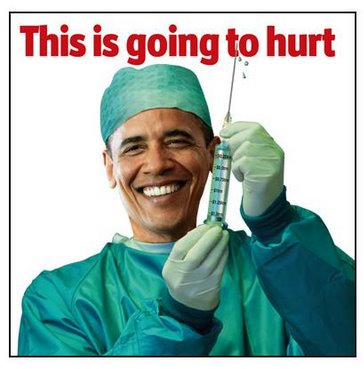
[Image credit: various websites.  If you know the original source, please let me know!]

April 15, 2012

Quick Quote: Noah Webster on getting the government we deserve

"When you become entitled to exercise the right of voting for public officers, let it be impressed on your mind that God commands you to choose for rulers, "just men who will rule in the fear of God." The preservation of government depends on the faithful discharge of this Duty; if the citizens neglect their Duty and place unprincipled men in office, the government will soon be corrupted; laws will be made, not for the public good so much as for selfish or local purposes; corrupt or incompetent men will be appointed to execute the Laws; the public revenues will be squandered on unworthy men; and the rights of the citizen will be violated or disregarded. If government fails to secure public prosperity and happiness, it must be because the citizens neglect the Divine Commands, and elect bad men to make and administer the Laws."

— Noah Webster, History of the United States (1832)


Comment: I see this as the continuation of a theme found in George Washington's farewell address.  The reason we have a government that has strayed so far from the Constitution is that the voters have not demanded constitutional fidelity. 

People tend to vote their values whether they realize it or not.  The kind of leaders we tolerate says as much about our values as it does those of the leaders themselves.

I will expand on this further in a future post.

March 29, 2012

How San Francisco’s $10.24 minimum wage hurts the people it allegedly helps

NBC Bay Area, March 29 brings us another example of the tyranny of good intentions:
Signs posted at Subway sandwich shops sadly inform San Francisco patrons -- we hear Willie Brown is a big fan -- that "all SUBWAY Restaurants in SF County DO NOT PARTICIPATE IN Subway National $5.00 Promotions," according to the newspaper.

[…] Apparently, the city's new minimum wage, raised to $10.24 as of Jan. 1, make $5 footlongs an impossible business model.
Apparently the economic concept is too difficult for the compassionate left to grasp: Raising the minimum wage also raises the cost of items sold at businesses that employ minimum-wage workers.  As these workers go out and spend their raise, the extra income is consumed by the price increases, and the employees are not much better off than they were before. 

When employers are allowed to pay wages at a level where each employee’s labor is a net economic benefit to the business, prices remain stable (absent other upward pressures on costs, such as government regulations or taxes).

The best way for a low-wage employee to better his life is to make himself more valuable to his employer through merit, or to get some training and find a better job.  When he does that, and the employer has the freedom to pay the employee what his labor is worth, everybody wins.

March 15, 2012

How to know if we really believe in the right to free speech

Mark Steyn, in a recent speech given in Australia:
Anyone can be in favour of free speech for Barney the Dinosaur and the Wiggles, but if you’re not in favour of free speech you find offensive and repellent and loathsome, you’re not in favour of free speech at all. And you’re on the side of creeping totalitarianism.
Ironically, a generation ago it was the left that claimed the need to remind conservatives of this truth.

December 5, 2011

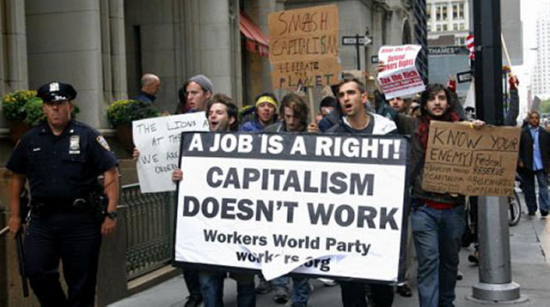
Memo #2 to Occupiers: You are almost certainly being played.

Well, the Occupiers haven't backed down on their Bolshevik rhetoric, so I'll go ahead and repeat the point I made in my last post:

If, somehow, your wildest dreams are realized and you end up overturning the capitalist system, YOU WILL NOT BE ABLE TO CONTROL WHAT TAKES ITS PLACE.

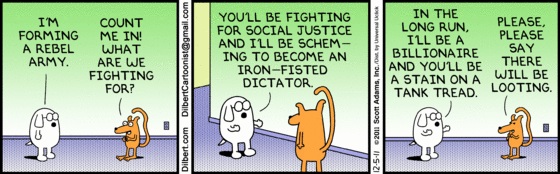
As soon as you realize you've been played by those who are even more nefarious than you are, it'll be too late -- you'll be a "stain on a tank tread".

Something tells me this is what Scott Adams had in mind with today's comic.


October 14, 2011

Memo to the idealists currently “occupying” Wall Street and various other places

Suppose you got everything you seem to want, up to and including the overthrow of capitalism.

You will not be able to control what takes its place.  Seriously.

You envision a utopian society, characterized by economic and social justice, where all is sunshine, rainbows and unicorns, where everyone happily puts the needs of the many above the needs of the few.

It will never happen, not in this life.  Mankind’s fallen nature guarantees it.  History proves it.  If you try it again, you’ll prove it again.

March 4, 2011

Quick Quote: Benjamin Franklin on the War on Poverty

I am for doing good to the poor, but I differ in opinion of the means. I think the best way of doing good to the poor, is not making them easy in poverty, but leading or driving them out of it. In my youth I traveled much, and I observed in different countries, that the more public provisions were made for the poor, the less they provided for themselves, and of course became poorer. And, on the contrary, the less was done for them, the more they did for themselves, and became richer.

-- Benjamin Franklin, On the Price of Corn and Management of the Poor, November 1766
Read the rest here.  Franklin appears to be of the opinion that we shouldn’t allow the social “safety net” to become a hammock.

December 16, 2009

San Francisco’s city government defies gravity; fails to collapse under its own bloated weight

San Francisco has already been described as an increasingly child-free city.  Lately, many have come to recognize yet another dubious distinction for SF.  Benjamin Wachs and Joe Eskenazi report December 14 in SF Weekly:
Despite its good intentions, San Francisco is not leading the country in gay marriage. Despite its good intentions, it is not stopping wars. Despite its spending more money per capita on homelessness than any comparable city, its homeless problem is worse than any comparable city's. Despite its spending more money per capita, period, than almost any city in the nation, San Francisco has poorly managed, budget-busting capital projects, overlapping social programs no one is certain are working, and a transportation system where the only thing running ahead of schedule is the size of its deficit.
It's time to face facts: San Francisco is spectacularly mismanaged and arguably the worst-run big city in America. This year's city budget is an astonishing $6.6 billion — more than twice the budget for the entire state of Idaho — for roughly 800,000 residents. Yet despite that stratospheric amount, San Francisco can't point to progress on many of the social issues it spends liberally to tackle — and no one is made to answer when the city comes up short.
“Despite its good intentions”… For some, the nobility of one’s intentions cover a multitude of sins.  Sure, many of these problems are worse than ever despite all of the money we’ve thrown at them, but at least we care.