C-Poll

The latest C-Poll is closed. You can read all about it here!

March 9, 2009

Nancy Reagan's stance on Embryonic SC research understandable, and wrong

Predictably, Ronald Reagan's widow Nancy has issued a statement praising Obama's reversal of W's stem cell policy:
Under fire from congressional Republicans for lifting restrictions on stem-cell research, President Barack Obama got a powerful endorsement for his move Monday from Nancy Reagan, the former’s president’s wife.

“I’m very grateful that President Obama has lifted the restrictions on federal funding for embryonic stem cell research,” she wrote in a statement released shortly after Obama reversed the Bush administration limits. “These new rules will now make it possible for scientists to move forward. I urge researchers to make use of the opportunities that are available to them, and to do all they can to fulfill the promise that stem cell research offers."

Nancy Reagan has been an outspoken advocate of stem-cell research – and scientists hope that the research could someday lead to a cure for Alzheimer’s disease, which afflicted her late husband, Ronald Reagan.

Her statement also illustrates how support for the research crosses party lines, even though many in the anti-abortion movement strongly oppose the research on moral and ethical grounds.
Ever since her husband was diagnosed with Alzheimer's Disease, Nancy has been an ardent proponent of doing whatever it takes to research a cure. The fact that it involves the destruction of living embryos is irrelevant. The fact that her husband would have strongly opposed her point of view is also irrelevant.

This is heartbreakingly personal for her. But that doesn't make it right.

Baptist missionaries seek to fill spiritual void in New England

New England may have been settled by deeply religious people who rejoiced in their freedom to worship God as they chose, but their descendants seem to have utterly abandoned the faith of their forebears. A recent study shows that the region has attained the dubious honor of being the "least religious part of the country", passing up the Pacific Northwest.

The remaining church community is dominated by theological liberalism, and most of the secular residents see little attraction in that.

It's interesting, then, to see that theologically-conservative Baptists are making considerable inroads in this spiritual wasteland, planting many churches in the region in recent years, and pursuing the ambitious goal of planting thousands more in the coming years. Rural areas are witnessing the strange sight of congregations that are teeming with young folks and are growing, not declining.

March 4, 2009

Are 'moderates' starting to experience buyer's remorse over their choice of president?

Jennifer Rubin recounts excerpts from recent essays by self-styled moderate commentators in which they appear to be coming out of their hypnotic trance. Never mind that everything known about Obama prior to the presidential election season indicated sympathies with radical leftist ideologies -- they were certain that Obama was telling the truth when he promised to govern from the center.

One of my favorite quotes from Rubin's article is by David Brooks, who takes every opportunity to avoid being labeled a right-wing conservative by colleagues further to the left. Here's how he expresses his sense of betrayal in the New York Times March 2:
Those of us who consider ourselves moderates — moderate-conservative, in my case — are forced to confront the reality that Barack Obama is not who we thought he was. His words are responsible; his character is inspiring. But his actions betray a transformational liberalism that should put every centrist on notice. As Clive Crook, an Obama admirer, wrote in The Financial Times, the Obama budget “contains no trace of compromise. It makes no gesture, however small, however costless to its larger agenda, of a bipartisan approach to the great questions it addresses. It is a liberal’s dream of a new New Deal.”
Mr. Brooks, Obama has zero -- zero -- history of bipartisan compromise. What made you think this fact would change once any meaningful opposition to his leftist ideology had been neutralized?

If you read on in Brooks' "Moderate Manifesto", you get the sense that he expected Obama to come closer to Brooks' Hamiltonian ideal of "limited but energetic government" (a term of art, that).

This would be worth a good laugh if the misperception hadn't made the difference in bringing Obama to power.


(Image credit: Made In England)

February 27, 2009

Obama has openly declared his plans to transform America; we can't say that we weren't warned

President Obama on Tuesday declared for all the world to hear that he won't rest until our country has been remade in the image of the European Union.

You know, that worker's paradise of freedom and entrepreneurship.

That place where the health care is free, if you can get an appointment.

That place with a bureaucracy that rivals the one found in Terry Gilliam's dystopic masterpiece Brazil.

Charles Krauthammer summarizes Obama's bold plans:
(1) Obama wants to be to universal health care what Lyndon Johnson was to Medicare. Obama has publicly abandoned his once-stated preference for a single-payer system as in Canada and Britain. But that is for practical reasons. In America, you can't get there from here directly.
Instead, Obama will create the middle step that will lead ultimately and inevitably to single-payer. The way to do it is to establish a reformed system that retains a private health-insurance sector but offers a new government-run plan (based on benefits open to members of Congress) so relatively attractive that people voluntarily move out of the private sector, thereby starving it. The ultimate result is a system of fully socialized medicine. This will likely not happen until long after Obama leaves office. But he will be rightly recognized as its father.
(2) Beyond cradle-to-grave health care, Obama wants cradle-to-cubicle education. He wants far more government grants, tax credits and other financial guarantees for college education -- another way station to another universal federal entitlement. He lauded the country for establishing free high school education during the Industrial Revolution; he wants to put us on the road to doing the same for college during the Information Age.
(3) Obama wants to be to green energy what John Kennedy was to the moon shot, its visionary and creator. It starts with the establishment of a government-guided, government-funded green energy sector into which the administration will pour billions of dollars from the stimulus package and billions more from budgets to come.
The America he leaves behind at the end of his term will be nothing like the one any of us have known.

February 26, 2009

Did the "era of big government" REALLY end during the Clinton administration?

Reuters gets my vote for the most clueless news article introduction of the day:
Obama brings back era of big government
Thu Feb 26, 2009 8:48pm GMT

By Steve Holland - Analysis

WASHINGTON (Reuters) - Bill Clinton declared more than a decade ago "the era of big government is over." With his new budget, President Barack Obama has brought it back.
Attention, Steve Holland: Bill Clinton's declaration was nothing more than hot air. Big government hardly slowed its expansion under Bill Clinton.

The era of big government certainly did not end under George W. Bush, either. Among many egregious examples, Bush's addition of prescription drugs to the Medicare entitlement was an abomination of big government expansion.

Of course, as Mr. Holland's article goes on to describe, Barack Obama has already beggared his predecessor's worst big-government accomplishments.

But, good grief -- there must be a better way to intro this fact than by resurrecting a meaningless throwaway line from a Clinton speech.

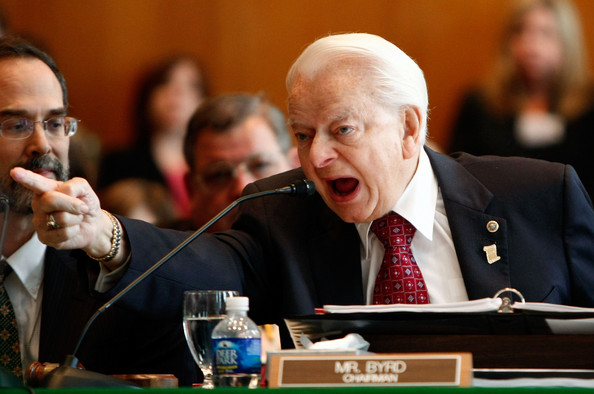
Sen. Robert Byrd: Convenient constitutionalist


West Virginia senator Robert Byrd usually busies himself diverting a disproportionate amount of federal expenditures into his state (and thereby getting an increasing number of public works named after him there).

Every once in a while, though, he erupts in a fit of constitutionalism, correctly calling attention to some abuse of the clearly-delineated restrictions on federal power.

For example, yesterday the senator criticized the Obama administration for violating the constitutional separation of powers, as Politico reported:

Sen. Robert Byrd (D-W.Va.), the longest-serving Democratic senator, is criticizing President Obama’s appointment of White House “czars” to oversee federal policy, saying these executive positions amount to a power grab by the executive branch.

In a letter to Obama on Wednesday, Byrd complained about Obama’s decision to create White House offices on health reform, urban affairs policy, and energy and climate change. Byrd said such positions “can threaten the Constitutional system of checks and balances. At the worst, White House staff have taken direction and control of programmatic areas that are the statutory responsibility of Senate-confirmed officials.”

While it's rare for Byrd to criticize a president in his own party, Byrd is a stern constitutional scholar who has always stood up for the legislative branch in its role in checking the power of the White House. Byrd no longer holds the powerful Appropriations chairmanship, so his criticism does not carry as much weight these days. Byrd repeatedly clashed with the Bush administration over executive power, and it appears that he's not limiting his criticism to Republican administrations.

Byrd also wants Obama to limit claims of executive privilege while also ensuring that the White House czars don’t have authority over Cabinet officers confirmed by the Senate.
Byrd's criticism appears to be on the mark, but in my opinion his motives are not entirely pure.

The third paragraph is key: "Byrd is a stern constitutional scholar who has always stood up for the legislative branch in its role in checking the power of the White House."

In other words, "constitutional scholar" Byrd stands up for the Constitution only when the power of the legislative branch is threatened.

You'll rarely (if ever) hear his thundering protests when Congress itself routinely steps out of its constitutional sandbox.

That said, we'll take whatever we can get.

Obama administration surprised, dismayed at its own immigration enforcement action

You can't make this stuff up. Washington Times, February 26:
Immigrant rights groups blasted President Obama on Wednesday for breaking what they called his "personal commitment" to change Bush-era immigration raids after U.S. authorities raided an engine machine shop in Washington state and detained illegal immigrants.
The Obama administration itself seemed taken aback by the raid by U.S. Immigration and Customs Enforcement agents, with Homeland Security Secretary Janet Napolitano vowing to Congress that she would "get to the bottom of this."
ICE agents enforce the law, and their boss vows she'll "get to the bottom of this".

And that phrase "Bush-era immigration raids" is a work of art.

Quick Quote: We know our cell phone contract better than we know the Constitution

As I have traveled across the country, I have been astounded just how many of our fellow citizens feel strongly about their constitutional rights but have no idea what they are, or for that matter, what the Constitution says. I am not suggesting that they become Constitutional scholars -- whatever that means. I am suggesting, however, that if one feels strongly about his or her rights, it does make sense to know generally what the Constitution says about them. It is at least as easy to understand as a cell phone contract -- and vastly more important.

-- Clarence Thomas, U.S. Supreme Court Justice, October 16, 2008 speech

Quick Quote: The U.S. is NOT a democracy!

Q. If we are not a democracy, why are our officials elected by a majority of the people, and why are our laws passed by a majority of the lawmakers?

A. We are not a democracy because both the people and the lawmakers are limited by the fundamental law of the land, our written Constitution. Election by the people is not a grant of power beyond the constitutional limits of the office. A representative government limited by law is a republic, not a democracy. In a republic a majority of the people cannot vote away their own rights, or the rights of others unless ... unless they step outside the Constitution.

-- Preserve The Constitution, By Don Fotheringham (October, 1995)

The rich don't make enough to fund Obama's spending spree

The Wall Street Journal does some basic arithmetic that gives the lie to President Obama's promise that households making less than $250,000 won't see their taxes go up "one single dime".

In fact, even if Obama seized 100% of the taxable income of the richest Americans, it wouldn't come close to covering the amount the administration wants to spend next fiscal year.

Face it. One way or the other, your taxes are going up.

February 25, 2009

Bernanke to borrowers: You picked a good time to take out an irresponsible loan

Let me get this right.

A borrower takes out a mortgage, knowing full well that he is buying more house than he can really afford in the long run.

Even in the best of economic times, this fellow stood a good chance of defaulting. But in the economic tsunami currently overwhelming the housing market, his mortgage is just one piece of debris among many.

Even though he, with premeditation, took out a loan that he knew he could not repay, should he have his fortunes restored at the expense of the taxpayers?

You betcha, says Federal Reserve Chairman Bernanke.

CNNMoney reports today:
Federal Reserve Chairman Ben Bernanke said Wednesday that the embattled housing market has crippled the economy, and at-risk homeowners need a bailout - even if they knew they couldn't afford their home in the first place.

"Some borrowers presumably knew what they were getting into," Bernanke said before the House Financial Services Committee. "But from a public policy point of view, the large amount of foreclosures are detrimental not just to the borrower and lender but to the broader system."

"In many of these situations we have to trade off the moral hazard issue against the greater good," he added.

Are we witnessing the abolition of personal responsibility in financial matters? For how long? Barney Frank agrees that "moral hazard needs to take a back seat for the time being". "For the time being" -- whatever that means.

That giant sucking sound you hear is the draining away of the livelihood of our children and grandchildren -- all of whom will be footing the bill for our current drunken spending spree:
"I'm worried that the [government's] policies will only delay the inevitable -- a full correction of the market -- while saddling future generations with trillions of dollars in debt," said Rep. Scott Garrett, R-N.J.

February 20, 2009

Another creepy example of Obama's personality cult


Detroit Free Press, January 21:
See Obama in yourself -- and take a photo for our gallery


You can help build our gallery of faces from people who see a part of President Barack Obama in themselves.

We've got a photo of Obama you can cut out for yourself -- click here to download it. Then follow the instructions, take a picture and send it to us here. Tell us what part of Obama is in you and we'll add your comments to your photo.

See more photos at freep.com/obamaportraits.

Of course we can trust the media to provide us fair and objective reporting on the Obama administration.

Internet SAFETY Act: Exchanging liberty for safety yet again

Did you ever notice that encroachments on our privacy and liberty are so often justified as being For The Sake Of The Children™? CNet's Declan Mccullagh reports:
Republican politicians on Thursday called for a sweeping new federal law that would require all Internet providers and operators of millions of Wi-Fi access points, even hotels, local coffee shops, and home users, to keep records about users for two years to aid police investigations.
The legislation, which echoes a measure proposed by one of their Democratic colleagues three years ago, would impose unprecedented data retention requirements on a broad swath of Internet access providers and is certain to draw fire from businesses and privacy advocates.
"While the Internet has generated many positive changes in the way we communicate and do business, its limitless nature offers anonymity that has opened the door to criminals looking to harm innocent children," U.S. Sen. John Cornyn, a Texas Republican, said at a press conference on Thursday. "Keeping our children safe requires cooperation on the local, state, federal, and family level."
Joining Cornyn was Texas Rep. Lamar Smith, the senior Republican on the House Judiciary Committee, and Texas Attorney General Greg Abbott, who said such a measure would let "law enforcement stay ahead of the criminals."
Two bills have been introduced so far--S.436 in the Senate and H.R.1076 in the House. Each of the companion bills is titled "Internet Stopping Adults Facilitating the Exploitation of Today's Youth Act," or Internet Safety Act.
Each contains the same language: "A provider of an electronic communication service or remote computing service shall retain for a period of at least two years all records or other information pertaining to the identity of a user of a temporarily assigned network address the service assigns to that user."
The article goes on to describe how sweeping this data retention requirement is.

Republicans can be forgiven for this encroachment, because it's For The Sake Of The Children™. Anybody who objects must hate children.

After all, I've got nothing to hide, so why do I care if the government has the ability to track my Internet usage?

CNN 'rescue' poll assumes too much, misses half of story

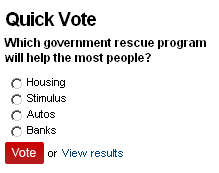
CNN/Money is running the following online poll today:


At the moment, "Housing" has a significant lead at 52%, and it is not likely to give up its lead.

I'm amazed at how much is assumed by the poll question. For example, the assumption that all of the listed programs will 'help' people.

Sure, many individuals will be able to benefit from, say, a government-subsidized mortgage adjustment. But is that the whole story?

Where will the money for that mortgage adjustment come from? How many other people will be harmed (through the confiscation of their assets) so that this person can be helped?

What is the net number of people that will be helped by these bailouts? It's quite possible that the net will be negative.

I apologize. The only real negative here is my selfish attitude. I must remember the words of our soon-to-be dear leader when he taught us last October:
"My attitude is that if the economy's good for folks from the bottom up, it's gonna be good for everybody. I think when you spread the wealth around, it's good for everybody."
Never mind. I'm okay now. Forget I said anything.