With the announcement of each new boycott of Arizona companies (such as the one just approved by L.A. County), I wonder if the Legion of the Outraged has thought this through completely.
If, somehow, these boycotts manage to have an actual economic impact on Arizona businesses, just who do they think will lose their jobs first? Wouldn't it be the lower-income employees?
Even if the middle- and upper-class somehow got hit first, their ensuing decrease in economic activity would affect... who?
I cannot escape the conclusion that those who purport to champion the cause of Hispanics in Arizona secretly hate them.

April 17, 2010
Government-authored spyware – what a great idea!
Tom’s Guide reports:
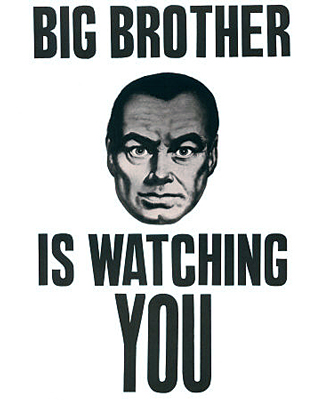
Big Brother is watching you. Actually, it's the RIAA and the MPAA, especially if you're parked on a BitTorrent client. The Electronic Frontier Foundation reports that both organizations--along with a few others--want to take the file-monitoring process a huge step further by infiltrating consumer PCs and deleting the infringing content off their hard drives. How? Through "anti-infringement" spyware developed and enforced by the government.
This is no joke.
"There are several technologies and methods that can be used by network administrators and providers...these include [consumer] tools for managing copyright infringement from the home (based on tools used to protect consumers from viruses and malware)," reads a caption in a joint comment (pdf) filed by the MPAA and RIAA.
The joint comment goes on to suggest other means of copyright enforcement including a mandatory scan on all internet connections to interdict transfers of illegal content, physical searches at all borders of personal media players, laptops, and USB sticks. There's even an indication that the parties want to enforce international bullying to force other countries to put similar policies in place.
A couple of observations are in order.
First, the only reason the RIAA and MPAA could even dream of getting the federal government to do something like this is that they know the fedgov recognizes no meaningful limits on its power. Industries take advantage of this fact all of the time – using the government as a bludgeon against one’s competitors has become a time-honored tradition in this country – but the RIAA/MPAA proposal goes beyond what we normally see.
Many people who will complain that this is an unconstitutional invasion of privacy and a denial of due process will, the next day, demand that the government provide health care, jobless benefits, welfare, etc. We can’t have it both ways. Either the federal government is bound by the U.S. Constitution, or it isn’t.
Second, is there any real difference between government-authored spyware on our computers and government-installed surveillance cameras in our homes? Both would have the same official purpose – crime prevention. I wonder if RIAA and MPAA executives would consent to government video surveillance of their mansions, “just in case” they decided to do something illegal.
April 15, 2010
Unions could indeed be the strongest force for good government, if it wasn’t for the fact that they are unions
Today’s email update from CNSNews had this ironic juxtaposition of headlines:
Rep. Grayson Calls Labor Unions Strongest Force for ‘Good Government’
April 14, 2010
Way to court the conservative base, Mitt

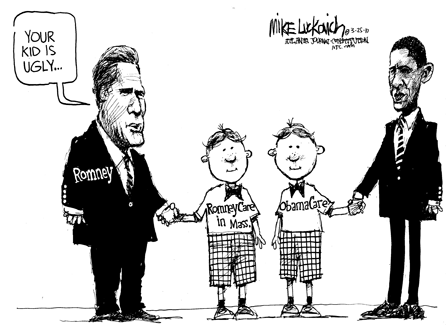
Mitt Romney’s opposition to ObamaCare appears to be based on technical objections – in other words, Romney thinks he would have done a better job of expanding his Mass-Care miracle to the national level. NY Times, April 9:
The Democratic National Committee has posted a video compilation of Mr. Romney’s comments praising the Massachusetts health insurance mandate. Twice last week, Mr. Obama pointedly observed that Mr. Romney seemed to be lambasting a federal plan that was derivative of his own Massachusetts model.
“I keep on scratching my head,” Mr. Obama said at a fund-raising reception in Boston. “I say, ‘Boy, this Massachusetts thing, who designed that?’ ”
In response, Mr. Romney is reminding audiences that Mr. Obama has cast the Republicans as the “party of no,” devoid of ideas. “And yet,” Mr. Romney said in Bedford, “he’s saying that I was the guy that came up with the idea for what he did. He can’t have it both ways.”
He added, “If ever again somewhere down the road I would be debating him, I would be happy to take credit for his accomplishment.”
Yes, he’s bragging about the fact that ObamaCare got its inspiration from Romney’s Mass-Care, which some insist will end up bankrupting the state of Massachusetts.
Remember, Mitt: the GOP’s conservative base dominates the primary voting. If you want to trick enough of them into thinking you’re a conservative, you need to stop showing your true colors.
Via: Rich Lowry, NRO
Vanity, thy name is Barack Obama
What rankles, though, is Obama's habit of putting down America while praising himself. The laughable assertion that Obama has taken 'historic steps to improve our own democracy' shows not humility but an extreme vanity. A truly humble president would occasionally evince some doubt as to whether he is worthy to lead America. Obama seems to doubt whether America is worthy of being led by him.
-- James Taranto, Best of the Web (WSJ), April 12
-- James Taranto, Best of the Web (WSJ), April 12
April 13, 2010
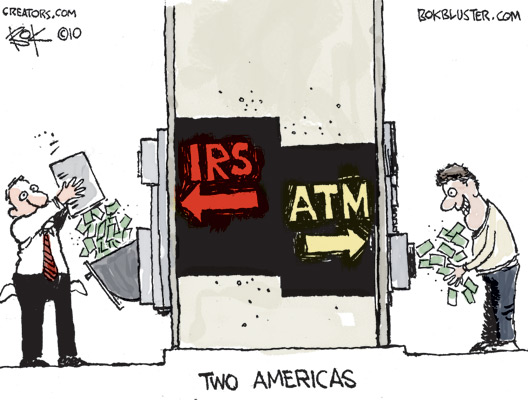
Two Americas: Tax consumers close to outnumbering tax payers for the first time
AP reported last week that nearly half of US households will have no income tax liability whatsoever this year:
“A government that robs Peter to pay Paul can always depend on the support of Paul.” – George Bernard Shaw
About 47 percent will pay no federal income taxes at all for 2009. Either their incomes were too low, or they qualified for enough credits, deductions and exemptions to eliminate their liability. That's according to projections by the Tax Policy Center, a Washington research organization.The untaxed 47%, once they realize the power of their position, will gladly vote for politicians who promise to raise taxes on someone else, while the remaining 53% can be divided and conquered on other issues.
“A government that robs Peter to pay Paul can always depend on the support of Paul.” – George Bernard Shaw
April 9, 2010
Timing of Stevens retirement announcement belies Obama administration concerns about November elections
US Supreme Court Justice John Paul Stevens had already telegraphed his intention to retire while Obama is president, so it was only a matter of when.
The WaPo reports today that he has now informed the president that he will retire at the end of the Court’s current term. Why now? On the surface, the timing seems pretty routine:
Stevens said he was announcing now so that the president would have time to make a nomination and the Senate to confirm in time for the start of the court's new term next October.
But why this year? Stevens has been quite clear that he didn’t want a Republican to name his successor, so in theory his retirement could have, for example, waited until next year.
Then again, the Obama White House senses an ill wind blowing among the electorate, a wind that might sweep some or all of the Democrat majority out of the Senate in November.
Even if the Dems retain their majority, the loss of just a few seats would force Obama to choose a nominee that is far less radical than he would like. Hence, given the uncertainties of November, there is no better time than now for Obama to get a justice more to his liking.
Is there any serious doubt that Stevens is deferring to the political calculations of the administration?
Yes, yes, I know, it happens with Republican presidents too.
The notion of an independent judiciary is long dead – yet another symptom of the twilight years of the American republic.
April 2, 2010
Conservatives shouldn’t play the identity politics game either
Phylllis Schlafly makes her case for the type of person who should be nominated to replace John Paul Stevens, should he be the next to retire:
With all due respect, Mrs. Schlafly, we shouldn’t be concerning ourselves with whether or not this group or that group is respresented among The Nine.For as long as we can remember, the U.S. Supreme Court has included at least one military veteran. Recent examples include Republican-appointed Chief Justice William Rehnquist, who died in 2005, and Justice John Paul Stevens, who is expected to resign this year.
The Democrats have not placed a veteran on the Supreme Court in nearly half a century. When President Obama fills Stevens' seat, will the High Court be left without anyone who has military experience?
Veterans in the U.S. Senate should make sure that such an embarrassment does not occur. Cases concerning the military appear every year before the Supreme Court, and our nation will not be well-served by a court lacking in military experience.
For my part, the only special interest I want to see represented in the Supreme Court is The Constitution of the United States.
Yeah, I know, I know. But I can dream, can’t I?Conservatives shouldn’t play the identity politics game either
Phylllis Schlafly makes her case for the type of person who should be nominated to replace John Paul Stevens, should he be the next to retire:
For as long as we can remember, the U.S. Supreme Court has included at least one military veteran. Recent examples include Republican-appointed Chief Justice William Rehnquist, who died in 2005, and Justice John Paul Stevens, who is expected to resign this year.
The Democrats have not placed a veteran on the Supreme Court in nearly half a century. When President Obama fills Stevens' seat, will the High Court be left without anyone who has military experience?
Veterans in the U.S. Senate should make sure that such an embarrassment does not occur. Cases concerning the military appear every year before the Supreme Court, and our nation will not be well-served by a court lacking in military experience.
With all due respect, Mrs. Schlafly, we shouldn’t be concerning ourselves with whether or not this group or that group is respresented among The Nine.
For my part, the only special interest I want to see represented in the Supreme Court is The Constitution of the United States.
Yeah, I know, I know. But I can dream, can’t I?
March 26, 2010
Quick Quote: Milton Friedman on why business is none of the government’s business
“The economic miracle that has been the United States was not produced by socialized enterprises, by government-union-industry cartels or by centralized economic planning. It was produced by private enterprises in a profit-and-loss system. And losses were at least as important in weeding out failures as profits in fostering successes. Let government succor failures, and we shall be headed for stagnation and decline.”
-- Milton Friedman
March 24, 2010
Is the GOP already losing its will to fight ObamaCare?
Jeffrey Anderson at National Review Online (emphasis added):
Be sure to vote in our C-Poll some time in the next 7 days!
Less than three days after the passage of Obamacare, many Republicans are already losing their stomach for the fight. As Ezra Klein gleefully — but aptly — observes over at the Washington Post, “In about 12 hours, the GOP's position has gone from ‘repeal this socialist monstrosity that will destroy our final freedoms’ to ‘there are some things we don't like about this legislation and would like to repeal, and there are some things we support and would like to keep.’ . . . At this rate, they'll be running on expanding the bill come November.”You can read the WaPo article here.
Sen. Jon Kyl said, “I would guess probably more realistically would be a potential repeal of pieces of the bill.” It lights the fire in the belly, doesn’t it? Sens. Mike Enzi and John Cornyn followed suit.
On MSNBC, Rudy Giuliani, said, “You just laid out how the Republicans should run the campaign, when we get a month, two months out of this — not repeal health care.” With all due respect to Mayor Giuliani, this is the sort of thinking that led to his Florida Strategy.
Sometimes, one has to wonder at Republicans’ tin ear. If they were writing Patrick Henry’s famous 1775 address, would they have advised, “Well, full liberty might be a bit much to ask for. And I’m not sure if we really want death. How about, 'Give me a little more liberty, or make me ill'?”
“Repeal, and then real reform” — that’s the right message, and the one that reflects the American people’s views. “Partial repeal” actually legitimizes Obamacare and helps to sell it by suggesting that the GOP doesn’t really think it’s all that bad.
Be sure to vote in our C-Poll some time in the next 7 days!
C-Poll: Have the Republicans grown a spine, and for the right reason?
A new poll has been posted at the top of the page:
The united House Republican stand against the just-passed health care 'reform' bill can best be attributed to…
If you wish to comment, feel free to do so here.
UPDATE: Is the GOP already losing its will to fight ObamaCare?
UPDATE, April 2: Here are the poll results (click for larger image):
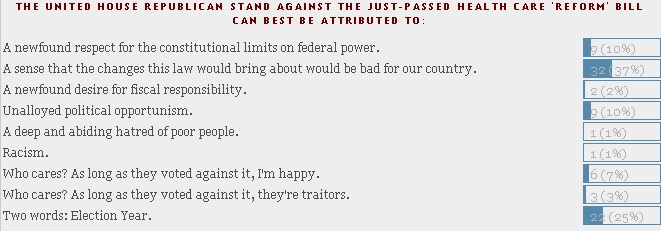
Unsurprisingly, constitutional concerns (i.e. “A newfound respect for the constitutional limits on federal power”) did not score well, although an amazing 10% thought that the bulk of the GOP congressfolks were thus motivated. Sorry, dear reader, but that’s crazy talk.
The winner at 37% was the second choice: “A sense that the changes this law would bring about would be bad for our country.” Well, okay, this happened to coincide with the constitutionally correct vote, but it won’t always.
Political calculation came in second, as embodied in the fourth and ninth choices (combining for 35%): “Unalloyed political opportunism” and “Two words: Election Year”.
For the record, I inclined toward one of the political calculation choices, given that many of the same folks expressing outrage at Obamacare voted for the Medicare prescription drug entitlement a few years ago.
This is what fawning media coverage looks like
I still laugh when I hear Democrats complain that Fox News is the only biased news channel out there. Thanks to NewsBusters, we have a sampling of how CBS and ABC waxed rhapsodic as they covered Obama’s signing of the health care “reform” law.
CBS Evening News’ Harry Smith, as a graphic of Obama’s signature was displayed:

So…. tell me again about Fox News?
CBS Evening News’ Harry Smith, as a graphic of Obama’s signature was displayed:
This is what history looks like, as it came from the hand of President Obama today with 22 different pen strokes comprising his signature.ABC World News’ Diane Sawyer lost no time insinuating that the Republicans are against Americans having health insurance:
Good evening. As of today, it is the law of the land that every man, woman and child in America will have health care coverage. And at the White House, the President signed the bill and marked this day in history, while Republican opponents marshaled forces, hoping to undo the law...ABC also reported seriously on a bit of political theater at Ted Kennedy’s grave. Said Sawyer:
You heard the President pay tribute to Senator Ted Kennedy, who devoted his career to health care reform. But there was another quiet tribute at the Senator's grave. A note left by his son, Congressman Patrick Kennedy. It said simply: 'Dad -- the unfinished business is done.'Inexplicably, the graphic also showed that the gravestone was also covered with dead insects. Not sure of the symbolism there.
So…. tell me again about Fox News?
March 23, 2010
Big Nanny stands ready to criticize your food choices
AP (via Yahoo) reports on one of the mandates buried in the health care “reform” signed today by the president:
So, what’s the next phase of the campaign? How about “informed consent”? Customers will not receive their food until they sign a form affirming that they are aware of the calorie impact of their meal.

But what if customers STILL won’t make good food choices? Is it really outlandish to predict that the government will eventually start regulating the maximum calorie content of restaurant meals?
One last thought: as the above excerpt shows, only restaurant chains with 20 or more locations are subject to the labeling requirements. This means that obese people can continue to patronize local non-chain restaurants in blissful (and deadly, if you believe the nannies) ignorance, regardless of the gastronomical atrocities on said restaurants’ menus.
This is an implicit acknowledgment of the fact that compliance with these regulations is awfully expensive. But, if we accept the notion of the federal government as our food-choice nanny, we cannot protest when the regulations are eventually made universal, even at the expense of the financial stability of our favorite local eatery. As Hillary Clinton famously said in 1994 regarding the financial impact of the Clinton administration’s attempt to nationalize the health care industry: “I can't be responsible for every undercapitalized small business in America.”
A requirement tucked into the massive U.S health care bill will make calorie counts impossible for thousands of restaurants to hide and difficult for consumers to ignore. More than 200,000 fast food and other chain restaurants will have to include calorie counts on menus, menu boards and even drive-throughs.“The idea is to make sure that customers process the calorie information as they are ordering.” But what if, despite the new labeling, the customer still ignores the calorie information? The administration (led by Gen. Michelle Obama) has declared war on obesity, so I can’t imagine it standing by idly as customers continue to order the foods they like.
The new law, which applies to any restaurant with 20 or more locations, directs the Food and Drug Administration to create a new national standard for menu labeling, superseding a growing number of state and city laws. President Barack Obama signed the health care legislation Tuesday.
The idea is to make sure that customers process the calorie information as they are ordering. Many restaurants currently post nutritional information in a hallway, on a hamburger wrapper or on their Web site. The new law will make calories immediately available for most items.
"The nutrition information is right on the menu or menu board next to the name of the menu item, rather than in a pamphlet or in tiny print on a poster, so that consumers can see it when they are making ordering decisions," says Sen. Tom Harkin, chairman of the Health, Education, Labor and Pensions Committee, who wrote the provision.
So, what’s the next phase of the campaign? How about “informed consent”? Customers will not receive their food until they sign a form affirming that they are aware of the calorie impact of their meal.
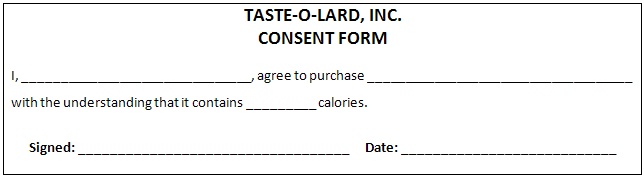
But what if customers STILL won’t make good food choices? Is it really outlandish to predict that the government will eventually start regulating the maximum calorie content of restaurant meals?
One last thought: as the above excerpt shows, only restaurant chains with 20 or more locations are subject to the labeling requirements. This means that obese people can continue to patronize local non-chain restaurants in blissful (and deadly, if you believe the nannies) ignorance, regardless of the gastronomical atrocities on said restaurants’ menus.
This is an implicit acknowledgment of the fact that compliance with these regulations is awfully expensive. But, if we accept the notion of the federal government as our food-choice nanny, we cannot protest when the regulations are eventually made universal, even at the expense of the financial stability of our favorite local eatery. As Hillary Clinton famously said in 1994 regarding the financial impact of the Clinton administration’s attempt to nationalize the health care industry: “I can't be responsible for every undercapitalized small business in America.”
The two legitimate, constitutional purposes of the federal government
A plain, non-mystical reading of the U.S. Constitution shows that the purpose and function of the federal government can be boiled down to just two principles:
- The federal government exists to exercise the collective will of the states in our country’s dealings with other countries (diplomatically and militarily).
- The federal government exists to ensure that the various states comprising our country play nicely with each other.
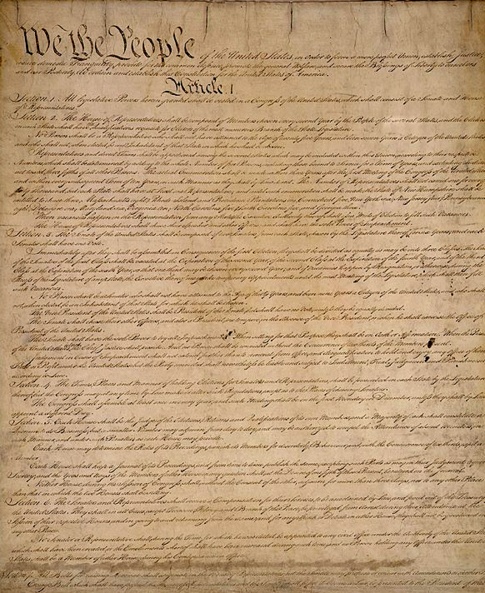
The text of the Constitution gives the details that support these principles. The first ten amendments were intended to make double sure that the federal government knew its place (they are, every one of them, constraints on federal power, not on state or local power)*.
Agree or disagree? Are there any other fundamental principles in the U.S. Constitution that are clearly distinct from the above two?
Please be so kind as to support your position in any civil way that you see fit.
* Some of the later amendments did violence to the constitutional relationship between the states and the federal government—but that’s a subject for another post.
Subscribe to:
Posts (Atom)