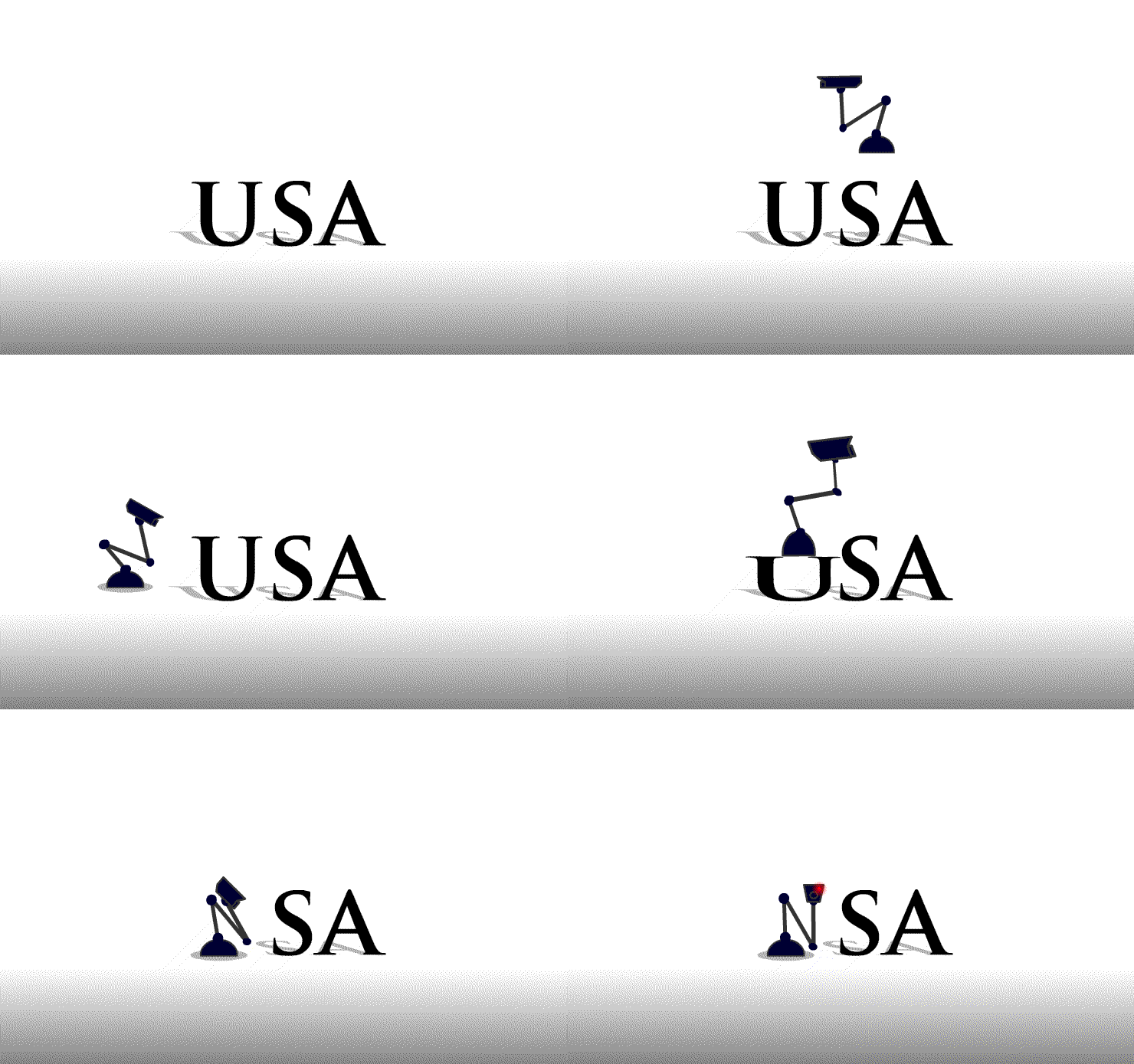
Human nature being what it is, government always tends toward authoritarianism (or worse), regardless of the nobility or ignobility of a government's founders. If the citizens were always in perfect harmony with the rulers, authoritarianism wouldn't be necessary. In the real world, though, government must eventually take measures to create harmony by force.
Many on the right, Christian conservatives included, are justifiably alarmed at the brazen power grabs of the left. They often think: "If only we can get our folks into power, all will be rainbows and unicorns again."
But is that realistic? George W. Bush, while deeply flawed, had his conservative moments during his presidency, and it was at those times that he faced the full onslaught of a culture that has never been more out of harmony with conservative and constitutional principles.
Remember my earlier statement: in the absence of natural harmony, governments can create harmony only by force. This is why authoritarian government isn't just the plaything of the left.
The late Francis Schaeffer, a Christian apologist and deep-thinker, saw peril in Christians' tendency to remain silent when government authoritarianism was directed at others. Writing in 1983, he warned:
Will we resist authoritarian government in all its forms regardless of
the label it carries and regardless of its origin? The danger in regard
to the rise of authoritarian government is that Christians will be
still as long as their own religious activities, evangelism, and life-styles are not disturbed.
[...] Here is a sentence to memorize: To make no decision in regard to the growth of authoritarian government is already a decision for it. —How Should We Then Live? (1976). Italics in the original.
More than thirty years later, Christians are now well aware of what it's like to be the target of the government's authoritarian impulses. Schaeffer might argue that our silence in the past made our current difficulties more likely.
Ted Cruz has already declared, and it's pretty much a foregone conclusion that Marco Rubio and Rand Paul, among others, will toss their hats into the ring within the next few weeks. Some on the right might see this as evidence of the enduring vitality of the conservative movement in the face of an aggressive cultural jihad against its values. I see the Republican establishment clinching the nomination, yet again -- and not necessarily because of any particular shortcomings the conservative challengers might possess.
Thesis: Every conservative that declares for the 2016 nomination, regardless of his/her ideological bona fides, decreases the probability that a conservative will actually win the nomination.
Every four years, we get the same thing in the GOP primary season: Several conservatives, one or two moderates acceptable to the establishment, and occasionally, some unabashedly liberal candidate who spends his campaign attacking the views of the 99% of the party who are to his right.
The conservative candidates all have passionate fan bases of varying sizes. These candidates spend the bulk of their time trying to win the other conservative factions over, all but ignoring the establishment candidate(s) at first: "If only the other conservative candidates would drop out of the race, their voters would unite behind me, and we could win this! How can they be so selfish?"
Conservatives select a 2016 standard-bearer. (Note: the establishment candidates are the relaxed ones in the foreground)
Each primary comes and goes. One conservative candidate does well here, and another there. The diffusion of the conservative vote into angry factions begins leading to plurality wins for at least one of the moderate candidates. As the delegate momentum builds for one moderate, other moderates drop out of the race, and the establishment's fundraising machine kicks into high gear for the anointed one.
Too late, the conservatives stop clawing at each other long enough to realize that the establishment candidate is pulling away. By then, it usually doesn't matter if all but one conservative drops out; all the moderate must do from this point forward is to calmly and cheerfully quote the remaining candidate's erstwhile conservative opponents against him or her. The conservative, who up to this point has focused exclusively on fellow conservatives, can do little but splutter in response.
Once again, the opportunity has been lost, and the moderate walks away with the nomination.
I've been an active voter for over 30 years, and I've witnessed this phenomenon far too many times for it to be attributed to my imagination. Alas, more than a year and a half prior to the 2016 election, this cycle appears to be no different.
There is much that I like about each of the likely conservative candidates, but I doubt that any of them will get the nod. The Texas primary is held late in the season, typically meaning that we will have only the establishment candidate and the last major conservative candidate to choose from. As usual, I'll probably cast a protest vote against the establishment. For all the good it'll do.
----
April 10 UPDATE:Rasmussen shows that I'm not alone in my pessimism.
This week, I was quite surprised to learn from my Facebook newsfeed that quite a few on the left are excited about the notion of mandatory voting for American citizens (at least, I assume they're wanting this just for the citizens). My gut reaction is that this is, quite possibly, one of the worst ideas ever presented as a solution to the phenomenon of low voter participation.
Before explaining why I believe this, I should note that this erupted into the news this week because our Dear Leader just endorsed the notion. Yahoo! News, March 18:
Obama floated the idea of mandatory voting in the U.S. while speaking to a civic group in Cleveland on Wednesday. Asked about the corrosive influence of money in U.S. elections, Obama digressed into the related topic of voting rights and said the U.S. should be making it easier — not harder— for people to vote.
Just ask Australia, where citizens have no choice but to vote, the president said.
"If everybody voted, then it would completely change the political map in this country," Obama said, calling it potentially transformative.
Yes, it would be grand if citizens took seriously their civic responsibility to participate in our democratic institutions. So, why don't they? The president's speech encapsulates the reasons that I usually see proffered by the Left:
Not only that, Obama said, but universal voting would "counteract money more than anything."
Disproportionately, Americans who skip the polls on Election Day are younger, lower-income and more likely to be immigrants or minorities, Obama said. "There's a reason why some folks try to keep them away from the polls," he said in a veiled reference to efforts in a number of Republican-led states to make it harder for people to vote.
Yikes! So...anywhere from a half to two-thirds of voting-age citizens are informed, motivated folks who are systematically kept away from the polls by Republican voter-suppression efforts.
Seriously?
Forcing these 50%+ of voting-age citizens to the polls won't turn them into informed, motivated voters. Any person who takes a half-serious look at human nature should be able to conclude two things: (1) These uninformed, unmotivated folks will look for the easiest way to avoid the failure-to-vote penalty (most likely a fine); and (2) The informed, motivated folks (both left and right) will be ready to help the uninformed, unmotivated folks discharge their duties in the most expedient way possible.
"Just tell me who to vote for, okay?"
This will come down to a contest of which ideological tribe can get the most apathetic sheep to the polls. The Left's giddiness about the mandatory voting proposal is evidence enough that progressives believe that they would win that contest.
Many people decry the prevalence of political/ideological arguments on Facebook, but I've come to appreciate this phenomenon to a certain extent. In the past, ideologues tended to keep to their own online neighborhoods, and as a result most people spent their days in the company of folks who agreed with them on the Issues That Matter.
Suddenly, Facebook. Just about everybody has relatives or friends who hail from some faraway part of the ideological spectrum, and many of those folks are pumped up enough about their worldview to post articles and memes about whatever motivates them. Facebook is facilitating what seems to be an unprecedented mixing of ideological tribes. As most with FB accounts know well, that mixing is often not a beautiful sight to behold.
For the most part, I've made my peace regarding this phenomenon in my own newsfeed. Those articles used to annoy me, and I would often launch into heated debates that never ended up moving the ball in either direction.
Gazing across the divide
Now, though, I see a personal growth opportunity in things that used to make my blood boil. I have a goal of truly understanding the progressive worldview -- not just its most common positions on current issues (those are usually easy to guess), but understanding the foundational assumptions about reality that set the progressive tribe apart from other worldview tribes.
So, I continue to poke and prod my interlocutors, but not necessarily for the purpose of winning the argument. How can one have a constructive argument when the two parties don't even agree on the definitions of terms that are important to the argument? No, my poking and prodding is intended to help me understand what makes them tick. And I truly do want to understand. Apparently, this is not normal or common, because progressives, even ones I'm related to, tend to react with suspicion when I tell them this.
To me, it's worth the effort. Not only am I better able to understand why someone believes something so outrageous (to me), I am also given many opportunities to test what I believe on the topic of the moment, and to decide which hills are worth fighting for.
Once I decide I need to jump into a debate, I'm better able to caution myself about my chances for success, given my understanding that my opponent's opinions usually flow rationally from a sea of assumptions that will never never come up in the current debate.
Dennis Prager has a concise explanation for why the Obama administration is so offended by Israeli Prime Minister Benjamin Netanyahu's hard line against the Islamists:
Appeasers hate those who confront evil.
Given that this president is the least likely of any president in
American history to confront evil — or even identify it — while Benjamin
Netanyahu is particularly vocal and eloquent about both identifying and
confronting evil, it is inevitable that the former will resent the
latter.
The negotiations with Iran over its nuclear weapons program are
today’s quintessential example. Those who will not confront a tyranny
engaged in terror from Argentina to the Middle East, and which is
committed to annihilating another country, will deeply resent Israel and
its leader.
Why can't Netanyahu understand that the terrorists don't need to be confronted and defeated; they need jobs?
Historian Victor Davis Hansen, writing in NRO on February 19, notes the geopolitical similarities between the world of the 1930s and the world of today:
Putin, the Islamic State, and Iran at first glance have as little
in common as did Germany, Italy, and Japan. But like the old Axis, they
are all authoritarians that share a desire to attack their neighbors.
And they all hate the West.
The grandchildren of those who appeased the dictators of the 1930s once
again prefer in the short term to turn a blind eye to the current
fascists. And the grandchildren of the survivors of the Holocaust once
again get blamed.
The 1930s should have taught us that aggressive autocrats do not have to
like each other to share hatred of the West.
The 1930s should have demonstrated to us that old-time American
isolationism and the same old European appeasement will not prevent but
only guarantee a war.
Meanwhile, some of the left's apologists, such as Steven Pinker and Andrew Mack at Slate, paint a rosy picture worthy of Pravda's descriptions of unrelenting Soviet triumph. As long as the "progressive" tribe is in power, the trend lines are incapable of being anything but positive:
The world is not falling apart. The kinds of violence to which most people are vulnerable—homicide, rape, battering, child abuse—have been in steady decline in most of the world. Autocracy is giving way to democracy. Wars between states—by far the most destructive of all conflicts—are all but obsolete. The increase in the number and deadliness of civil wars since 2010 is circumscribed, puny in comparison with the decline that preceded it, and unlikely to escalate.
We have been told of impending doom before: a Soviet invasion of Western Europe, a line of dominoes in Southeast Asia, revanchism in a reunified Germany, a rising sun in Japan, cities overrun by teenage superpredators, a coming anarchy that would fracture the major nation-states, and weekly 9/11-scale attacks that would pose an existential threat to civilization.
Why is the world always “more dangerous than it has ever been”—even as a greater and greater majority of humanity lives in peace and dies of old age?
The spirit behind President
Obama’s recent proposal to make community college free is
understandable, but he has fallen victim to the fallacy of composition.
He has made the mistake of believing that if one person benefits from an
action, then everyone else who takes the same action will also benefit.
Economics teaches us otherwise. Although getting an associate
degree or some college education at a community college may benefit any
one person, in the aggregate a policy that increases the supply of
people with associate degrees can backfire unless it has been designed
to fill an existing excess demand. Otherwise such a policy will merely
exacerbate an existing excess supply of labor with that level of
educational attainment.
Unless our economy magically creates positions for this excess supply of labor, what we'll end up with is overtrained restaurant workers.
A
recent survey
conducted by the Oklahoma State University Department of Agricultural
Economics found that 80.44% of respondents supported a government policy
mandating labels on foods containing DNA. Not GMOs. DNA, the genetic material contained in every living thing known to science and practically every food, GMO or otherwise.
The results smack of satire, but they're real.
The Food Demand Survey (FooDs)
is an online poll of a representative sample of the U.S. population,
conducted every month by Oklahoma State agricultural economist Jayson
Lusk and research specialist Susan Murray. The most recent month's
survey included a question regarding the institution of government
policies concerning food. The results, which you can read in full here, indicate that "a large majority (82%) support mandatory
labels on GMOs." What's curious, note Lusk and Murray, is that roughly
"the same amount (80%) also support mandatory labels on foods containing DNA."
Even though the survey's sampling method does not appear to be ideal, the result does seem to reflect the human social tendency to jump onto issue bandwagons with little or no factual knowledge of the issues. If someone we know and admire (be it a friend or some celebrity) is passionately for or against something, it's easy and natural to tag along.
There is a common superstition that all "chemicals" in food are bad. "DNA" sounds like a chemical (which, of course, it is), so you bet I want to be informed when chemicals with ominous-sounding three-letter acronyms are present in my food! Indeed, many who embrace the concept of "organic" foods seem to think that it is too much work to ponder the scientific pros and cons of various additives that have been part of our food supply for generations.
The GMO (Genetically Modified Organism) controversy is another good example of hysteria driven by scientific illiteracy. Foods with one or more GMO ingredients have been dubbed "Frankenfoods" -- a reference to Frankenstein's monster -- by many activists. I doubt they wish us to carry the analogy too far, given that the townspeople's reaction to the creature was irrational and emotion-driven. The analogy the activists WANT us to take from the story is the notion that we must never tamper with nature, ever, for any reason. A large majority of Americans are emotionally drawn to this argument, which almost certainly accounts for the fact that 82% support the proposed GMO labeling requirement, despite the fact that there is little or no scientific evidence that any of the GMOs approved for consumption are harmful to humans in any way.
To me, the curious twist to the anti-GMO crusade is that its activist core appears to reside in to the part of the political left boasting an average education level higher than that of the general population. They have every reason to be familiar with the scientific truth behind GMOs, but they're the ones that appear to be driving the emotional opposition.
How can this be? Some on the right are fond of observing that when Soviet communism collapsed, unreconstructed Marxists in the west appear to have adopted the environmental movement as the platform for continuing the advancement of their socioeconomic agenda. There is strong circumstantial evidence to support this notion. First, the environmental movement started to blossom dramatically even as the dust was still settling from the collapse of the communist bloc. Second -- and this is more significant to me -- virtually every policy prescription advanced to solve the environmental crisis du jour happens to align perfectly with the socioeconomic goals of the Marxist left: crippling regulation, punishing taxation, global wealth redistribution, etc.
The dilemma for the educated activists on the left is that their numbers aren't anywhere near what is needed to successfully advance their anticapitalist agenda, so they have no choice but to harness the ignorance of those whose convictions about food are driven more by superstition than by facts. Thus, even though these activists often scorn the scientific illiteracy of average Americans, expediency keeps their mouths shut as GMO myths continue to run rampant in the mass media, in blogs, and on Facebook.
Most long-time C-Pol readers (and you'd have to be long-time readers, given my recent posting frequency) know I'm no fan of the Obama administration, but if this
story is true in its details*, I'll give credit where credit is due. From the WaPo, January 16:
Attorney General Eric H. Holder Jr. on Friday barred local and state police from using federal law to seize cash, cars and other property without warrants or criminal charges.
Holder’s action represents the most sweeping check on police power to confiscate personal property since the seizures began three decades ago as part of the war on drugs.
Since 2008, thousands of local and state police agencies have made more than 55,000 seizures of cash and property worth $3 billion under a civil asset forfeiture program at the Justice Department called Equitable Sharing.
The program has enabled local and state police to make seizures and then have them “adopted” by federal agencies, which share in the proceeds. It allowed police departments and drug task forces to keep up to 80 percent of the proceeds of adopted seizures, with the rest going to federal agencies.
"Civil Asset Forfeiture" (police seizing alleged drug money or assets
purchased with alleged drug money) has been the most-abused weapon in
the "War on Drugs" arsenal in the past three decades. The problem is
that the assets are far too often seized WITHOUT DUE PROCESS, and often
WITHOUT PROBABLE CAUSE that a crime has been committed. It's hard to imagine a more egregious violation of 4th Amendment protections.
Over the years, this has led to countless cases where people traveling
with significant amounts of cash -- with no criminal taint whatsoever --
have had that cash confiscated by the authorities under the official
presumption that it's drug cash. Often, the police will simply seize
the cash and send the people on their way without filing any charges
(remember, filing charges means proving probable cause and following due
process, which will almost certainly fail). Victims who have the means
to file a legal challenge to get their money back are often faced with
the unconstitutional burden of proving their cash was NOT related to
drug activities.
This is evil, and I'm at a loss to understand
how this practice has endured for three decades, except to observe that
this has been a tremendous cash cow for every level of government -- the
authorities seizing the goods share the proceeds with other
authorities, essentially buying their silence, so the folks who COULD
stop the practice have no incentive to do so. This action by AG Holder
has already provoked complaints that this would harm the budgets of
police departments. Sorry, but this money is as much illegally obtained
(by the police) as drug money is (by the pushers). If the assets were
forfeited through proper due process, I might have some sympathy for
this complaint.
So, props to AG Holder if he is truly ending
federal participation in the splitting of the spoils (if I'm misinterpreting the effect of his action, please let me know in the comments). The problem won't
end at the state and local levels until voters get angry enough to hold
their elected officials accountable. Alas, there are so many issues
out there that motivate people's votes, and this one, as terrible as it
is, is likely to get lost in the noise. Sigh.
------------------------------------
* January 21 UPDATE: I'm glad I used the disclaimer "if this story is true in its details" because, as Reason's Jacob Sullum notes January 19, Holder's action is much less significant than press reports made it out to be:
Holder's order applies
only to "adoption," which happens when a state or local agency
seizes property on its own and then asks the Justice Department to
pursue forfeiture under federal law. "Over the last six
years," the DOJ says in the
press release announcing Holder's new policy, "adoptions
accounted for roughly three percent of the value of forfeitures in
the Department of Justice Asset Forfeiture Program." By comparison,
the program's reports to
Congress indicate that "equitable sharing" payments to
state and local agencies accounted for about 22 percent of total
deposits during those six years. That means adoptions, which
the DOJ says represented about 3 percent of deposits, accounted for
less than 14 percent of equitable sharing. In other words,
something like 86 percent of the loot that state and local law
enforcement agencies receive through federal forfeitures will be
unaffected by Holder's new policy.
Phooey. It's better than nothing, I guess, but it's hardly worth one cheer, much less three.
The Internal Revenue Service, despite having the same six-year heads-up the rest of us had regarding the demise of Windows XP support, was caught unprepared when the deadline arrived. Engadget, April 13:
[S]upport for XP officially stopped on April 8th, meaning that Microsoft will no longer provide support or security updates for the venerable OS. However, governmental computers can't be left vulnerable, so the IRS will be paying Microsoft millions of dollars for custom support to keep their machines secure and functional. Right now, over half the agency's PCs still run XP, despite Microsoft telling the whole world that it would stop support for the OS in 2014 six years ago.
Too busy targeting Tea Party organizations and implementing Obamacare enforcement, I suppose. As far as priorities go, it's business as usual.
Booker T. Washington, born on this day in 1856, wrote the following in his book, Up From Slavery:
I have always been made sad when I have heard
members of any race claiming rights or privileges, or certain badges of
distinction, on the ground simply that they were members of this or that
race, regardless of their own individual worth or attainments.
I have been made to feel sad for such persons because I am conscious of
the fact that mere connection with what is known as a superior race
will not permanently carry an individual forward unless he has
individual worth, and mere connection with what is regarded as an
inferior race will not finally hold an individual back if he possess
intrinsic, individual merit.
Every persecuted individual and
race should get much consolation out of the great human law, which is
universal and eternal, that merit, no matter under what skin found, is,
in the long run, recognized and rewarded. This I have said here, not to
call attention to myself as an individual, but to the race to which I am
proud to belong.
A publisher of peer-reviewed scientific
journals, named in honor of a man famous for challenging the consensus
of the day, pulls the plug on one of its journals after an
issue that challenges the consensus of the day. JoNova, January 18:
In extraordinary news, the scientific journal Pattern Recognition in Physics has been unexpectedly terminated, a “drastic decision” taken just ten months after it started.
The publisher appears to be shocked that in a recent special issue
the scientists expressed doubt about the accelerated warming predicted
by the IPCC. For the crime of not bowing before the sacred tabernacle,
apparently the publishers suddenly felt the need to distance themselves,
and in the most over-the-top way. The reasons they gave had nothing to
do with the data, the logic, and they cite no errors. There can be no
mistake, this is about enforcing a permitted line of thought.
I must say, it’s a brilliant (if a tad expensive) way to draw
attention to a scientific paper. It’s the Barbara-Streisland [sic] moment in
science. Forget “withdrawn”, forget “retracted”, the new line in the
sand is to write a paper so hot they have to terminate the whole
journal! Skeptics could hardly come up with a more electric publicity
campaign.